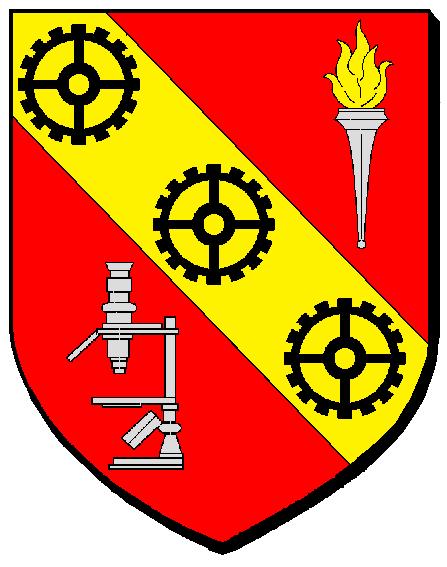
Coats of arms in France began in the mid-12th century, right around the same time it appeared elsewhere in Europe. At first, it was mainly linked to knights and noble families. But soon it spread to other parts of society, like merchants, towns, and the Church.
Unlike some countries where heraldry was strictly controlled, in France, almost anyone could create a coat of arms, as long as they followed the rules and didn’t copy someone else’s design. This made French heraldry diverse and colorful!
What Makes French Heraldry Special?

While English heraldry is heavy on lions, French heraldry developed its own flavor:
-
Rule of Tinctures: French heraldry followed the famous "rule of tinctures," which meant bright colors (like red, blue, green, or black) had to be placed against metals (gold or silver) for contrast. This made sure the design was easy to read from afar. For instance, putting a blue lion on a red background would be a mistake - it would look muddy. But a gold lion on a blue background? That’s the perfect example of clarity.
-
Crowns and Coronets: In France, people had an elaborate ranking system of coronets, signaling dukes, counts, and barons. Nobles had their own special coronets (small crowns) that showed their rank. A duke’s coronet looked different from a count’s or a baron’s, and these subtle differences instantly told you someone’s status in society.
-
Supporters: While English heraldry often featured lions, unicorns, or other animals standing beside the shield, French heraldry was more restrained. Supporters were rare and usually reserved for royal arms. When they did appear, they often showed angels or saints, tying the design closely to faith and divine protection.
-
Language of Heraldry: Even the vocabulary of heraldry has French roots. Words like argent (silver), gules (red), and azure (blue) come directly from Old French. That’s why heraldry across Europe still feels distinctly French in tone, even today.
Local French Heraldic Charges
In medieval France, cities and guilds also adopted their own arms to show independence and pride. These arms worked like logos, showing off independence, pride, and local identity.
-
Dauphins of France used dolphins as their emblem. Originally, this came from Guigues IV of Albon, called le Dauphin (Latin: Guigo Dalphinus). He was the first count to take the name Dauphin (meaning "dolphin"), which became a title among his successors. Later, when the French crown acquired the Dauphiné region, the heir to the throne was called the Dauphin of France, keeping the dolphin as a symbol.

-
Burgundy, a historical region in France that made Pinot Noir and Chardonnay grapes displayed striking blue and red diagonal stripes.

The Most Famous Symbol in French Heraldry

One of the most famous symbols is the fleur-de-lis, a stylized lily. It was the mark of the French monarchy and still appears in French culture today. While it was used in heraldry across Europe, in France it symbolized royalty, purity, and divine right.
Legend says that the fleur-de-lis came to King Clovis, the first king of France, in a dream. At a time when dreams and omens shaped the choices of rulers, this vision gave the lily a sacred status.
Heraldry and the French Revolution
During the French Revolution, coats of arms were seen as symbols of monarchy and privilege. In 1790, heraldry was officially abolished. However, the fleur-de-lis and other designs still lived on in art, memory, and even secret use.
Loyalists and loyal families would sometimes keep their arms hidden on personal objects, like signet rings (remember that one scene in Les Miserables?). In some cases, they even used simplified versions in private letters or seals as a quiet way to show allegiance to the throne.
Later, Napoleon brought back heraldry with his own twist. Napoleonic heraldry was more structured, with toques (caps with ostrich feathers) replacing coronets. These designs showed rank. For example, dukes had 7 feathers, counts had 5, barons had 3, and knights had 1. He wanted to scrap the old aristocracy (based on birth) and replace it with a new hierarchy that rewarded merit, military service, and loyalty to the people.
Notable French Coats of Arms
Royal Arms of France
The classic blue shield with golden fleurs-de-lis is one of the most recognized coats of arms in the world. First showing many lilies (called a "semis"), it was later simplified to just three fleurs-de-lis.
Joan of Arc
One of the most famous women in heraldry, this legendary heroine was granted her own coat of arms in 1429. Her shield showed a sword supporting a crown, flanked by two fleurs-de-lis. It symbolized her divine mission and loyalty to the French crown.
House of La Fayette
This noble family rose to fame in the Middle Ages and again during the American Revolution, thanks to the Marquis de Lafayette. Their arms featured the short but sweet motto, “Cur Non” which translates to “Why not?”
House of Montmorency
One of the oldest and most prestigious noble families in France, the Montmorency arms typically displayed a red cross. Their long military tradition made their heraldry instantly recognizable throughout medieval France.
Louis Pasteur

While not of noble descent, Louis Pasteur (the pioneering microbiologist) has been honored in heraldic imagery. Coats of arms associated with his legacy often feature a microscope, symbolizing his groundbreaking discoveries in microbiology and the development of pasteurization. The Pasteur Institute in Paris continues to bear his name.
This shows why it can be meaningful to make your own coat of arms so it reflects your achievements and passions in life, just like Pasteur’s does with science!
And if you’re wondering whether your own heritage connects to French heraldry, you can always find your family crest and see if fleurs-de-lis, crowns, or mottos appear in your lineage!
French Heraldry Today
French heraldry is more visible in many towns, cities, and regions that still proudly display their coats of arms. The fleur-de-lis remains an enduring symbol, even appearing on passports and stamps, though France itself doesn’t have an official coat of arms.
Why French Heraldry Still Matters
From Joan of Arc’s sword and crown to Napoleon’s feathers, coats of arms reveal the values and struggles of the people who carried them.
So, the next time you see a fleur-de-lis or a shield carved above a city gate, think of it as a fun portal to learn about your French lineage and history!
Image Credits:
- Blason et armes en frontispice de la maison natale de François-René de Chateaubriand à Saint-Malo via Wikimedia Commons, source
- Frescos of coats of arms (1270s) of France, Jerusalem and Silesia. Via Wikimedia Commons, source
- Coat of Arms of the Dauphin of France via Wikimedia Commons, source
- Arms of Eudes de Bourgogne via Wikimedia Commons, source
- Borough (Arrondissement) of Paris via Wikimedia Commons, source