Map of Germany showing where the Aachen arms are recorded
The Aachen arms were recorded in Westphalia, c. 1816.
Westphalia was a land of small estates and fortified farmhouses in western Germany. Its families were numerous and not especially rich, but each held its own ground, and holding ground was what brought arms.
This is where the arms were entered in the register. Families often moved to other parts of the country, so the same name can turn up in more than one region.
The body that granted and recorded arms in Germany in this period.
Frederick William III of Prussia
Sovereign of the period
Frederick William III of Prussia
1797–1840
Reigning in Germany when the Aachen arms are first recorded.
How Arms Worked in Germany
Prussian heraldry was strictly tied to social rank and noble status rather than being a free choice for every citizen. These symbols were treated as permanent family property that moved through the generations to all legitimate heirs. If a family branch wanted to change their design to stand out, they had to apply for official permission to alter their specific version of the shield.
Granting authority
The Prussian Heroldsamt acted as the central state office that managed and strictly controlled all noble titles and coats of arms.
How they got arms
Families usually obtained their arms through formal royal grants or by proving their long-standing noble status to the state authorities.
Where arms were recorded
All official coats of arms were kept in the rolls of the Prussian Heroldsamt, which functioned from 1706 until 1918.
The family's standing
Recorded among the armigerous families of Westphalia.
Origin & History of the Aachen Family in Germany
The family name Aachen originates from the historic city of Aachen, located in the Rhineland region of Germany. During the medieval period, it was common for families to adopt the name of their home city as a way to identify their origins when they traveled or moved to new areas. By the early nineteenth century, records confirm that members of the family had established themselves in the Westphalia region. This migration was likely driven by the industrial growth and economic changes occurring in Westphalia during the year 1816. As these families settled into their new surroundings, they carried the name of their ancestral home with them, preserving a link to their roots while becoming part of the local history of Westphalia.
Aachen Meaning & Related Branches
Root word
Aquae
Latin term referring to waters, springs, or a spa.
This name
AachenA topographic name for someone living near the thermal springs of the city.
also spelled
Achen
Aken
Ahken
Documented Sources
J. B. Rietstap, Armorial Général, Gouda: G. B. van Goor Zonen, 1884–87
Kohlheim, Rosa and Volker Kohlheim, Duden Familiennamen: Herkunft und Bedeutung, 2005
Bahlow, Hans, Deutsches Namenlexikon: Familien- und Vornamen nach Ursprung und Sinn erklärt, 1967
Landesarchiv Nordrhein-Westfalen, Personenstandsregister und Zivilstandsregister der Rheinprovinz und Westfalens, 1816
Digital archive packCoat of arms PNG, gold border print PDF, vector SVG and the certificate of authenticity. Sent to your email in minutes.


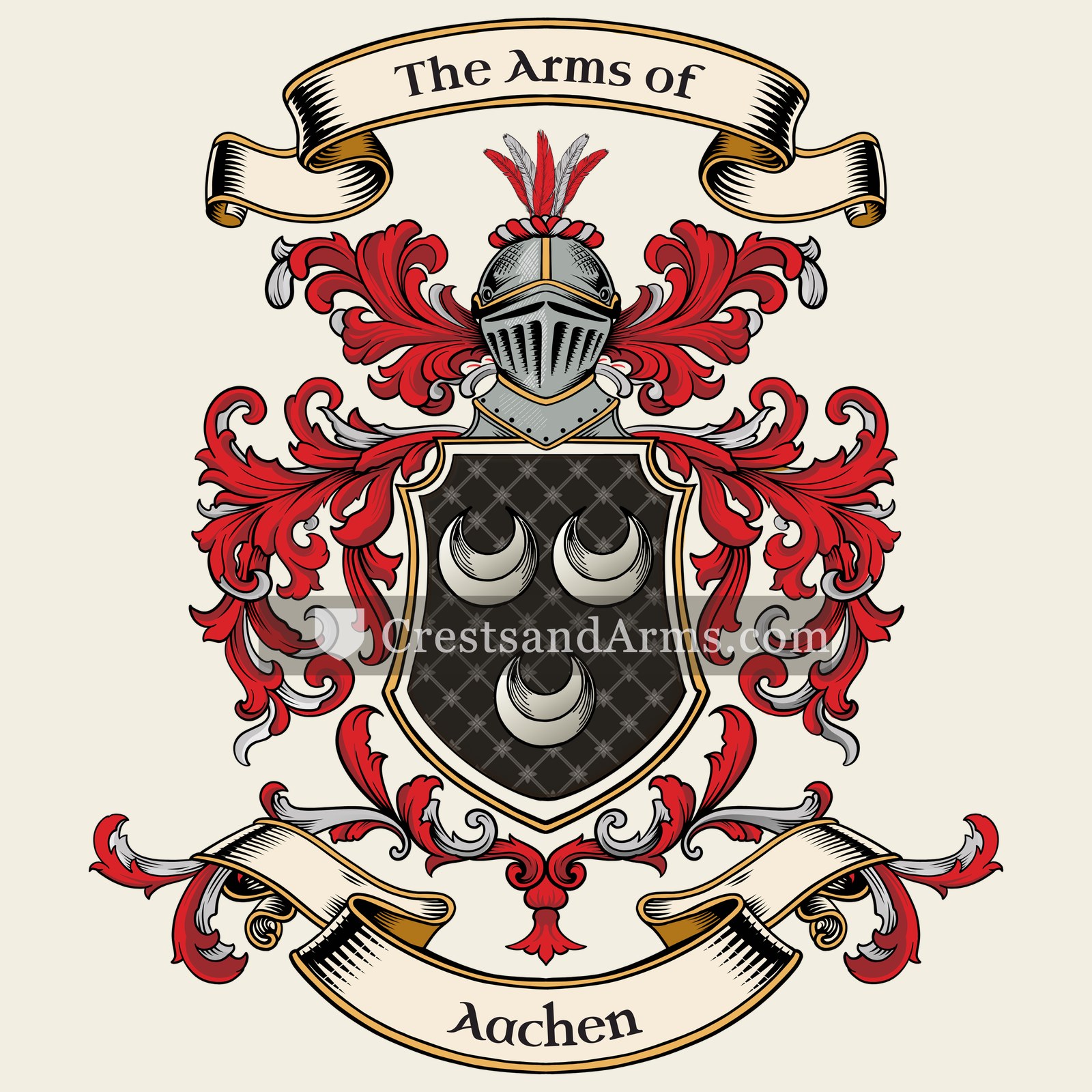
 crescentHonour by the sovereign, and the second son
 crescentHonour by the sovereign, and the second son