Map of Spain showing where the Abarbanel arms are recorded
The Abarbanel arms were recorded in Port, c. 1722.
Arms such as these were typically recorded in Castile.
Castile was the heart of Spain and the source of most of its noble families. Land won in the long wars against the Moors was granted out to fighting men, and a man granted land was granted arms along with it.
This is where the arms were entered in the register. Families often moved to other parts of the country, so the same name can turn up in more than one region.
The body that granted and recorded arms in Spain in this period.
Philip V of Spain
Sovereign of the period
Philip V of Spain
1714–1724
Reigning in Spain when the Abarbanel arms are first recorded.
How Arms Worked in Spain
In Spain, a coat of arms was considered a form of property that belonged to the entire family line. These arms were passed down from a father to all his children equally. Younger branches of the family usually kept the original design without needing to add any special marks to distinguish their specific line.
Granting authority
The Cronista Rey de Armas was the official body that regulated and granted coats of arms throughout Spain.
How they got arms
Families often obtained their arms through royal grants or by proving their noble status to the official heraldic authority.
Where arms were recorded
Coats of arms were officially recorded in the registers of the Cronista Rey de Armas starting in 1496.
The family's standing
Recorded among the armigerous families of Spain.
Origin & History of the Abarbanel Family in Spain
The Abarbanel family name is deeply rooted in the history of the Iberian Peninsula, where it gained prominence as a distinguished lineage of scholars, financiers, and communal leaders. While the name is most famously associated with the medieval period, records confirm that members of the family maintained a significant presence in Castile by 1722. The name itself is thought to be of Hebrew origin, often interpreted as a combination of words meaning "father of God" or "God is my father." Throughout the centuries, the family was known for its intellectual contributions and its ability to navigate the complex political landscapes of Spain. Even as they faced periods of migration and social upheaval, the family preserved their identity and continued to play active roles in the regions where they settled. Their long history in Castile reflects a legacy of resilience and a commitment to maintaining their heritage across many generations.
Abarbanel Meaning & Related Branches
Root word
Abravanel
Derived from the Hebrew words for father and God.
This name
AbarbanelRefers to a noble lineage often associated with the priestly class or divine fatherhood.
also spelled
Abarban
Abarbanell
Related arms
Galbanrecorded with Abarbanel, same area
Henriquezrecorded with Abarbanel, same area
Documented Sources
J. B. Rietstap, Armorial Général, Gouda: G. B. van Goor Zonen, 1884–87
Baer, Yitzhak, A History of the Jews in Christian Spain, 1961
Netanyahu, Benzion, Don Isaac Abravanel: Statesman and Philosopher, 1953
Archivo General de Simancas, Consejo de Castilla, 1722
Digital archive packCoat of arms PNG, gold border print PDF, vector SVG and the certificate of authenticity. Sent to your email in minutes.


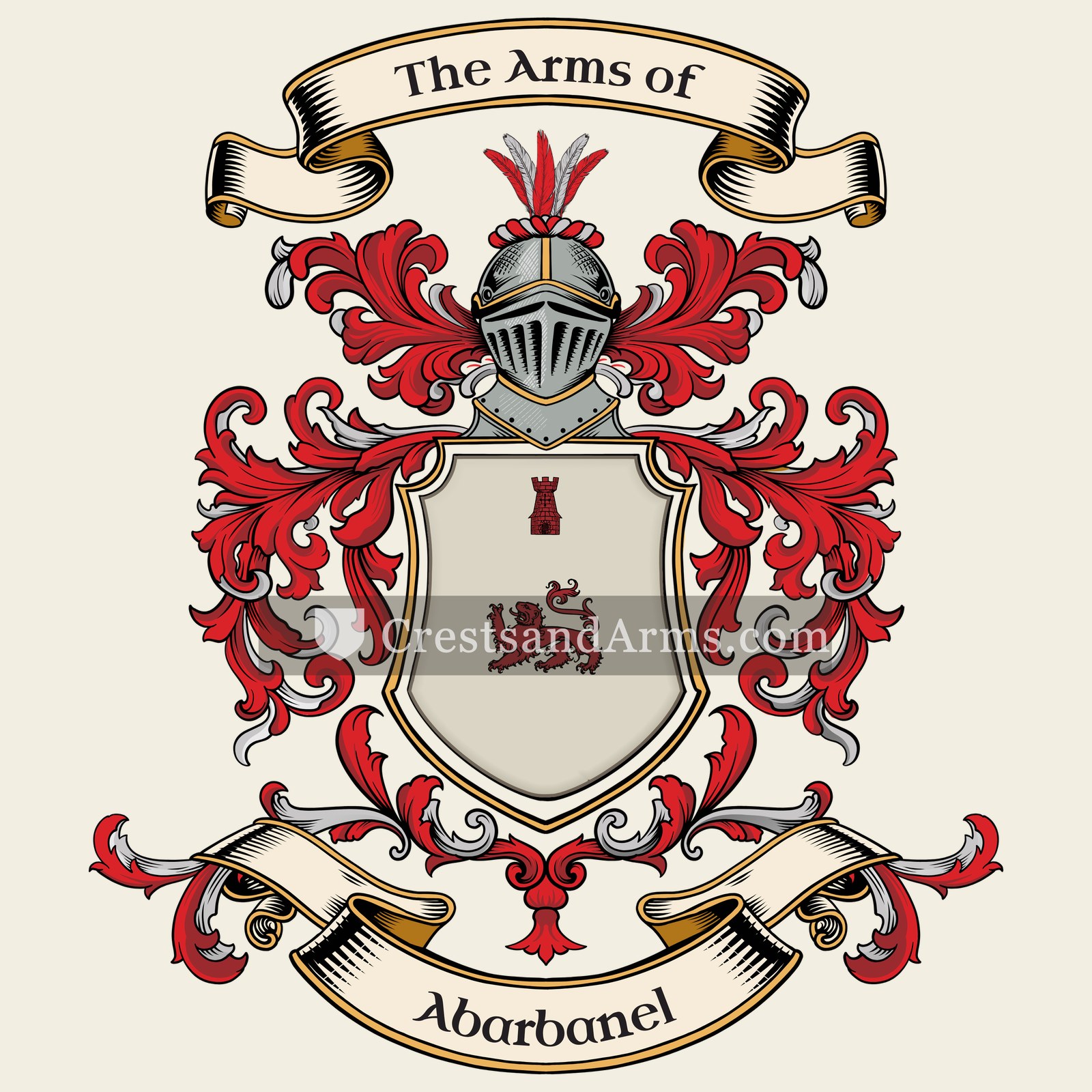
 lionCourage, strength and royalty
 towerGrandeur and solidity, and a stronghold defended
 lionCourage, strength and royalty
 towerGrandeur and solidity, and a stronghold defended