Map of Wales showing where the Abdeen arms are recorded
The Abdeen arms were recorded in Wales, c. 1647.
Arms such as these were typically recorded in Denbigh.
Denbighshire was north Welsh country of hills and small estates. Land was held by a great many families rather than a few, and each holding brought its own claim to a coat of arms.
This is where the arms were entered in the register. Families often moved to other parts of the country, so the same name can turn up in more than one region.
The body that granted and recorded arms in Wales in this period.
Charles I of England
Sovereign of the period
Charles I of England
1625–1649
Reigning in Wales when the Abdeen arms are first recorded.
How Arms Worked in Wales
English heraldry allowed arms to be shared by all legitimate descendants of the original owner. These symbols were treated as personal property that moved through the generations to all children. While the eldest son kept the original design, other family members could use the same shield without needing to change it or register their own unique versions.
Granting authority
The College of Arms in London has regulated the use of coats of arms throughout England and Wales since 1484.
How they got arms
Families typically obtained their coats of arms through a formal grant from the Crown or by proving their ancient right to them.
Where arms were recorded
All official coats of arms are recorded in the registers kept at the College of Arms, which date back to the fifteenth century.
The family's standing
Recorded among the armigerous families of Wales.
Origin & History of the Abdeen Family in Wales
The history of the Abdeen family name is deeply rooted in the cultural landscape of the seventeenth century. While the name carries distinct linguistic connections to regions across the Middle East and North Africa, its presence in the historical record of Denbigh by 1647 suggests a fascinating story of migration and integration. During this period, Denbigh served as a significant market town where families from diverse backgrounds often settled to participate in trade and local governance. The appearance of the Abdeen name in these early Welsh records indicates that members of the family were established members of the community during a time of great social change. By integrating into the local life of Denbigh, these early ancestors helped shape the identity of the family as one that valued stability and community involvement. Their presence in these official documents provides a rare glimpse into the lives of early settlers who navigated the complexities of seventeenth-century society.
Abdeen Meaning & Related Branches
Root word
Abd
Semitic root meaning servant or worshipper.
This name
AbdeenDerived from Arabic, signifying a servant of the divine or religious devotion.
also spelled
Abdean
Abdein
Abdenne
Documented Sources
Sir Bernard Burke, The General Armory of England, Scotland, Ireland and Wales, London: Harrison & Sons, 1884
Denbighshire Archives, Denbigh Borough Records (D/DM/118)
National Library of Wales, Cofnodion Llys y Sesiwn Fawr (Records of the Court of Great Sessions), 1647
Digital archive packCoat of arms PNG, gold border print PDF, vector SVG and the certificate of authenticity. Sent to your email in minutes.


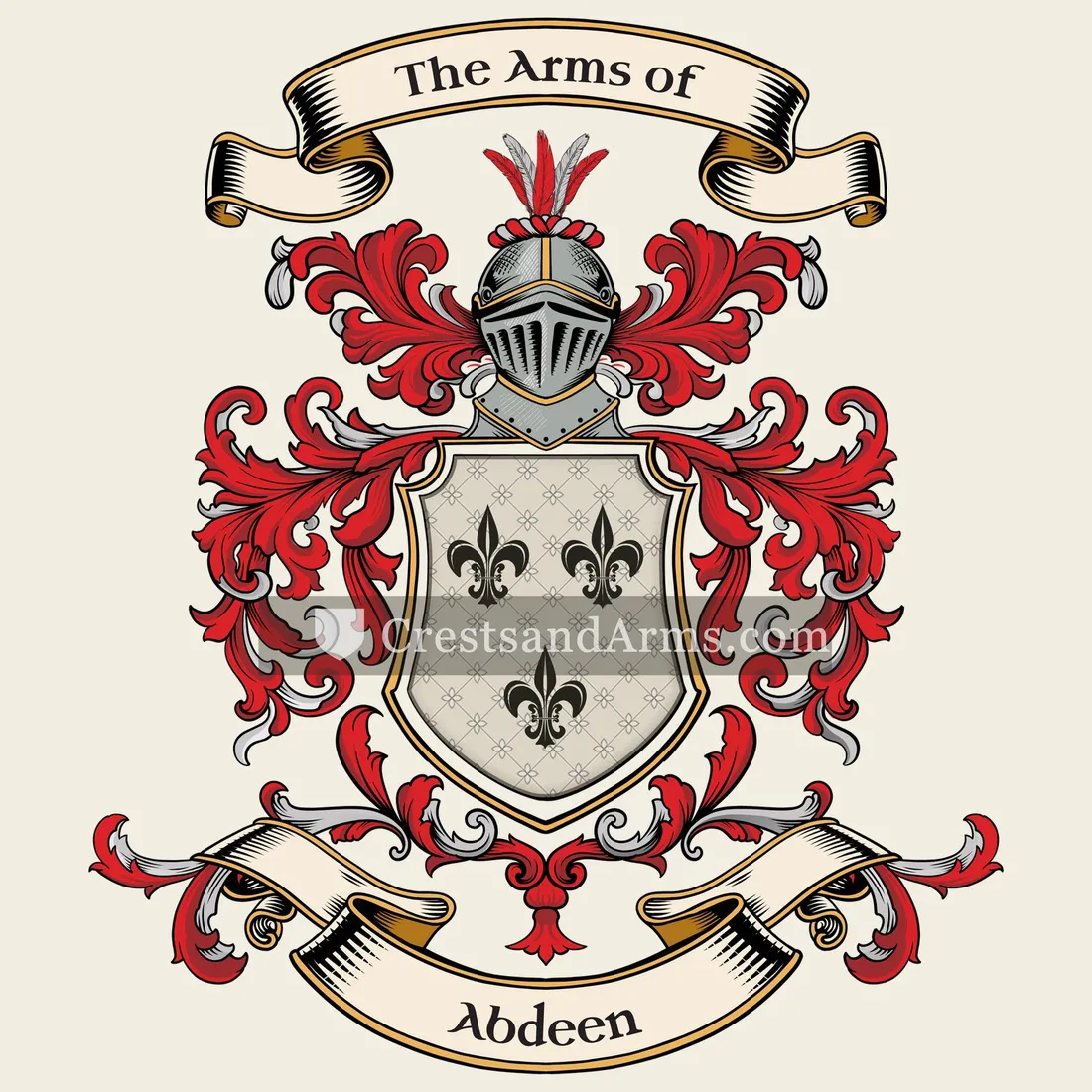
 fleur de lisPurity, light, and the sixth son
 fleur de lisPurity, light, and the sixth son