Map of Netherlands showing where the Abeel arms are recorded
The Abeel arms were recorded in Harlem, c. 1815.
This is where the arms were entered in the register. Families often moved to other parts of the country, so the same name can turn up in more than one region.
Region
Harlem
Town
Harlem
First recorded
1815
Granting Authority for the Abeel Arms
Hoge Raad van Adel
Photograph made by me · CC BY-SA 3.0
The body that granted and recorded arms in Netherlands in this period.
William I of the Netherlands
Sovereign of the period
William I of the Netherlands
1815–1840
Reigning in Netherlands when the Abeel arms are first recorded.
How Arms Worked in Netherlands
In the Netherlands, coats of arms were often used by noble families and those who held specific public offices. These arms were passed down through the generations to legitimate descendants. Younger branches of a family usually kept the original design without needing to add special marks. This system ensured that the family identity remained clear and consistent over many years.
Granting authority
The Hoge Raad van Adel is the official body that regulates and manages noble titles and coats of arms in the Netherlands.
How they got arms
Families typically obtained their coats of arms through official royal grants or by proving their long-standing historical use of the symbols.
Where arms were recorded
Coats of arms are officially recorded in the registers held by the Hoge Raad van Adel, which began its work in 1814.
The family's standing
Recorded among the armigerous families of Netherlands.
Origin & History of the Abeel Family in Netherlands
The Abeel family name has deep roots in the early development of New York, tracing its origins back to the Dutch colonial period. The family patriarch, Christoffel Janse Abeel, arrived in the New Netherland colony during the mid-17th century and eventually settled in Albany. Over the following generations, the family became prominent figures in trade, local government, and the military. By the early 19th century, members of the Abeel family had established a significant presence in Harlem, which was then a distinct area transitioning from rural farmland to a developing residential community. Their transition from colonial pioneers to established citizens in 1815 reflects the broader growth of New York City as it expanded northward during the post-Revolutionary era.
Abeel Meaning & Related Branches
Root word
Abel
Derived from the Hebrew word for breath or vapor.
This name
AbeelA patronymic surname indicating descent from a person named Abel.
also spelled
Abels
Abeel
Documented Sources
J. B. Rietstap, Armorial Général, Gouda: G. B. van Goor Zonen, 1884–87
Pearson, Jonathan. Contributions for the Genealogies of the First Settlers of the Ancient County of Albany, from 1630 to 1800. 1872
Riker, James. Revised History of Harlem (City of New York): Its Origin and Early Annals. 1904
New York State Archives, New York Secretary of State Land Papers, 1643–1803
Digital archive packCoat of arms PNG, gold border print PDF, vector SVG and the certificate of authenticity. Sent to your email in minutes.


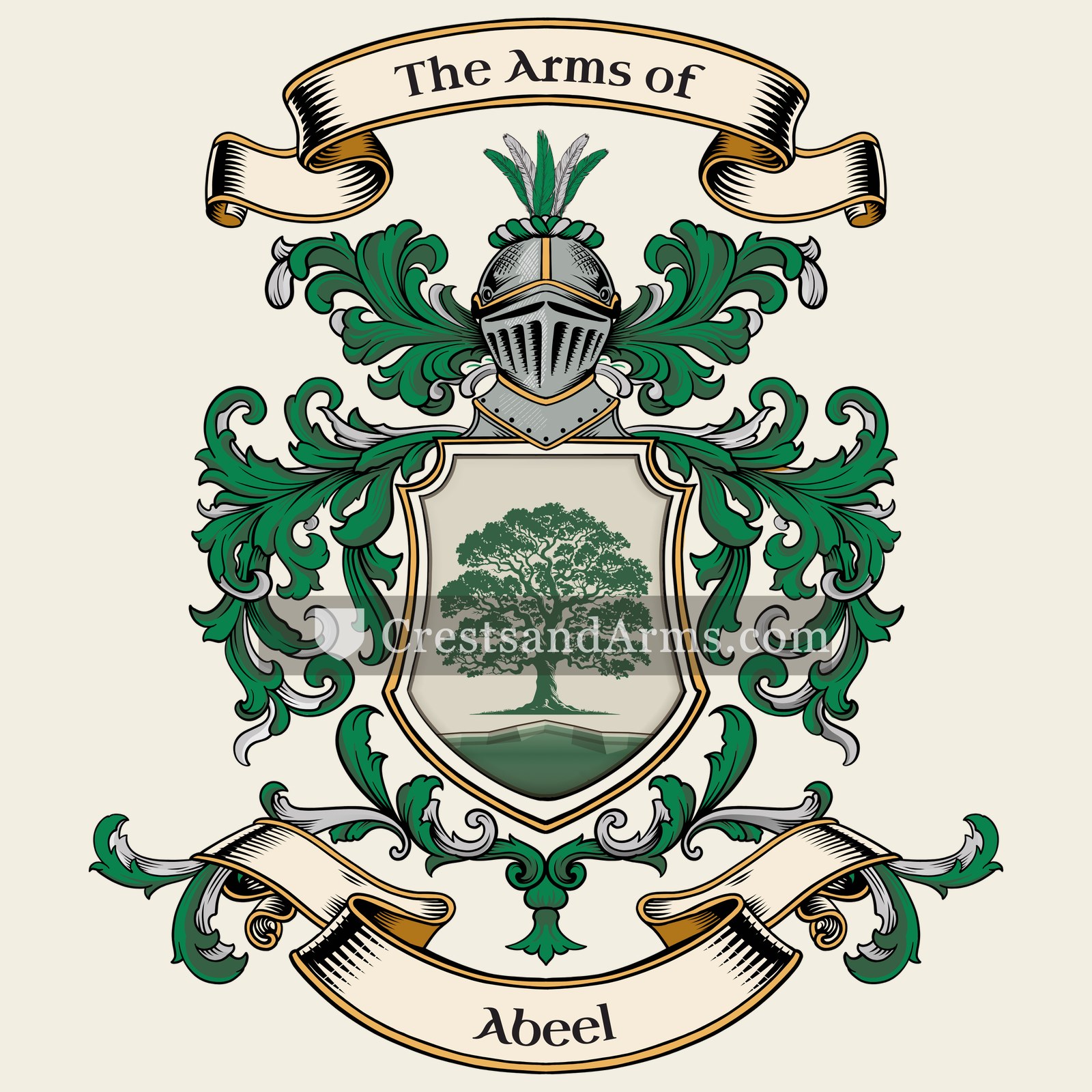
 mountThe ground held, and steadfastness upon it
 treeLife, endurance and deep roots
 mountThe ground held, and steadfastness upon it
 treeLife, endurance and deep roots