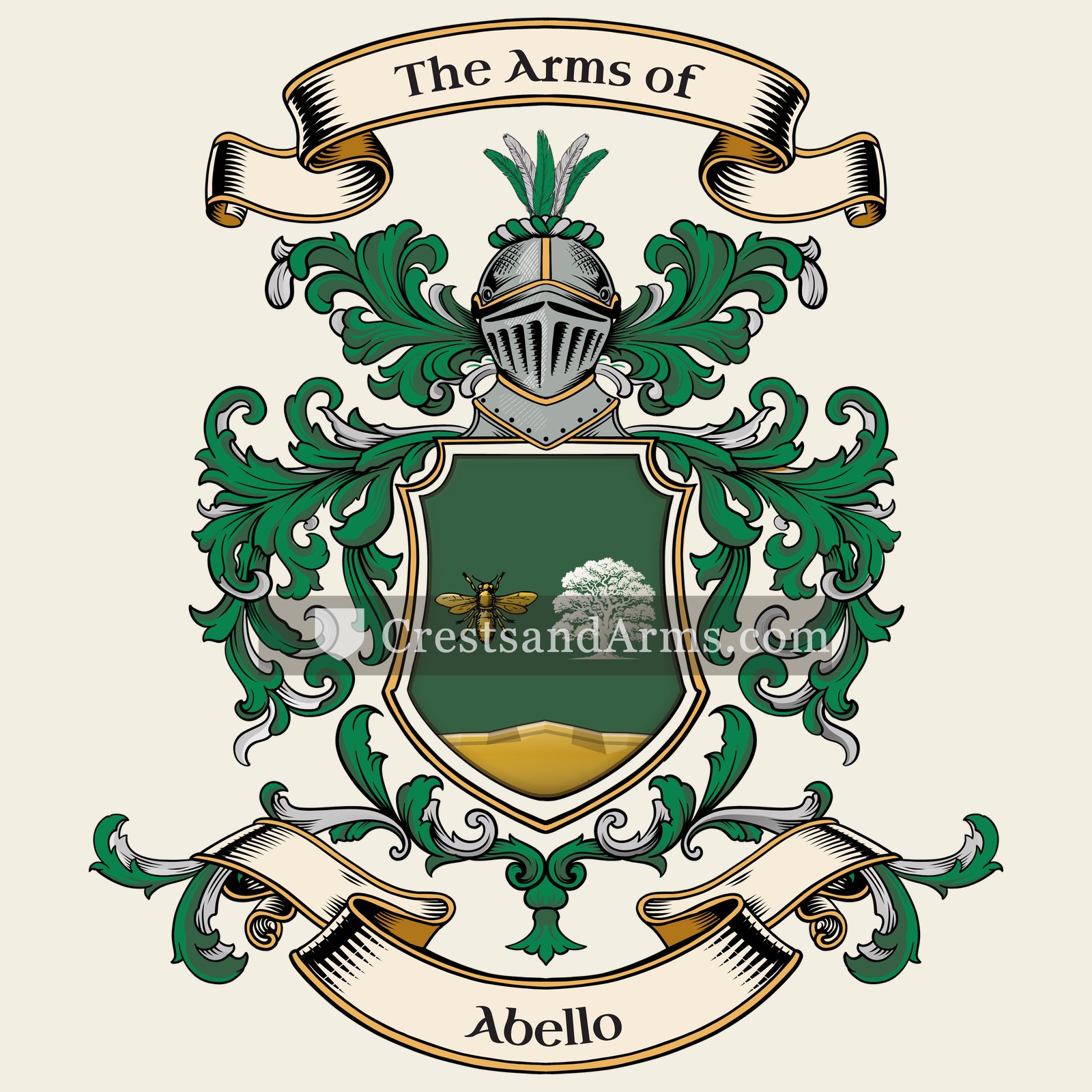
A record of documented arms, meaning and origin, researched for the Abello family of Spain.
Reg. 7021 · Spanish, A–C
Coat of Arms & Family Crest Details
Symbols on this shield
mountThe ground held, and steadfastness upon it
beeIndustry, order and tireless work
treeLife, endurance and deep roots
Colours
Green (Vert)Means: Hope
Gold (Or)Means: Generosity
Historical info
Source
J. B. Rietstap, Armorial Général, Gouda: G. B. van Goor Zonen, 1884–87
Blazon (the actual original written record)
“De sin. à une ruche d'or entourée d'abeilles du même, posée à dextre, et un châtaigner au nat., fruité d'or, posé à sen., le tout soutenu d'une terrasse au nat.”
SpainAsturies, c. 1722
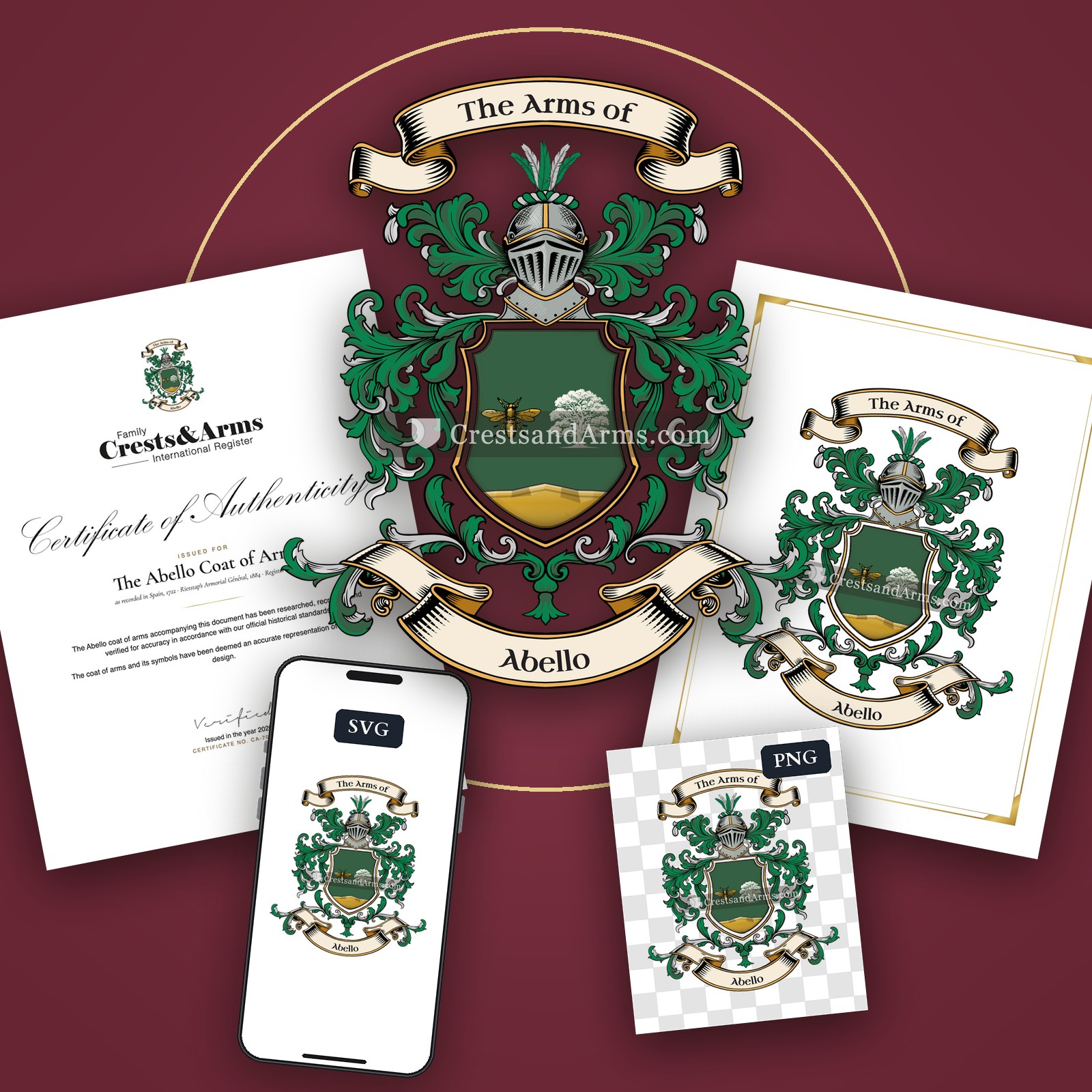
Digital archive packCoat of arms PNG, gold border print PDF, vector SVG and the certificate of authenticity. Sent to your email in minutes.
Map of Spain showing where the Abello arms are recorded
The Abello arms were recorded in Asturies, c. 1722.
This is where the arms were entered in the register. Families often moved to other parts of the country, so the same name can turn up in more than one region.
The body that granted and recorded arms in Spain in this period.
Philip V of Spain
Sovereign of the period
Philip V of Spain
1714–1724
Reigning in Spain when the Abello arms are first recorded.
How Arms Worked in Spain
In Spain, a coat of arms was considered a form of property that belonged to the entire family line. These arms were passed down from a father to all his children equally. Younger branches of the family usually kept the original design without needing to add any special marks to distinguish their specific line.
Granting authority
The Cronista Rey de Armas was the official body that regulated and granted coats of arms throughout Spain.
How they got arms
Families often obtained their arms through royal grants or by proving their noble status to the official heraldic authority.
Where arms were recorded
Coats of arms were officially recorded in the registers of the Cronista Rey de Armas starting in 1496.
The family's standing
Recorded among the armigerous families of Spain.
Origin & History of the Abello Family in Spain
The family name Abello has deep roots in the northern region of Spain known as Asturias. By the year 1722, records confirm that members of the family were already established in this rugged, mountainous area. The name is believed to be a variation of the word abuelo, which means grandfather or elder in Spanish. This suggests that the name may have originally served as a nickname for a respected patriarch or a person who held a position of wisdom within their local community. As families in Asturias were often tied to specific valleys or small villages, the Abello name likely grew alongside the agricultural development of the region. Over time, the family became part of the social fabric of northern Spain, living through the transition from medieval traditions to the more centralized administration of the eighteenth century.
Abello Meaning & Related Branches
Root word
Abel
Derived from the Hebrew word for breath or vapor.
This name
AbelloA patronymic surname meaning son of Abel or descendant of the breath.
also spelled
Abelo
Abellio
Documented Sources
J. B. Rietstap, Armorial Général, Gouda: G. B. van Goor Zonen, 1884–87
Archivo Histórico de Asturias, Protocolos Notariales de Oviedo
Archivo de la Real Chancillería de Valladolid, Registro de Ejecutorias
Moll, Francesc de Borja, Els llinatges catalans: Catalunya, País Valencià i les Illes, 1959
García García, María del Carmen, La población de Asturias en el siglo XVIII, 1985
Digital archive packCoat of arms PNG, gold border print PDF, vector SVG and the certificate of authenticity. Sent to your email in minutes.


 mountThe ground held, and steadfastness upon it
 beeIndustry, order and tireless work
 treeLife, endurance and deep roots
 mountThe ground held, and steadfastness upon it
 beeIndustry, order and tireless work
 treeLife, endurance and deep roots