A record of documented arms, meaning and origin, researched for the Abrahamsen family lines. Documented in 2 countries.
Reg. 4240 · Danish, A–C
Coat of Arms & Family Crest Details
Symbols on this shield
treeLife, endurance and deep roots
lionCourage, strength and royalty
harpWell-tuned governance and love of music
Colours
Gold (Or)Means: Generosity
Red (Gules)Means: Military strength
Historical info
Source
J. B. Rietstap, Armorial Général, Gouda: G. B. van Goor Zonen, 1884–87
Blazon (the actual original written record)
“Coupé: au 1 parti: a. d'or au lion de gu., arm. et lamp. d'arg.; b. de gu. à une harpe d'or; au 2 d'arg. à une plante de trois épis d'or et quatre feuilles de sin. Cq. cour. C.: à dextre un demi-vol cont. de sa., et à sen. un bras arm. au nat., tenant une épée d'arg., garnie d'or.”
Denmarkc. 1722
Digital archive packCoat of arms PNG, gold border print PDF, vector SVG and the certificate of authenticity. Sent to your email in minutes.
Map of Denmark showing where the Abrahamsen arms are recorded
The Abrahamsen arms were recorded in Denmark, c. 1722.
Arms such as these were typically recorded in Sjaælland.
Zealand held the Danish court, the crown's offices and Copenhagen itself. Families who served the king kept estates within reach of it, and royal service was the ordinary route to a coat of arms.
This is where the arms were entered in the register. Families often moved to other parts of the country, so the same name can turn up in more than one region.
The body that granted and recorded arms in Denmark in this period.
Frederik IV of Denmark
Sovereign of the period
Frederik IV of Denmark
1699–1730
Reigning in Denmark when the Abrahamsen arms are first recorded.
How Arms Worked in Denmark
Danish heraldry during this period was closely tied to noble status and royal favor rather than being open to all citizens. Arms were typically granted by the monarch to individuals, and these symbols were then shared by all members of the noble house. If a family line died out, the right to use those specific arms ended with them.
Granting authority
The Danish royal chancery held the power to issue and regulate official coats of arms for the kingdom.
How they got arms
Families usually received their arms through a formal royal grant that confirmed their noble status and rights.
Where arms were recorded
These grants were officially recorded in the Danish Royal Chancery records starting in the sixteenth century.
The family's standing
Recorded among the armigerous families of Denmark.
Origin & History of the Abrahamsen Family in Denmark
The name Abrahamsen is a classic example of a patronymic surname, which means it was formed by taking the father’s first name and adding a suffix to indicate descent. In the Danish tradition, the suffix "sen" simply means "son of," identifying the bearer as the son of Abraham. By the year 1722, records confirm that families carrying this name were established on the island of Sjaælland. During this period, most people in Denmark did not have fixed family names that passed down through generations. Instead, a man named Abraham would have a son named Hans, who would be known as Hans Abrahamsen. If Hans then had a son named Peter, that child would be called Peter Hansen. The fact that the name Abrahamsen persisted as a family identifier suggests that these early ancestors were part of a growing shift toward permanent surnames, likely influenced by the administrative needs of the Danish crown to track citizens for military service and taxation.
Coat of Arms & Family Crest Details
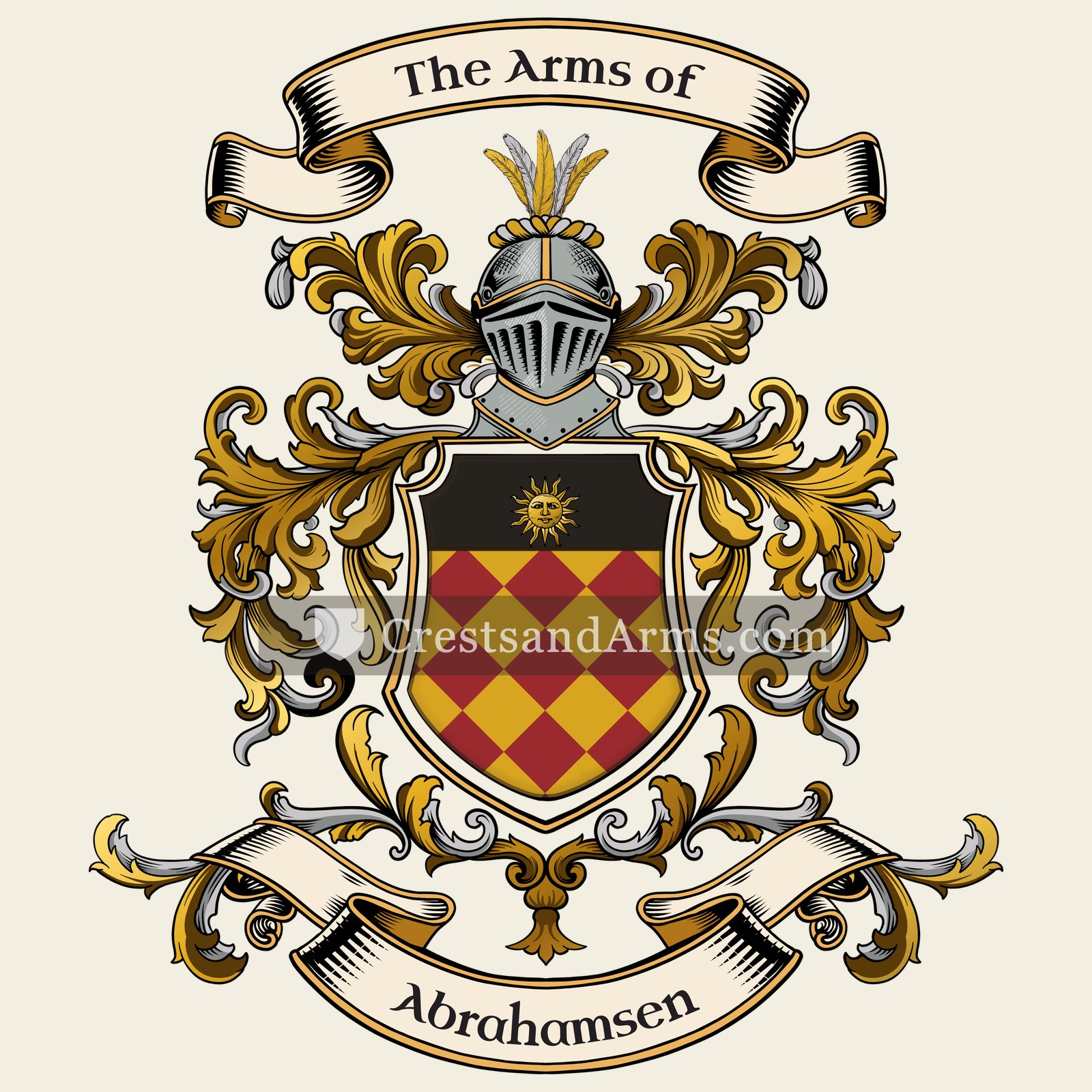
Symbols on this shield
chiefAuthority, wisdom and dominion
sunGlory, splendour and the source of life
Colours
Gold (Or)Means: Generosity
Black (Sable)Means: Constancy
Red (Gules)Means: Military strength
Historical info
Source
Sir Bernard Burke, The General Armory of England, Scotland, Ireland and Wales, London: Harrison & Sons, 1884
Blazon (the actual original written record)
“Lozengy or and gu. on a chief sa. the sun in his splendour or”
Walesc. 1647
Digital archive packCoat of arms PNG, gold border print PDF, vector SVG and the certificate of authenticity. Sent to your email in minutes.
Map of Wales showing where the Abrahamsen arms are recorded
The Abrahamsen arms were recorded in Wales, c. 1647.
Arms such as these were typically recorded in Denbigh.
Denbighshire was north Welsh country of hills and small estates. Land was held by a great many families rather than a few, and each holding brought its own claim to a coat of arms.
This is where the arms were entered in the register. Families often moved to other parts of the country, so the same name can turn up in more than one region.
The body that granted and recorded arms in Wales in this period.
Charles I of England
Sovereign of the period
Charles I of England
1625–1649
Reigning in Denmark when the Abrahamsen arms are first recorded.
How Arms Worked in Wales
English heraldry allowed arms to be shared by all legitimate descendants of the original owner. These symbols were treated as personal property that moved through the generations to all children. While the eldest son kept the original design, other family members could use the same shield without needing to change it or register their own unique versions.
Granting authority
The College of Arms in London has regulated the use of coats of arms throughout England and Wales since 1484.
How they got arms
Families typically obtained their coats of arms through a formal grant from the Crown or by proving their ancient right to them.
Where arms were recorded
All official coats of arms are recorded in the registers kept at the College of Arms, which date back to the fifteenth century.
The family's standing
Recorded among the armigerous families of Wales.
Origin & History of the Abrahamsen Family in Wales
The surname Abrahamsen is a patronymic name, meaning it was originally formed by combining the given name Abraham with the suffix "sen," which translates to "son of." While this naming convention is primarily associated with Scandinavian and Northern European roots, the presence of the family in the Welsh town of Denbigh by 1647 suggests a fascinating history of migration and integration. During the seventeenth century, Wales was a hub for trade and religious movement, often attracting individuals from across the North Sea who sought new opportunities in growing market towns. By settling in Denbigh, the early Abrahamsen family became part of the local social fabric, likely adapting to the Welsh language and customs while maintaining their distinct ancestral name. Their documented presence in the town records during this period indicates they were established residents who contributed to the community life of the region during a time of significant political and social change in Britain.
Abrahamsen Meaning & Related Branches
Root word
Abraham
Exalted father of a multitude of nations.
This name
AbrahamsenPatronymic surname meaning son of the exalted father.
also spelled
Abrahamsen
Abramson
Documented Sources
J. B. Rietstap, Armorial Général, Gouda: G. B. van Goor Zonen, 1884–87
Kruse, Arne. Navne i Danmark. 2005
Nielsen, Oluf. Danske Navne. 1883
Rigsarkivet (Danish National Archives), Kirkebøger for Sjaælland (Parish registers for Sjaælland)
Rigsarkivet (Danish National Archives), Folketællinger (Census records)
Digital archive packCoat of arms PNG, gold border print PDF, vector SVG and the certificate of authenticity. Sent to your email in minutes.


 treeLife, endurance and deep roots
 lionCourage, strength and royalty
 harpWell-tuned governance and love of music
 treeLife, endurance and deep roots
 lionCourage, strength and royalty
 harpWell-tuned governance and love of music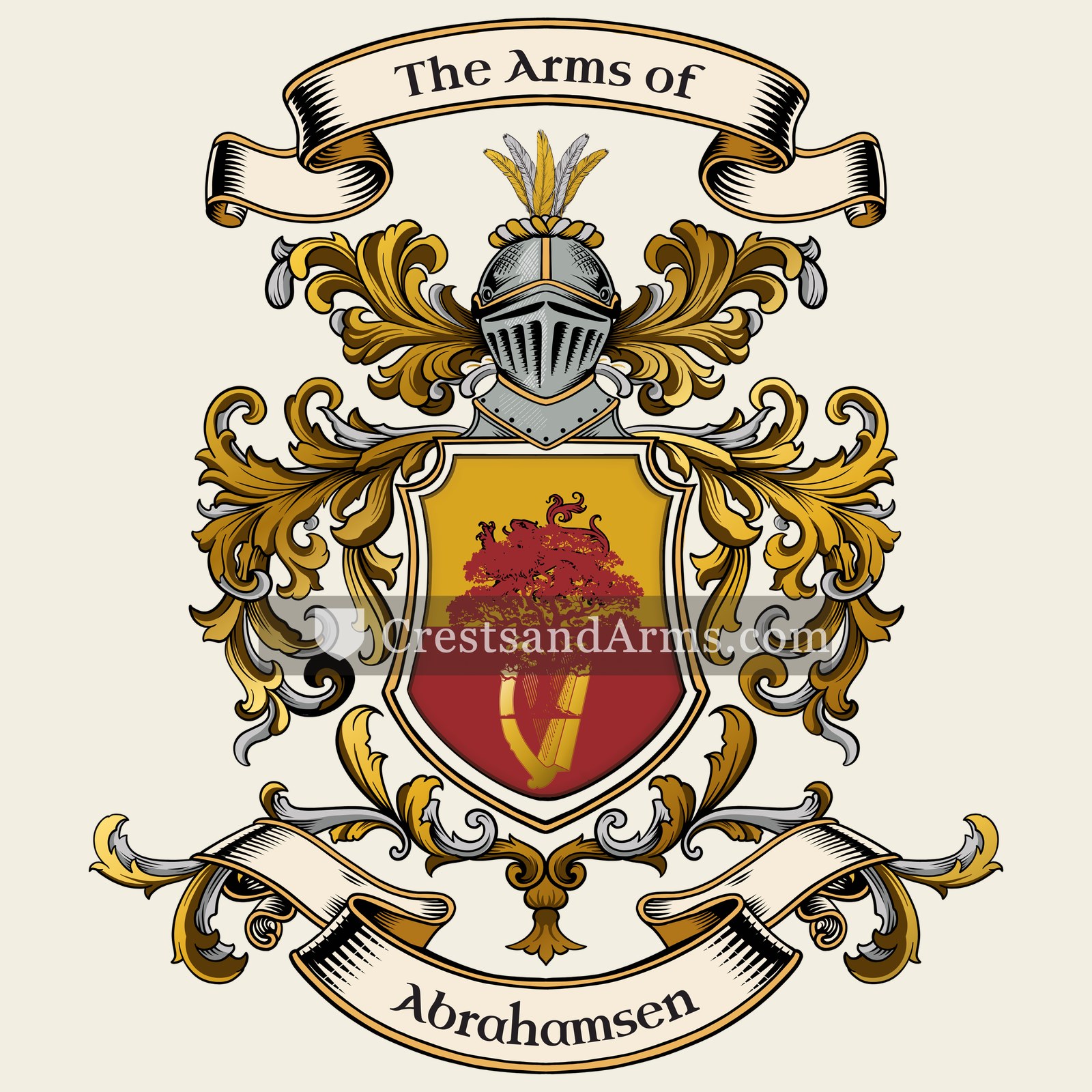


 chiefAuthority, wisdom and dominion
 sunGlory, splendour and the source of life