Map of France showing where the Abrams arms are recorded
The Abrams arms were recorded in Lorraine, c. 1663.
Lorraine sat on the border between France and the German lands, and border country bred soldiers. Families here held small estates and served in arms, and a fighting man was exactly the sort who carried a shield of his own.
This is where the arms were entered in the register. Families often moved to other parts of the country, so the same name can turn up in more than one region.
The body that granted and recorded arms in France in this period.
Louis XIV of France
Sovereign of the period
Louis XIV of France
1643–1715
Reigning in France when the Abrams arms are first recorded.
How Arms Worked in France
In France, a coat of arms was a mark of honor that passed down through the male line to all legitimate descendants. Families often used the same shield without changes to show their shared heritage. If a branch wanted to stand out, they could add a small mark to their shield to show their specific place in the family tree.
Granting authority
The Juge d'armes de France acted as the official authority that regulated and verified coats of arms across the country.
How they got arms
Families typically inherited their arms from ancestors, though they could also receive them through royal grants or by proving their noble status.
Where arms were recorded
Coats of arms were officially recorded in the Armorial Général de France, which began its main collection in the year 1696.
The family's standing
Recorded among the armigerous families of Lorraine.
Origin & History of the Abrams Family in France
The surname Abrams is a patronymic name, which means it was originally created to identify a person as the son of a man named Abraham. This name has deep historical roots across Europe, reflecting the widespread influence of biblical naming traditions. By 1663, records confirm that members of the family were established in the Lorraine region of France. During this period, Lorraine was a crossroads of culture and language, situated between the French and German-speaking worlds. Families in this area often navigated complex political shifts as the region moved between different sovereign powers. As the family lived in this borderland, they likely adapted to the local social customs while maintaining their identity through their distinct surname. Over the following generations, the name spread further as family members moved to find new opportunities, eventually carrying the name across borders and oceans.
Abrams Meaning & Related Branches
Root word
Avraham
Hebrew for father of a multitude
This name
AbramsPatronymic surname derived from the biblical name meaning exalted father
also spelled
Abram
Dabram
Abram de Zinkoor
Abrams
Documented Sources
J. B. Rietstap, Armorial Général, Gouda: G. B. van Goor Zonen, 1884–87
Dauzat, Albert. Dictionnaire étymologique des noms de famille et prénoms de France. 1951
Morlet, Marie-Thérèse. Dictionnaire étymologique des noms de famille. 1991
Digital archive packCoat of arms PNG, gold border print PDF, vector SVG and the certificate of authenticity. Sent to your email in minutes.


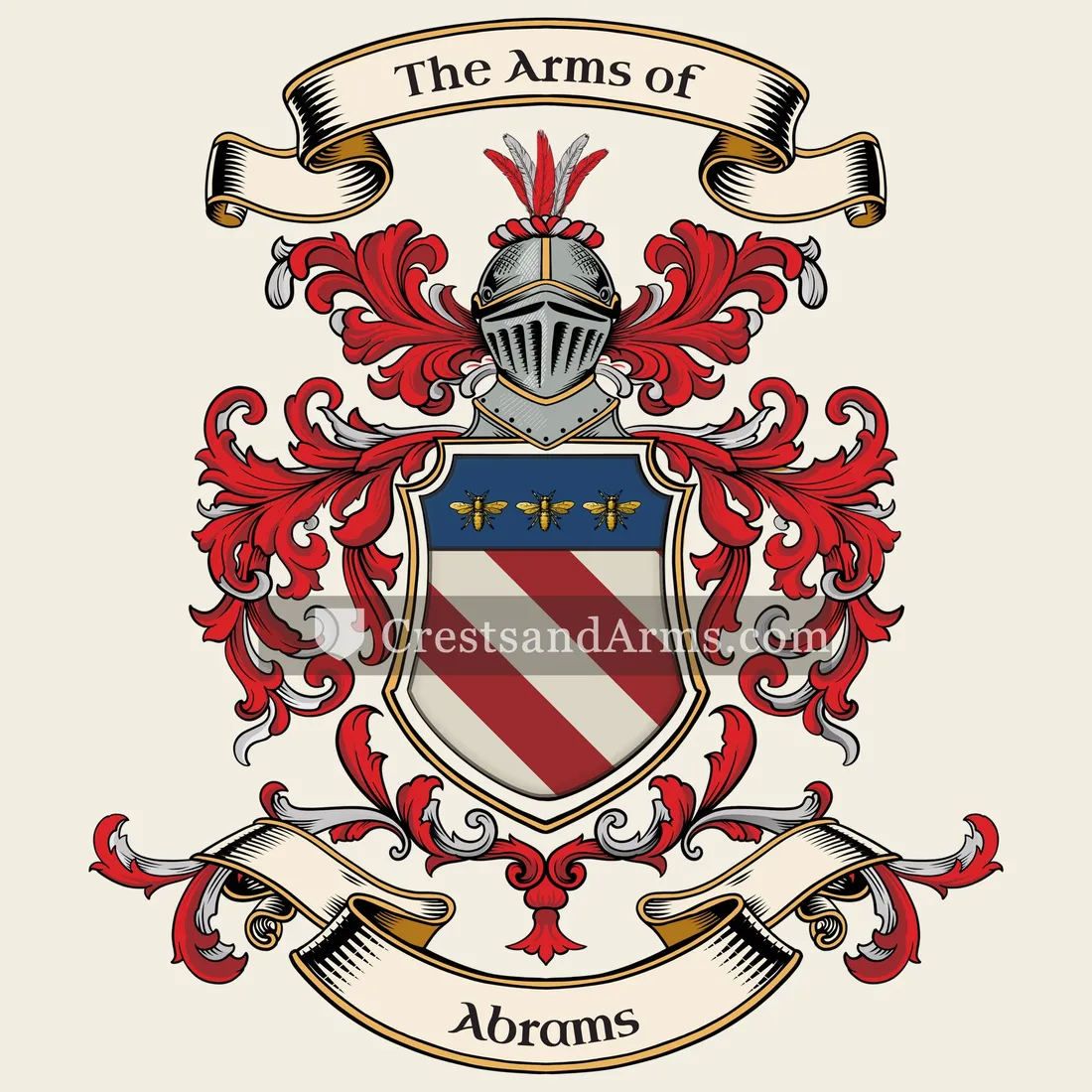
 bendDefence, and the scarf of a commander
 chiefAuthority, wisdom and dominion
 beeIndustry, order and tireless work
 bendDefence, and the scarf of a commander
 chiefAuthority, wisdom and dominion
 beeIndustry, order and tireless work