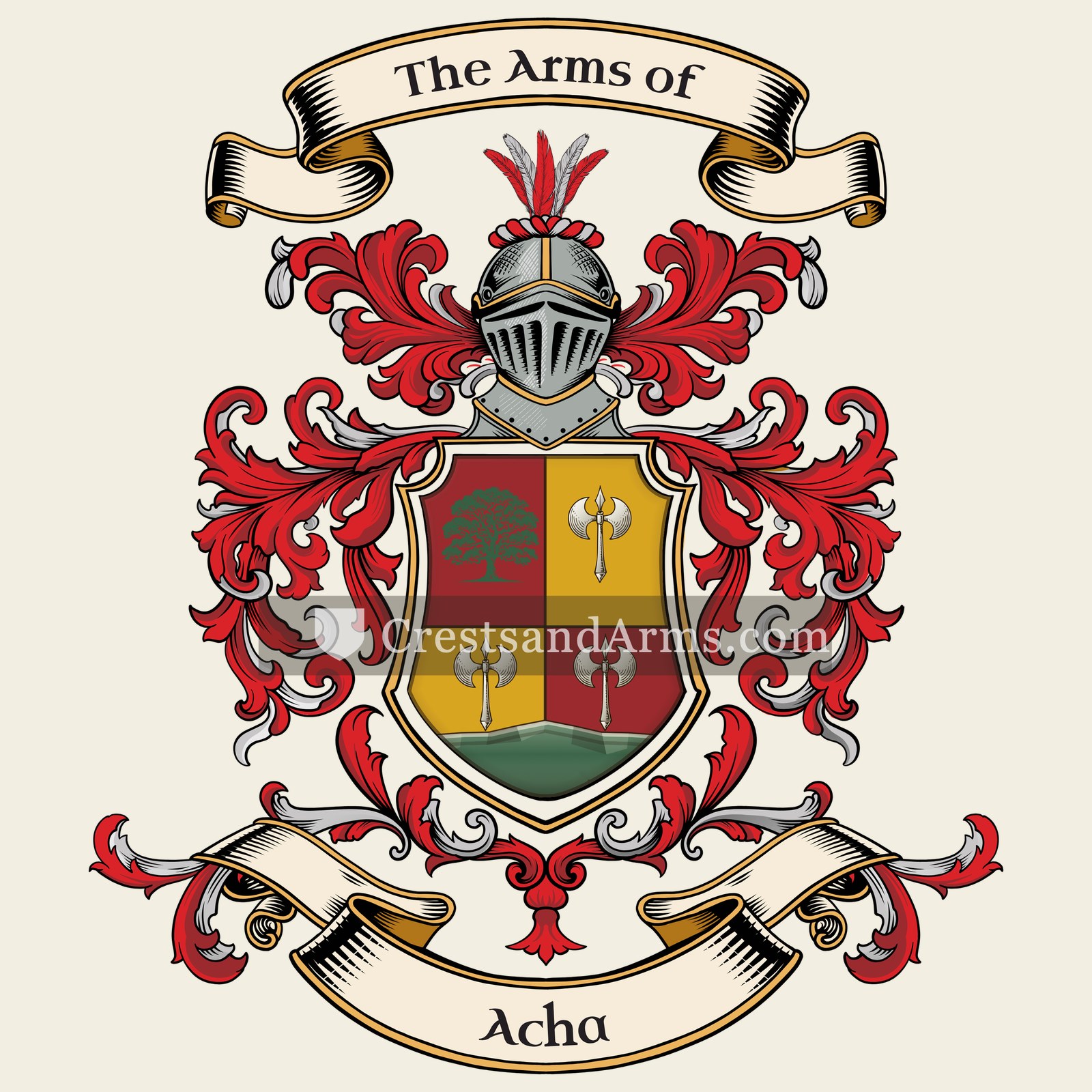
A record of documented arms, meaning and origin, researched for the Acha family of Spain.
Reg. 2134 · Spanish, A–C
Coat of Arms & Family Crest Details
Symbols on this shield
mountThe ground held, and steadfastness upon it
treeLife, endurance and deep roots
axeThe execution of military duty
Colours
Red (Gules)Means: Military strength
Gold (Or)Means: Generosity
Green (Vert)Means: Hope
Silver (Argent)Means: Peace and sincerity
Historical info
Source
J. B. Rietstap, Armorial Général, Gouda: G. B. van Goor Zonen, 1884–87
Blazon (the actual original written record)
“De gu. à l'arbre de sin., terrassé du même, senestré de trois haches d'arg., 2 et 1. — Armes mod.: Ec.: au 1 de gu. à trois haches d'arg., 2 et 1; au 2 d'or à trois panelles de gu., les tiges en haut; au 3 d'or à l'arbre de sin., terrassé du même, et un dextrochère d'arg., mouv. de la terrasse, br. sur le fût de l'arbre et tenant une épée d'arg.; au 4 d'azur à trois bandes d'arg.”
SpainBiscaye, c. 1722
Digital archive packCoat of arms PNG, gold border print PDF, vector SVG and the certificate of authenticity. Sent to your email in minutes.
Map of Spain showing where the Acha arms are recorded
The Acha arms were recorded in Biscaye, c. 1722.
This is where the arms were entered in the register. Families often moved to other parts of the country, so the same name can turn up in more than one region.
The body that granted and recorded arms in Spain in this period.
Philip V of Spain
Sovereign of the period
Philip V of Spain
1714–1724
Reigning in Spain when the Acha arms are first recorded.
How Arms Worked in Spain
In Spain, a coat of arms was considered a form of property that belonged to the entire family line. These arms were passed down from a father to all his children equally. Younger branches of the family usually kept the original design without needing to add any special marks to distinguish their specific line.
Granting authority
The Cronista Rey de Armas was the official body that regulated and granted coats of arms throughout Spain.
How they got arms
Families often obtained their arms through royal grants or by proving their noble status to the official heraldic authority.
Where arms were recorded
Coats of arms were officially recorded in the registers of the Cronista Rey de Armas starting in 1496.
The family's standing
Recorded among the armigerous families of Spain.
Origin & History of the Acha Family in Spain
The family name Acha traces its deep roots to the rugged landscape of Biscay, a province in the Basque Country of northern Spain. By the year 1722, records confirm that members of the Acha family were well-established residents within this region. The name itself is derived from the Basque word atxa, which translates to a rocky crag or a steep cliff. This linguistic connection suggests that the earliest ancestors likely lived near prominent geographical landmarks or mountainous terrain that defined the local scenery. As a traditional Basque surname, it reflects a history tied closely to the land and the distinct cultural identity of the people living in the Pyrenees foothills. Over generations, the family became part of the social fabric of Biscay, contributing to the agricultural and community life that shaped the northern coast of the Iberian Peninsula.
Acha Meaning & Related Branches
Root word
atxa
Basque word for a rock or a crag.
This name
AchaRefers to someone who lived near a prominent rocky outcrop or cliff.
also spelled
Aka
Asha
Documented Sources
J. B. Rietstap, Armorial Général, Gouda: G. B. van Goor Zonen, 1884–87
Gorrotxategi Nieto, Mikel. Surnames in the Basque Country. 2012
Mendizabal, Joseba. Basque Toponymy and Family Names. 2005
Archivo Histórico Eclesiástico de Bizkaia, Libros Sacramentales de la Diócesis de Bilbao. 1722
Digital archive packCoat of arms PNG, gold border print PDF, vector SVG and the certificate of authenticity. Sent to your email in minutes.


 mountThe ground held, and steadfastness upon it
 treeLife, endurance and deep roots
 axeThe execution of military duty
 mountThe ground held, and steadfastness upon it
 treeLife, endurance and deep roots
 axeThe execution of military duty