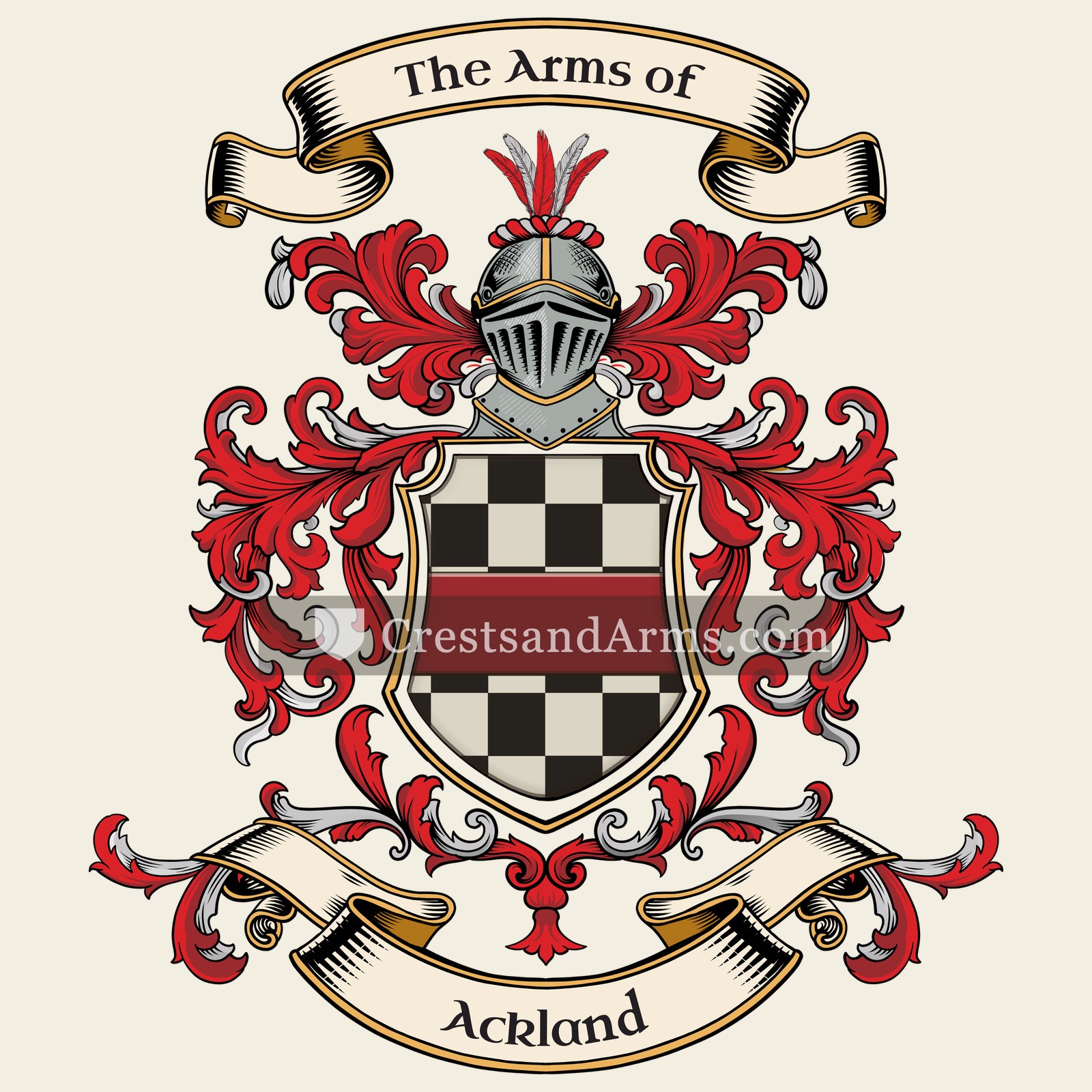
A record of documented arms, meaning and origin, researched for the Ackland family of Britain.
Reg. 5140 · Britain, A–C
Coat of Arms & Family Crest Details
Symbols on this shield
chequyConstancy, and the counting-board
fessThe military belt, and readiness to serve
Colours
Silver (Argent)Means: Peace and sincerity
Red (Gules)Means: Military strength
Black (Sable)Means: Constancy
Historical info
Source
J. B. Rietstap, Armorial Général, Gouda: G. B. van Goor Zonen, 1884–87
Blazon (the actual original written record)
“Echiq. d'arg. et de sa.; à la fasce de gu. C.: un faucon au nat., perché sur une main gantelée mise en fasce. D.: INÉBRANLABLE [Comp. Fuller-Acland-Hood et Fuller-Palmer-Acland.]”
DevonshireDevonshire, c. 1644
Digital archive packCoat of arms PNG, gold border print PDF, vector SVG and the certificate of authenticity. Sent to your email in minutes.
Map of Britain showing where the Ackland arms are recorded
The Ackland arms were recorded in Devonshire, c. 1644.
This is where the arms were entered in the register. Families often moved to other parts of the country, so the same name can turn up in more than one region.
The body that granted and recorded arms in Britain in this period.
Charles I of England
Sovereign of the period
Charles I of England
1625–1649
Reigning in Britain when the Ackland arms are first recorded.
How Arms Worked in Britain
English heraldry allowed arms to be shared by all legitimate descendants of the original owner. These symbols were treated as personal property that moved through the generations to all children. While the eldest son kept the original design, other family members could use the same shield without needing to change it or register their own unique versions.
Granting authority
The College of Arms in London has regulated the use of coats of arms throughout England and Wales since 1484.
How they got arms
Families typically obtained their coats of arms through a formal grant from the Crown or by proving their ancient right to them.
Where arms were recorded
All official coats of arms are recorded in the registers kept at the College of Arms, which date back to the fifteenth century.
The family's standing
Recorded among the armigerous families of Devonshire.
Origin & History of the Ackland Family in Britain
The surname Ackland is deeply rooted in the landscape of Devonshire, where the family established a strong presence by the middle of the seventeenth century. The name is locative in origin, meaning it was likely derived from a specific place known as "Oakland" or a similar variation referring to a clearing in an oak forest. During the 1640s, the region was caught in the turmoil of the English Civil War, which shaped the lives of families living in the rural parishes of the West Country. As the family settled into their local communities, they became part of the agricultural and social fabric of Devon. Over the following generations, the name spread from these early rural strongholds into the wider maritime and trade networks that defined the history of the county. By maintaining their ties to the Devonshire soil, the early Acklands helped establish a lasting legacy that persisted long after the political upheavals of the 1600s had passed.
Ackland Meaning & Related Branches
Root word
Ac-land
Old English words for oak tree and land or territory.
This name
AcklandRefers to a person who lived on or near a tract of oak-covered land.
also spelled
Ackland
Akland
Documented Sources
J. B. Rietstap, Armorial Général, Gouda: G. B. van Goor Zonen, 1884–87
Reaney, P.H., A Dictionary of British Surnames, 1958
Hoskins, W.G., Devon, 1954
The National Archives, Kew, Exchequer: King's Remembrancer: Lay Subsidy Rolls, E 179
Digital archive packCoat of arms PNG, gold border print PDF, vector SVG and the certificate of authenticity. Sent to your email in minutes.


 chequyConstancy, and the counting-board
 fessThe military belt, and readiness to serve
 chequyConstancy, and the counting-board
 fessThe military belt, and readiness to serve