Map of France showing where the Acklin arms are recorded
The Acklin arms were recorded in Auvergne, c. 1427.
Auvergne was mountain country in the middle of France, poor in money but thick with old families. Estates were small and held for a very long time, and long tenure counted for more than wealth when it came to arms.
This is where the arms were entered in the register. Families often moved to other parts of the country, so the same name can turn up in more than one region.
The body that granted and recorded arms in France in this period.
Charles VII of France
Sovereign of the period
Charles VII of France
1422–1461
Reigning in France when the Acklin arms are first recorded.
How Arms Worked in France
In France, a coat of arms was a mark of honor that passed down through the male line to all legitimate descendants. Families often used the same shield without changes to show their shared heritage. If a branch wanted to stand out, they could add a small mark to their shield to show their specific place in the family tree.
Granting authority
The Juge d'armes de France acted as the official authority that regulated and verified coats of arms across the country.
How they got arms
Families typically inherited their arms from ancestors, though they could also receive them through royal grants or by proving their noble status.
Where arms were recorded
Coats of arms were officially recorded in the Armorial Général de France, which began its main collection in the year 1696.
The family's standing
Recorded among the armigerous families of Auvergne.
Origin & History of the Acklin Family in France
The history of the Acklin family name is deeply rooted in the rugged landscape of the Auvergne region in central France. By the year 1427, records confirm that members of the family were established residents within this mountainous territory. During the fifteenth century, the Auvergne was a place defined by its volcanic geography and its complex system of feudal land ownership. Families in this area often took names that reflected their specific local ties or their roles within the rural community. As the Acklin family navigated life in this province, they likely participated in the agricultural and social traditions that shaped the French countryside during the late Middle Ages. Over time, the name became a distinct marker of their heritage as they moved through the historical shifts of the region.
Acklin Meaning & Related Branches
Root word
Acilin
Derived from the Latin name Acilius, likely meaning edge or point.
This name
AcklinA locative or patronymic surname originating from the French region of Acqueville or the Germanic name Acilin.
also spelled
Ayceline
Aycelinn
Aycelins
Aselin
Documented Sources
J. B. Rietstap, Armorial Général, Gouda: G. B. van Goor Zonen, 1884–87
Archives départementales du Puy-de-Dôme, Série E: Familles et seigneuries


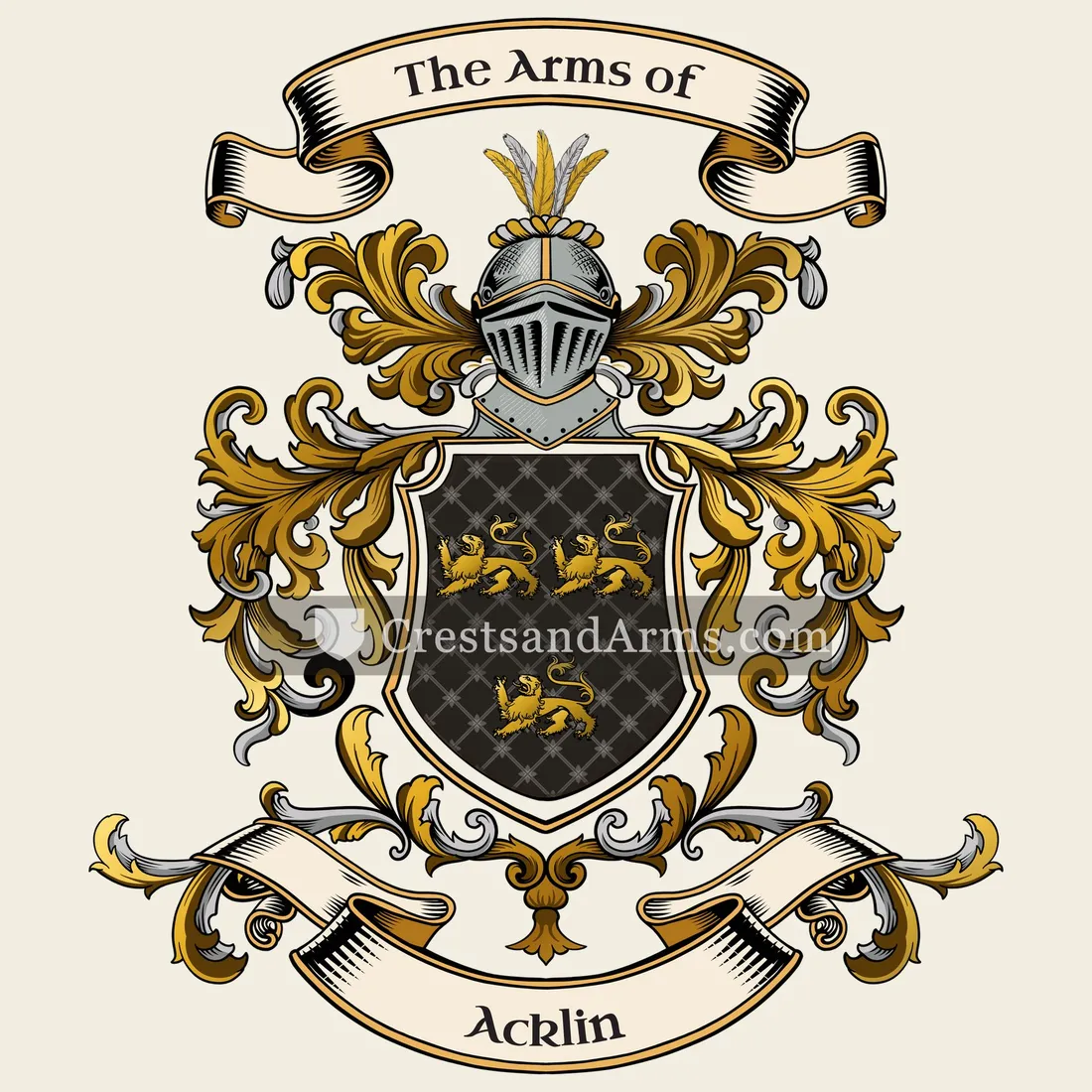
 lionCourage, strength and royalty
 lionCourage, strength and royalty