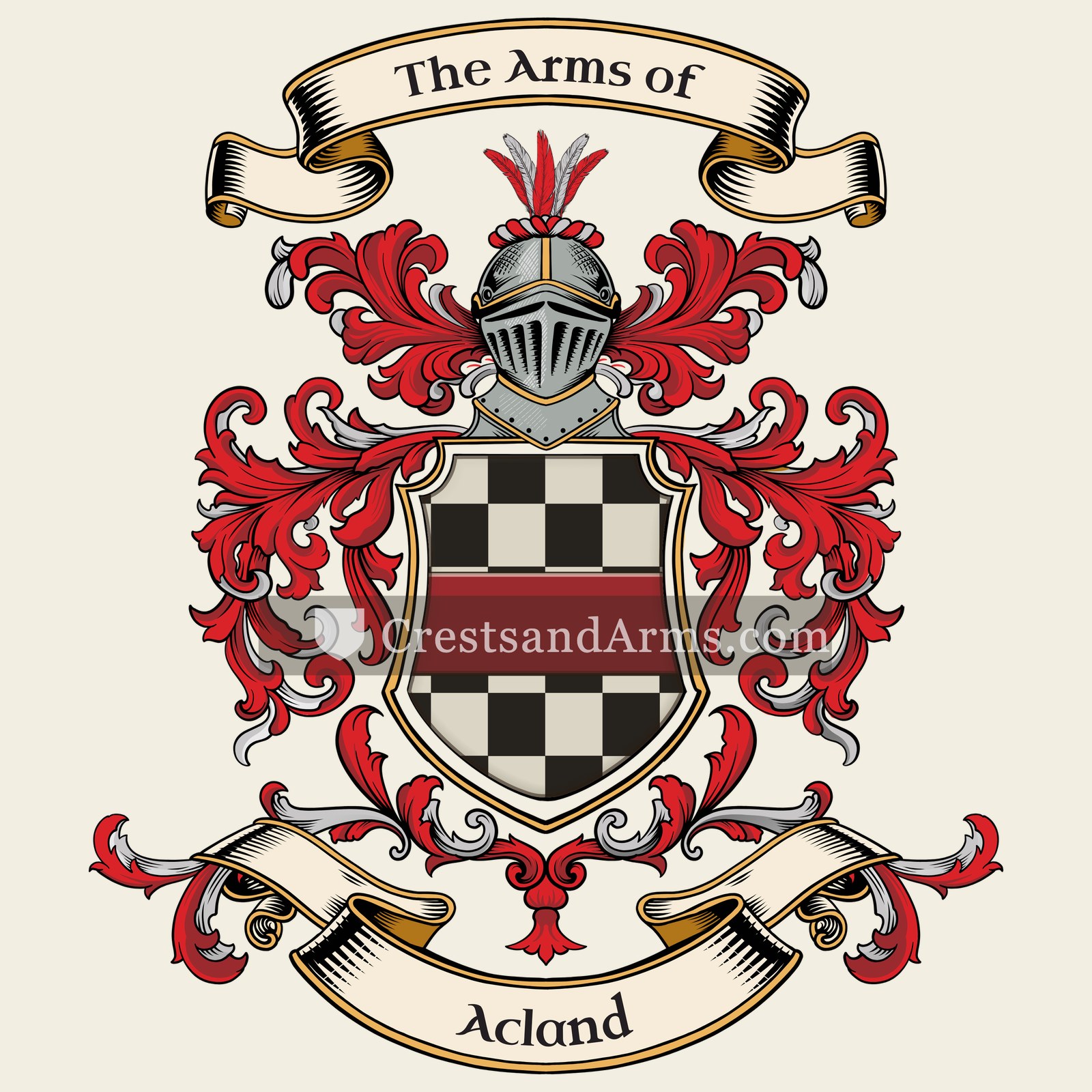
A record of documented arms, meaning and origin, researched for the Acland family lines. Documented in 2 countries.
Reg. 3216 · Britain, A–C
Coat of Arms & Family Crest Details
Symbols on this shield
chequyConstancy, and the counting-board
fessThe military belt, and readiness to serve
Colours
Silver (Argent)Means: Peace and sincerity
Red (Gules)Means: Military strength
Black (Sable)Means: Constancy
Historical info
Source
J. B. Rietstap, Armorial Général, Gouda: G. B. van Goor Zonen, 1884–87
Blazon (the actual original written record)
“Echiq. d'arg. et de sa.; à la fasce de gu. C.: un faucon au nat., perché sur une main gantelée mise en fasce. D.: INÉBRANLABLE [Comp. Fuller-Acland-Hood et Fuller-Palmer-Acland.]”
DevonshireDevonshire, c. 1644
Digital archive packCoat of arms PNG, gold border print PDF, vector SVG and the certificate of authenticity. Sent to your email in minutes.
Map of Britain showing where the Acland arms are recorded
The Acland arms were recorded in Devonshire, c. 1644.
This is where the arms were entered in the register. Families often moved to other parts of the country, so the same name can turn up in more than one region.
The body that granted and recorded arms in Britain in this period.
Charles I of England
Sovereign of the period
Charles I of England
1625–1649
Reigning in Britain when the Acland arms are first recorded.
How Arms Worked in Britain
English heraldry allowed arms to be shared by all legitimate descendants of the original owner. These symbols were treated as personal property that moved through the generations to all children. While the eldest son kept the original design, other family members could use the same shield without needing to change it or register their own unique versions.
Granting authority
The College of Arms in London has regulated the use of coats of arms throughout England and Wales since 1484.
How they got arms
Families typically obtained their coats of arms through a formal grant from the Crown or by proving their ancient right to them.
Where arms were recorded
All official coats of arms are recorded in the registers kept at the College of Arms, which date back to the fifteenth century.
The family's standing
Recorded among the armigerous families of Devonshire.
Origin & History of the Acland Family in Britain
The Acland family name is deeply rooted in the landscape of Devonshire, where the family established a prominent presence long before the mid-seventeenth century. The name itself is topographical, derived from the Old English words for oak and land, suggesting that the earliest ancestors were identified by the specific woods or clearings they inhabited in the West Country. By 1644, the family was already well-entrenched in local society, holding significant estates that allowed them to play an active role in the regional politics and agricultural life of the era. Their history is closely tied to the manor of Acland in the parish of Landkey, which served as the ancestral home for generations. This long-standing connection to the soil of Devon helped the family build a lasting reputation as influential landowners who shaped the development of their local community over several centuries.
Coat of Arms & Family Crest Details
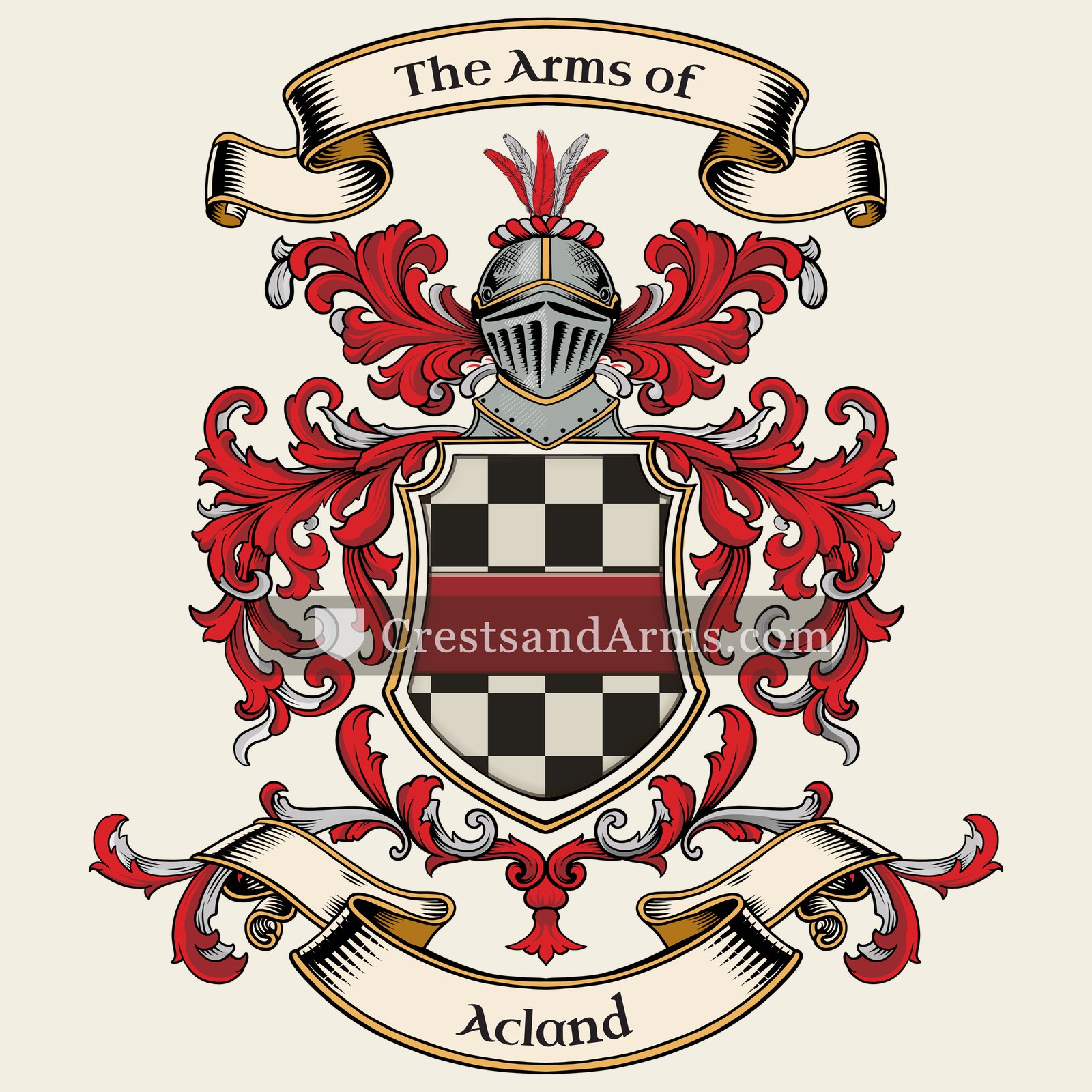
Symbols on this shield
chequyConstancy, and the counting-board
fessThe military belt, and readiness to serve
Colours
Silver (Argent)Means: Peace and sincerity
Red (Gules)Means: Military strength
Black (Sable)Means: Constancy
Historical info
Source
Sir Bernard Burke, The General Armory of England, Scotland, Ireland and Wales, London: Harrison & Sons, 1884
Blazon (the actual original written record)
“Chequy ar. and sa. a fesse gu”
DevonColomb John · Devon, c. 1620
Digital archive packCoat of arms PNG, gold border print PDF, vector SVG and the certificate of authenticity. Sent to your email in minutes.
Map of England showing where the Acland arms are recorded
The Acland arms were recorded in Devon, c. 1620.
Devon was a county of small manors and seafaring families. Its gentry were spread thickly across the countryside, and money made at sea often bought an estate, which in turn brought a coat of arms.
This is where the arms were entered in the register. Families often moved to other parts of the country, so the same name can turn up in more than one region.
The body that granted and recorded arms in England in this period.
James VI and I
Sovereign of the period
James VI and I
1603–1625
Reigning in Britain when the Acland arms are first recorded.
How Arms Worked in England
English heraldry allowed arms to be shared by all legitimate descendants of the original owner. These symbols were treated as personal property that moved through the generations to all children. While the eldest son kept the original design, other family members could use the same shield without needing to change it or register their own unique versions.
Granting authority
The College of Arms in London has regulated the use of coats of arms throughout England and Wales since 1484.
How they got arms
Families typically obtained their coats of arms through a formal grant from the Crown or by proving their ancient right to them.
Where arms were recorded
All official coats of arms are recorded in the registers kept at the College of Arms, which date back to the fifteenth century.
The family's standing
Recorded among the armigerous families of Devon.
Origin & History of the Acland Family in England
The Acland family name is deeply rooted in the landscape of Devon, England, where the family has maintained a continuous presence for many centuries. The name itself is topographical, derived from the Old English words for oak and land, suggesting that the earliest ancestors likely settled near a prominent oak grove or a specific wooded estate. By the early 17th century, the family was already well-established as prominent landowners in the region, particularly around the parish of Landkey. Their long history in this area is marked by a strong connection to the local community and the management of rural estates. This deep attachment to the Devon countryside allowed the family to build a lasting legacy that persisted through generations of agricultural and social change in the West Country.
Acland Meaning & Related Branches
Root word
Ake-land
Old English for oak tree and land or territory.
This name
AclandRefers to a person who lived on or near a piece of land containing oak trees.
also spelled
Ackland
Akland
Documented Sources
J. B. Rietstap, Armorial Général, Gouda: G. B. van Goor Zonen, 1884–87
Hoskins, W. G., Devon, 1954
Risdon, Tristram, The Chorographical Description or Survey of the County of Devon, 1811
Vivian, J. L., The Visitations of the County of Devon, 1895
South West Heritage Trust, Acland Family of Killerton Papers
Digital archive packCoat of arms PNG, gold border print PDF, vector SVG and the certificate of authenticity. Sent to your email in minutes.


 chequyConstancy, and the counting-board
 fessThe military belt, and readiness to serve
 chequyConstancy, and the counting-board
 fessThe military belt, and readiness to serve