A record of documented arms, meaning and origin, researched for the Acquah family lines. Documented in 2 countries.
Reg. 1947 · Italian, A–C
Meaning of the Acquah family crest colors & symbols
Symbols on this shield
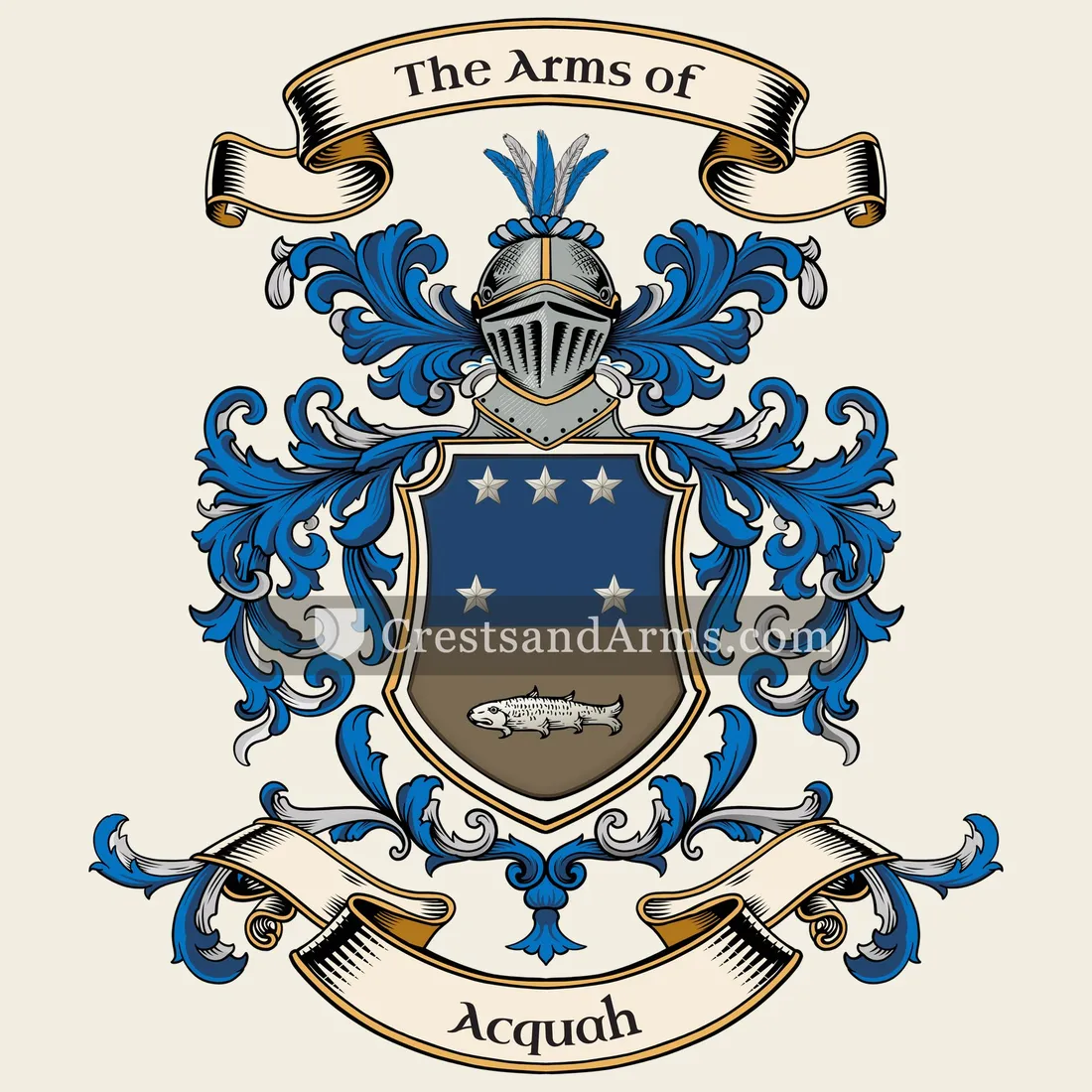
mulletThe third son, and a divine quality from above
fishA true and generous mind, and Christian faith
Colours
Blue (Azure)Means: Loyalty and truth
Silver (Argent)Means: Peace and sincerity
Historical info
Source
J. B. Rietstap, Armorial Général, Gouda: G. B. van Goor Zonen, 1884–87
Blazon (the actual original written record)
“Coupé d'azur sur une eau au nat.; l'azur ch. de cinq étoiles d'arg., 3 et 2, et l'eau ch. d'un poisson nageant au nat. Cq. cour. C.: trois pl. d'aut., une d'or entre deux d'azur. L. d'or et d'azur.”
Italyc. 1775
Digital archive packCoat of arms PNG, gold border print PDF, vector SVG and the certificate of authenticity. Sent to your email in minutes.
Map of Italy showing where the Acquah arms are recorded
The Acquah arms were recorded in Italy, c. 1775.
Arms such as these were typically recorded in Venice.
Venice ran on trade, and its great families were merchants before they were anything else. The city kept a formal list of its noble houses, and a name on that list carried arms as a matter of record.
This is where the arms were entered in the register. Families often moved to other parts of the country, so the same name can turn up in more than one region.
The body that granted and recorded arms in Italy in this period.
Alvise Giovanni Mocenigo
Sovereign of the period
Alvise Giovanni Mocenigo
1763–1778
Reigning in Italy when the Acquah arms are first recorded.
How Arms Worked in Italy
In the Italian states, coats of arms were often used by noble families to show their status and history. These symbols were passed down through the generations to all legitimate male descendants. Younger branches of a family usually kept the original design but sometimes added small changes to distinguish their specific line from the main branch.
Granting authority
Various local rulers and city governments controlled the use of coats of arms across the different Italian states.
How they got arms
Families often assumed their own arms or received them as official grants from local lords, popes, or city councils.
Where arms were recorded
Arms were recorded in local city archives or private family books rather than in one single national register.
The family's standing
Recorded among the armigerous families of Italy.
Origin & History of the Acquah Family in Italy
The history of the Acquah family in Venice begins to emerge clearly in the late eighteenth century, a period when the city served as a vibrant hub for international trade and cultural exchange. By 1775, records indicate that members of the family were established within the Venetian Republic, likely drawn to the city by its reputation as a center for maritime commerce and diplomacy. During this era, Venice was a gateway between Western Europe and the Mediterranean, and families like the Acquahs often integrated into the local merchant class or administrative circles. While the name carries a distinct linguistic footprint, its presence in Venice suggests that the family was part of the fluid movement of people across the Italian peninsula. Their life in the city was defined by the unique social structure of the Venetian Republic, where families often balanced private business interests with the complex political demands of the state. Through their residence in Venice, the Acquah family became a small but significant part of the city’s long history of welcoming diverse lineages into its civic life.
Meaning of the Acquah family crest colors & symbols
Symbols on this shield
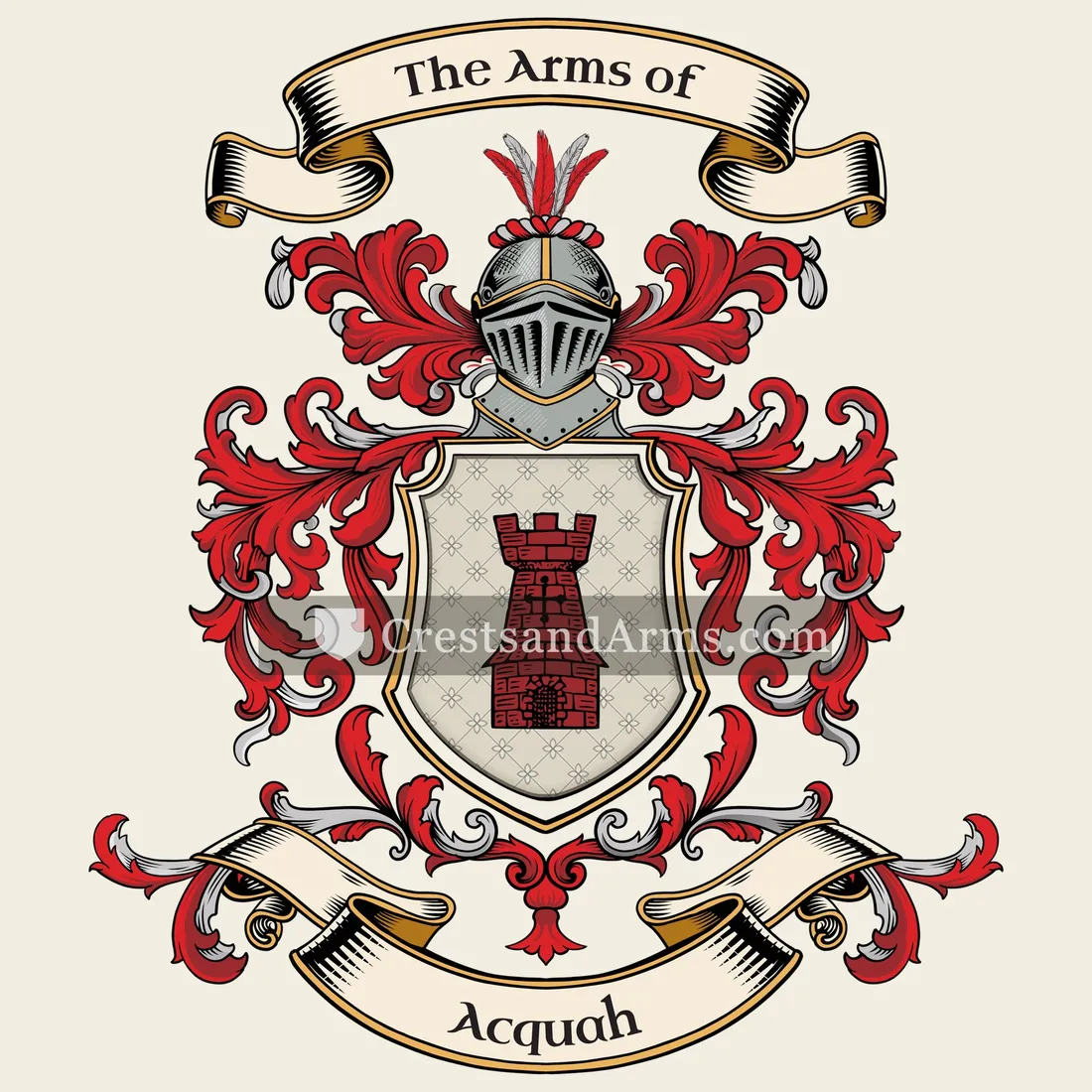
towerGrandeur and solidity, and a stronghold defended
Colours
Silver (Argent)Means: Peace and sincerity
Red (Gules)Means: Military strength
Historical info
Source
J. B. Rietstap, Armorial Général, Gouda: G. B. van Goor Zonen, 1884–87
Blazon (the actual original written record)
“D'arg. au château sommé de deux tours de gu., ouv. et aj. d'azur, s'élevant d'une mer au nat.”
Austriac. 1772
Digital archive packCoat of arms PNG, gold border print PDF, vector SVG and the certificate of authenticity. Sent to your email in minutes.
Map of Austria showing where the Acquah arms are recorded
The Acquah arms were recorded in Austria, c. 1772.
Arms such as these were typically recorded in Tyrol.
Tyrol was mountain country in western Austria, where the valleys were held by families who had been there a very long time. Old tenure counted for more than money, and old families carried arms.
This is where the arms were entered in the register. Families often moved to other parts of the country, so the same name can turn up in more than one region.
Region
Tyrol
First recorded
1772
Granting Authority for the Acquah Arms
Imperial and Royal chancery
Sodacan · CC BY-SA 3.0
The body that granted and recorded arms in Austria in this period.
Joseph II, Holy Roman Emperor
Sovereign of the period
Joseph II, Holy Roman Emperor
1765–1790
Reigning in Italy when the Acquah arms are first recorded.
How Arms Worked in Austria
Austrian coats of arms were often linked directly to noble titles granted by the Emperor. These symbols belonged to the entire family line rather than just one individual. When a family grew, new branches kept the original design without needing to change it. This system allowed all members of a noble house to share the same identity across many generations.
Granting authority
The Imperial and Royal chancery managed all heraldic matters and controlled the official granting of arms throughout the Austrian lands.
How they got arms
Families typically received their arms through a formal imperial decree that often accompanied the elevation of a person to noble status.
Where arms were recorded
Official records of these grants were kept in the Imperial Register of Nobility which began its formal documentation process in 1453.
The family's standing
Recorded among the armigerous families of Austria.
Origin & History of the Acquah Family in Austria
The history of the Acquah family in Austria begins in the mountainous region of Tyrol, where records confirm their presence as early as 1772. While the name is often associated with West African origins, its appearance in the Alpine landscape suggests a unique migration story during the late eighteenth century. During this period, Tyrol served as a vital crossroads for traders and travelers moving between the Mediterranean and Central Europe. Family members likely settled in these high-altitude communities to participate in the local mining or timber industries that defined the regional economy. By integrating into the social fabric of the Austrian Alps, the early Acquah settlers adapted to the German-speaking culture of the area while maintaining their distinct family identity. Their presence in local parish registers from this time indicates that they were established residents who played a role in the daily life of their mountain villages.
Acquah Meaning & Related Branches
Root word
Aqua
Latin term referring to water or a body of water.
This name
AcquahDerived from a topographic descriptor for someone living near a water source.
also spelled
Acquas
Acquae
Acquaia
Akwa
Aqua
Documented Sources
J. B. Rietstap, Armorial Général, Gouda: G. B. van Goor Zonen, 1884–87
Archivio di Stato di Venezia, Anagrafi di cittadini e forestieri (1775)
Lane, Frederic C., Venice, A Maritime Republic (1973)
Norwich, John Julius, A History of Venice (1982)
Digital archive packCoat of arms PNG, gold border print PDF, vector SVG and the certificate of authenticity. Sent to your email in minutes.


 mulletThe third son, and a divine quality from above
 fishA true and generous mind, and Christian faith
 mulletThe third son, and a divine quality from above
 fishA true and generous mind, and Christian faith


 towerGrandeur and solidity, and a stronghold defended