A record of documented arms, meaning and origin, researched for the Adare family lines. Documented in 3 countries.
Reg. 4372 · French, A–C
Coat of Arms & Family Crest Details
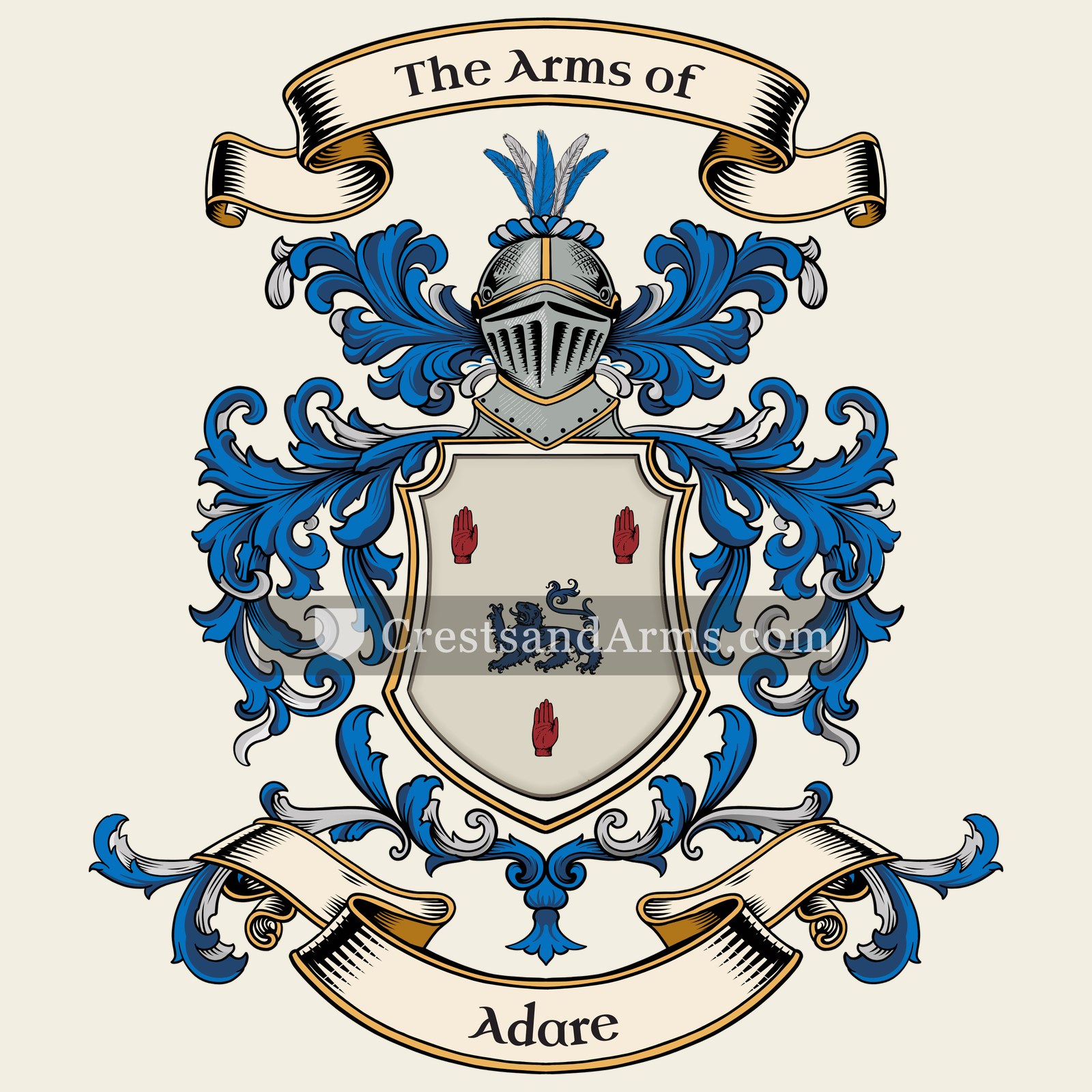
Symbols on this shield
paleMilitary strength, and a fortified defence
chiefAuthority, wisdom and dominion
handFaith, sincerity and justice
Colours
Gold (Or)Means: Generosity
Silver (Argent)Means: Peace and sincerity
Red (Gules)Means: Military strength
Historical info
Source
J. B. Rietstap, Armorial Général, Gouda: G. B. van Goor Zonen, 1884–87
Blazon (the actual original written record)
“Tranché d'or sur arg.; à trois mains dextres appaumées de gu., en pals, 2 en chef et 1 en p. C.: une tête d'homme de carn., posée de front, surm. de la légende: LOYAL AU MORT. T.: à dextre un chevalier, arm. de toutes pièces, tenant une bannière aux armes de l'écu; à sen. un chef irlandais, en costume national, tenant une pique. D.: MANIBUS VICTORIA DEXTRIS. (de l'un en l'autre.”
Francec. 1838
Digital archive packCoat of arms PNG, gold border print PDF, vector SVG and the certificate of authenticity. Sent to your email in minutes.
Map of France showing where the Adare arms are recorded
The Adare arms were recorded in France, c. 1838.
Arms such as these were typically recorded in Bretagne.
More families held coats of arms in Bretagne than anywhere else in France. The land was divided into many small estates rather than a few large ones, so far more households counted as gentry, and each needed a shield of its own to be told apart.
This is where the arms were entered in the register. Families often moved to other parts of the country, so the same name can turn up in more than one region.
The body that granted and recorded arms in France in this period.
How Arms Worked in France
In France, a coat of arms was a mark of honor that passed down through the male line to all legitimate descendants. Families often used the same shield without changes to show their shared heritage. If a branch wanted to stand out, they could add a small mark to their shield to show their specific place in the family tree.
Granting authority
The Juge d'armes de France acted as the official authority that regulated and verified coats of arms across the country.
How they got arms
Families typically inherited their arms from ancestors, though they could also receive them through royal grants or by proving their noble status.
Where arms were recorded
Coats of arms were officially recorded in the Armorial Général de France, which began its main collection in the year 1696.
The family's standing
Recorded among the armigerous families of France.
Origin & History of the Adare Family in France
The family name Adare carries a distinct history rooted in the cultural landscape of western France. By the early nineteenth century, records confirm that members of the family were firmly established in the region of Bretagne. This area was known for its strong sense of local identity and its unique linguistic traditions. Families living in Bretagne during the 1830s often navigated a society transitioning through significant political and social changes following the French Revolution. The presence of the Adare name in this province suggests that the family was part of the local community during a time when rural life and regional trade were the primary drivers of the economy. While the name may have evolved in spelling or pronunciation over the generations, its documented appearance in 1838 serves as a clear anchor point for understanding the family’s early life in the French countryside.
Coat of Arms & Family Crest Details
Symbols on this shield
bendDefence, and the scarf of a commander
handFaith, sincerity and justice
Colours
Gold (Or)Means: Generosity
Black (Sable)Means: Constancy
Red (Gules)Means: Military strength
Historical info
Source
Sir Bernard Burke, The General Armory of England, Scotland, Ireland and Wales, London: Harrison & Sons, 1884
Blazon (the actual original written record)
“Per bend or and sa. three dexter hands appaumée couped and erect gu”
ScotlandKinhilt, c. 1748
Digital archive packCoat of arms PNG, gold border print PDF, vector SVG and the certificate of authenticity. Sent to your email in minutes.
Map of Scotland showing where the Adare arms are recorded
The Adare arms were recorded in Kinhilt, c. 1748.
Arms such as these were typically recorded in Edinburgh.
Edinburgh was the seat of Scotland's government, its courts and its heralds. Families with business there settled nearby, and being close to where arms were recorded is exactly why so many of them appear.
This is where the arms were entered in the register. Families often moved to other parts of the country, so the same name can turn up in more than one region.
The body that granted and recorded arms in Scotland in this period.
George II of Great Britain
Sovereign of the period
George II of Great Britain
1727–1760
Reigning in France when the Adare arms are first recorded.
How Arms Worked in Scotland
Scottish heraldry is unique because it treats a coat of arms as a piece of personal property protected by law. Only one person can own a specific design at any given time. When a family grows, the head keeps the original shield while other relatives must apply for their own distinct version with slight changes to prove their specific identity.
Granting authority
The Court of the Lord Lyon acts as the official body that regulates and controls all heraldic matters throughout Scotland.
How they got arms
Individuals obtain a legal right to their arms through a formal petition process that confirms their identity and family connection.
Where arms were recorded
All valid coats of arms are officially entered into the Public Register of All Arms and Bearings starting from 1672.
The family's standing
Recorded among the armigerous families of Scotland.
Origin & History of the Adare Family in Scotland
The Adare family name has deep roots in the urban landscape of Scotland, particularly within the historic capital of Edinburgh. By the middle of the eighteenth century, the family was well-established in the city, appearing in local records as early as 1748. During this era, Edinburgh was undergoing a period of significant intellectual and social growth known as the Scottish Enlightenment. Families like the Adares were often part of the growing professional and merchant classes that helped shape the city’s expansion beyond its medieval walls. While the name is sometimes associated with geographic locations in Ireland, its presence in Scotland highlights the movement of people across the Irish Sea during a time of increased trade and migration. These early ancestors lived through a transformative period in Scottish history, witnessing the city evolve from a cramped fortress town into a modern center of culture and commerce.
Coat of Arms & Family Crest Details
Symbols on this shield
lionCourage, strength and royalty
handFaith, sincerity and justice
Colours
Silver (Argent)Means: Peace and sincerity
Blue (Azure)Means: Loyalty and truth
Red (Gules)Means: Military strength
Historical info
Source
Sir Bernard Burke, The General Armory of England, Scotland, Ireland and Wales, London: Harrison & Sons, 1884
Blazon (the actual original written record)
“Ar. a lion rampant az. between three dexter hands appaumée erected and couped gu”
EnglandGenoch, c. 1772
Digital archive packCoat of arms PNG, gold border print PDF, vector SVG and the certificate of authenticity. Sent to your email in minutes.
Map of England showing where the Adare arms are recorded
The Adare arms were recorded in Genoch, c. 1772.
Arms such as these were typically recorded in York.
Yorkshire is the largest of the English counties, and it held more gentry families than any other. Land there was split among a great many households rather than a few, so a great many of them carried arms.
This is where the arms were entered in the register. Families often moved to other parts of the country, so the same name can turn up in more than one region.
The body that granted and recorded arms in England in this period.
George III of Great Britain
Sovereign of the period
George III of Great Britain
1760–1801
Reigning in France when the Adare arms are first recorded.
How Arms Worked in England
English heraldry allowed arms to be shared by all legitimate descendants of the original owner. These symbols were treated as personal property that moved through the generations to all children. While the eldest son kept the original design, other family members could use the same shield without needing to change it or register their own unique versions.
Granting authority
The College of Arms in London has regulated the use of coats of arms throughout England and Wales since 1484.
How they got arms
Families typically obtained their coats of arms through a formal grant from the Crown or by proving their ancient right to them.
Where arms were recorded
All official coats of arms are recorded in the registers kept at the College of Arms, which date back to the fifteenth century.
The family's standing
Recorded among the armigerous families of England.
Origin & History of the Adare Family in England
The surname Adare is rooted in the landscape of Northern England, where it emerged as a distinct family identifier during the eighteenth century. By 1772, records confirm that members of the family were firmly established in the historic city of York. During this period, York served as a vital hub for trade and craftsmanship, suggesting that the early Adare family likely participated in the urban economy of the North. The name itself is often linked to geographical origins, potentially derived from locations in Ireland or Scotland, which reflects the frequent movement of people across the British Isles during the era of industrial growth. As the family settled into the social fabric of York, they became part of the local community that helped define the city's identity during the late Georgian period. These early ancestors laid the foundation for the family name in England, moving from transient origins to becoming documented residents of one of the country's most significant historical centers.
Related Branches & Arms
Root word
Adare
Derived from the Germanic root adal meaning noble.
This name
AdareRefers to a person of noble birth or from a noble estate.
also spelled
Adayr
Adayre
Documented Sources
J. B. Rietstap, Armorial Général, Gouda: G. B. van Goor Zonen, 1884–87
Archives départementales du Finistère, État civil, 1838
Archives départementales d'Ille-et-Vilaine, Recensement de la population, 1838
Le Moyne de La Borderie, Arthur, Histoire de Bretagne, 1896
Digital archive packCoat of arms PNG, gold border print PDF, vector SVG and the certificate of authenticity. Sent to your email in minutes.


 paleMilitary strength, and a fortified defence
 chiefAuthority, wisdom and dominion
 handFaith, sincerity and justice
 paleMilitary strength, and a fortified defence
 chiefAuthority, wisdom and dominion
 handFaith, sincerity and justice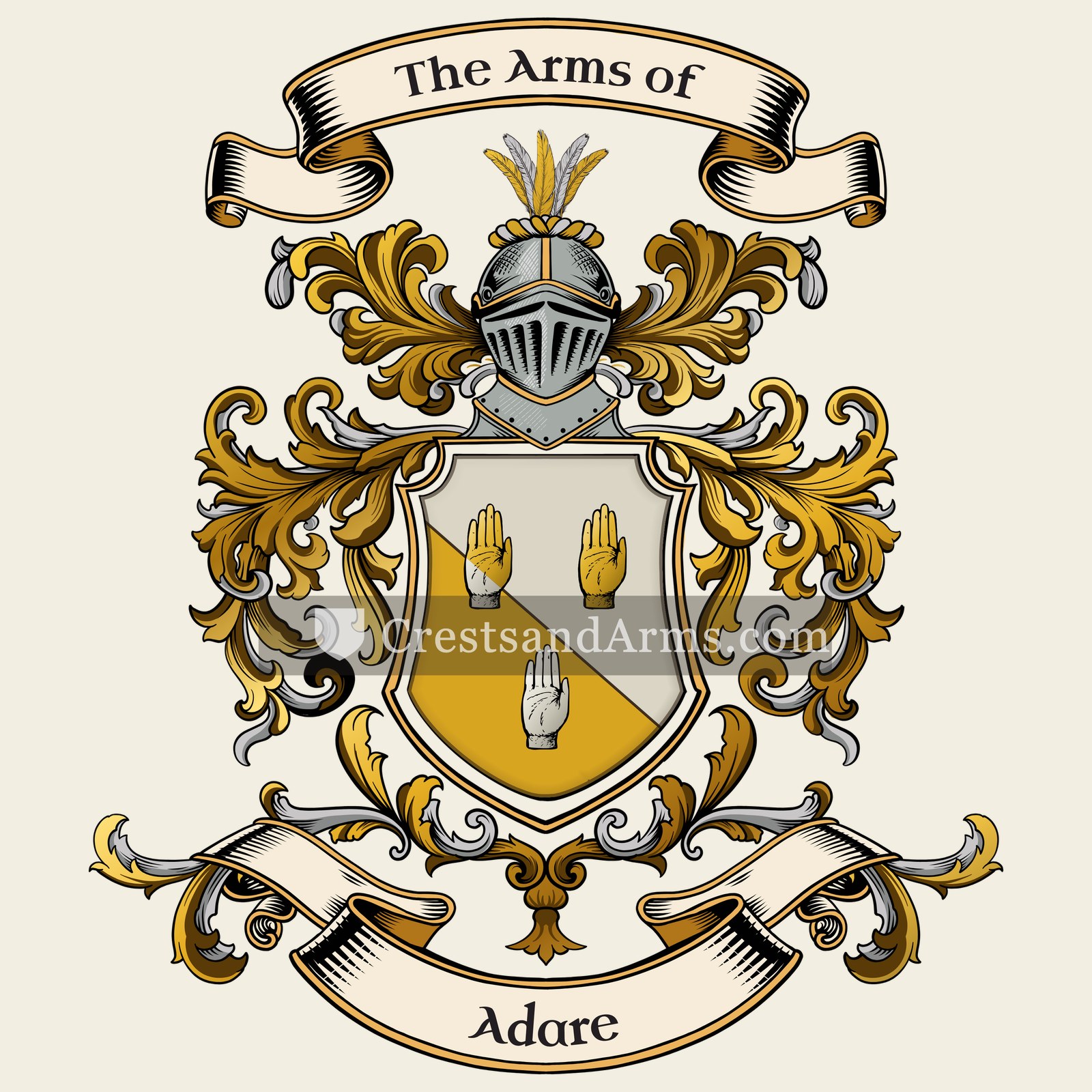

 bendDefence, and the scarf of a commander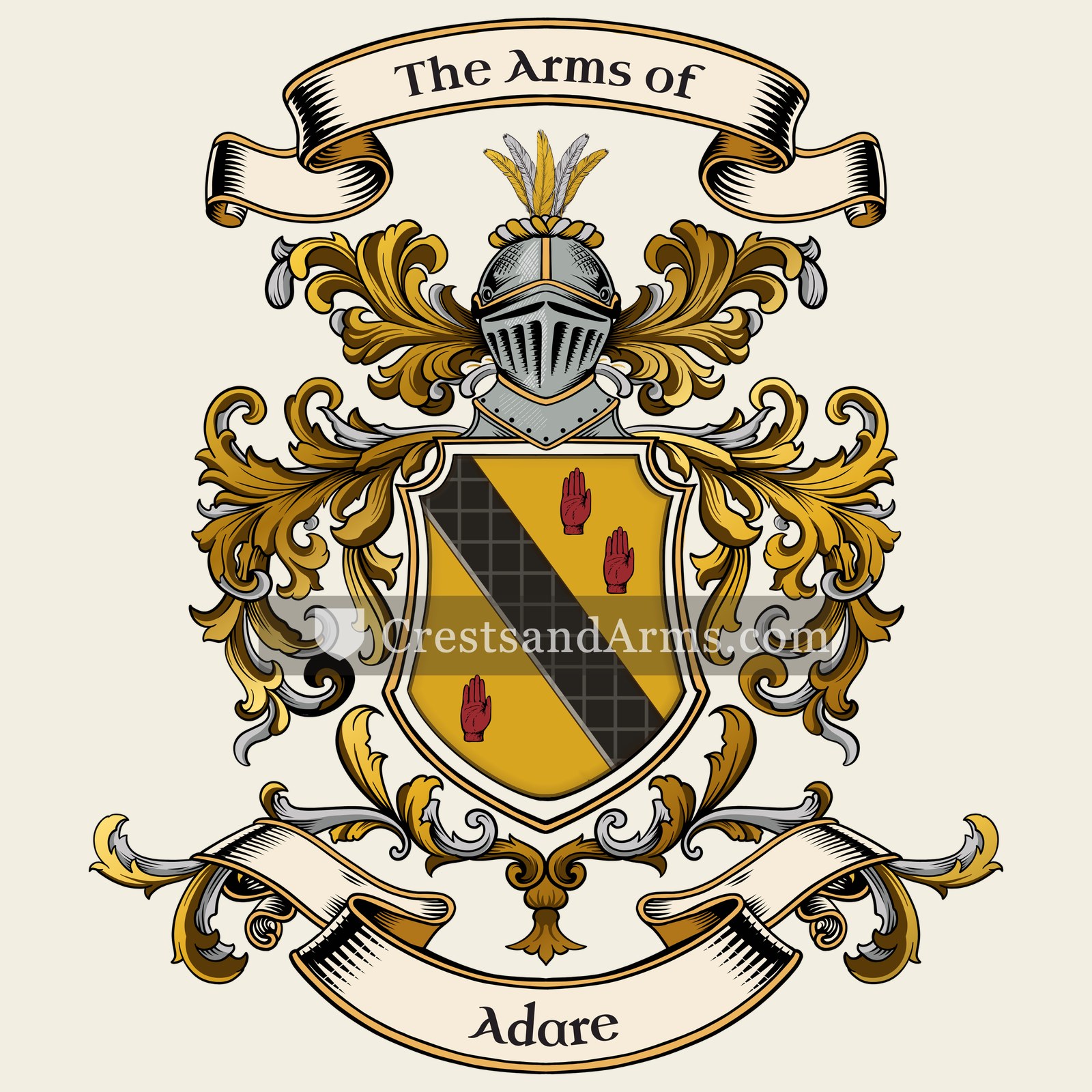


 lionCourage, strength and royalty