Map of England showing where the Adeoye arms are recorded
The Adeoye arms were recorded in Hertford, c. 1620.
Hertfordshire lay just north of London and filled with families who had made money in the City. Buying an estate within a day's ride was the usual next step, and an estate brought arms with it.
This is where the arms were entered in the register. Families often moved to other parts of the country, so the same name can turn up in more than one region.
The body that granted and recorded arms in England in this period.
James VI and I
Sovereign of the period
James VI and I
1603–1625
Reigning in England when the Adeoye arms are first recorded.
How Arms Worked in England
English heraldry allowed arms to be shared by all legitimate descendants of the original owner. These symbols were treated as personal property that moved through the generations to all children. While the eldest son kept the original design, other family members could use the same shield without needing to change it or register their own unique versions.
Granting authority
The College of Arms in London has regulated the use of coats of arms throughout England and Wales since 1484.
How they got arms
Families typically obtained their coats of arms through a formal grant from the Crown or by proving their ancient right to them.
Where arms were recorded
All official coats of arms are recorded in the registers kept at the College of Arms, which date back to the fifteenth century.
The family's standing
Recorded among the armigerous families of Hertford.
Origin & History of the Adeoye Family in England
The family name Adeoye originates from the Yoruba people of West Africa, where it carries the profound meaning of "the crown has a title" or "the crown is worthy." While the name is deeply rooted in Nigerian history, the presence of family members in Hertford as early as 1620 suggests a remarkable story of early global movement. During the seventeenth century, the Atlantic world was becoming increasingly connected through trade and exploration, which allowed individuals from diverse backgrounds to travel to England. These early ancestors likely navigated a society that was very different from their homeland, adapting to the climate and culture of a historic English market town. Their presence in the official records of Hertford provides a rare glimpse into the lives of early African settlers who lived and worked in Britain long before the modern era. By maintaining their identity and name, these individuals helped establish a legacy that bridges two distinct cultures across several centuries.
Adeoye Meaning & Related Branches
Root word
Oye
Yoruba term referring to a crown, chieftaincy, or royal authority.
This name
AdeoyeRefers to the crown or royalty arriving, signifying a noble or royal birth.
also spelled
Ady
Adie
Documented Sources
Sir Bernard Burke, The General Armory of England, Scotland, Ireland and Wales, London: Harrison & Sons, 1884
Dabydeen, David, The Black Presence in English Literature, 1985
Fryer, Peter, Staying Power: The History of Black People in Britain, 1984
Ogunbowale, P. O., The Essentials of the Yoruba Language, 1970
Hertfordshire Archives and Local Studies, Hertford Parish Registers, 1600–1650
Digital archive packCoat of arms PNG, gold border print PDF, vector SVG and the certificate of authenticity. Sent to your email in minutes.


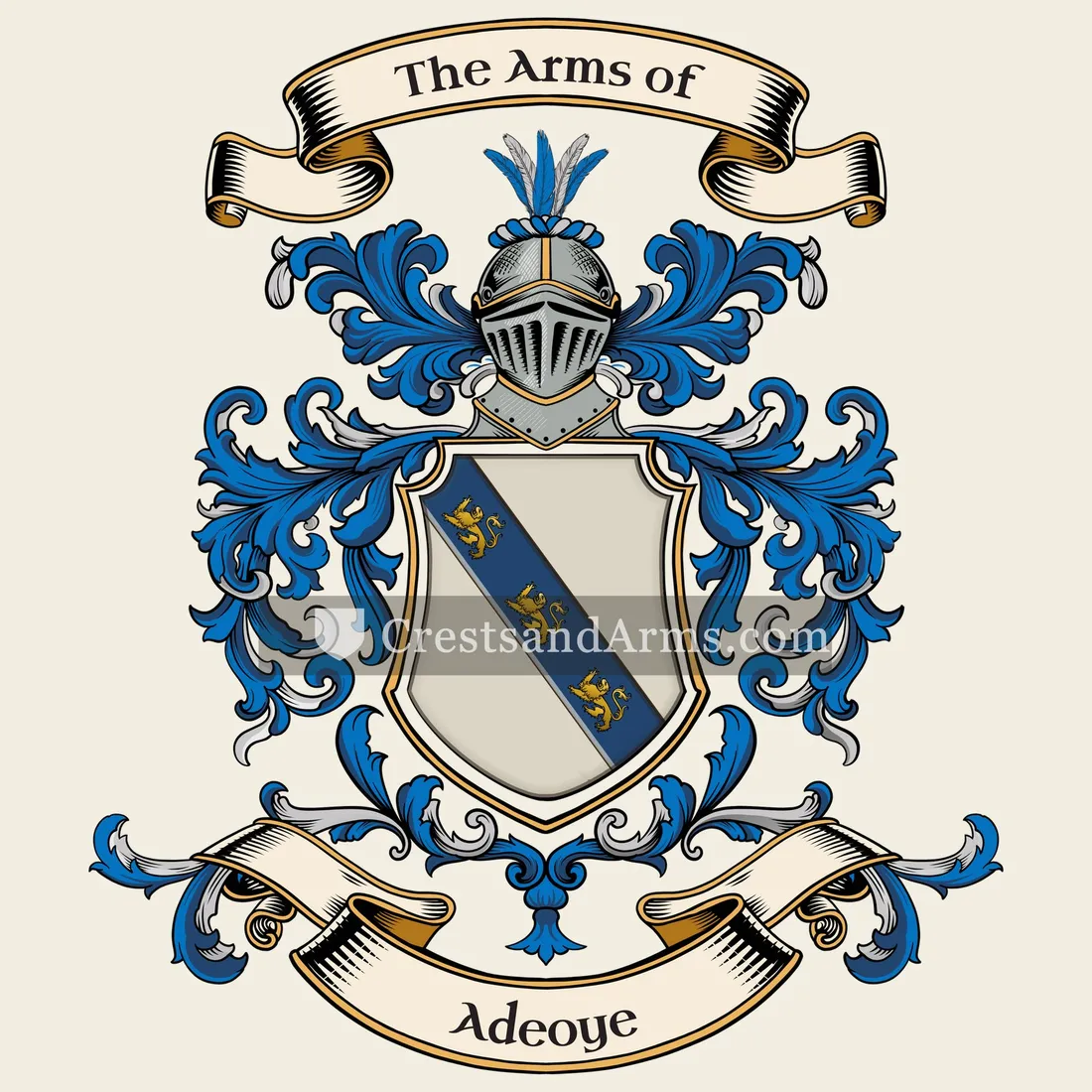
 bendDefence, and the scarf of a commander
 lionCourage, strength and royalty
 bendDefence, and the scarf of a commander
 lionCourage, strength and royalty