Map of Italy showing where the Adhami arms are recorded
The Adhami arms were recorded in Florence, c. 1775.
This is where the arms were entered in the register. Families often moved to other parts of the country, so the same name can turn up in more than one region.
The body that granted and recorded arms in Italy in this period.
Alvise Giovanni Mocenigo
Sovereign of the period
Alvise Giovanni Mocenigo
1763–1778
Reigning in Italy when the Adhami arms are first recorded.
How Arms Worked in Italy
In the Italian states, coats of arms were often used by noble families to show their status and history. These symbols were passed down through the generations to all legitimate male descendants. Younger branches of a family usually kept the original design but sometimes added small changes to distinguish their specific line from the main branch.
Granting authority
Various local rulers and city governments controlled the use of coats of arms across the different Italian states.
How they got arms
Families often assumed their own arms or received them as official grants from local lords, popes, or city councils.
Where arms were recorded
Arms were recorded in local city archives or private family books rather than in one single national register.
The family's standing
Recorded among the armigerous families of Italy.
Origin & History of the Adhami Family in Italy
The Adhami family name carries a history that reflects the movement of people across the Mediterranean and into the heart of Europe. By the year 1775, records confirm that members of the family were established in Florence, a city known at the time for its vibrant trade networks and intellectual exchange. During this era, Florence served as a crossroads for families arriving from the Levant and other eastern regions, often seeking new opportunities in the bustling commercial centers of Tuscany. The presence of the Adhami family in such a prominent Italian city suggests they were likely involved in the merchant classes or professional guilds that defined Florentine society in the late eighteenth century. As they integrated into the local culture, they contributed to the diverse social fabric of the city, maintaining their distinct identity while adapting to the customs and language of their new home. This migration pattern highlights the long-standing connections between the Mediterranean world and the Italian peninsula, illustrating how families like the Adhamis helped shape the cosmopolitan character of historic Florence.
Meaning of the Adhami family crest colors & symbols
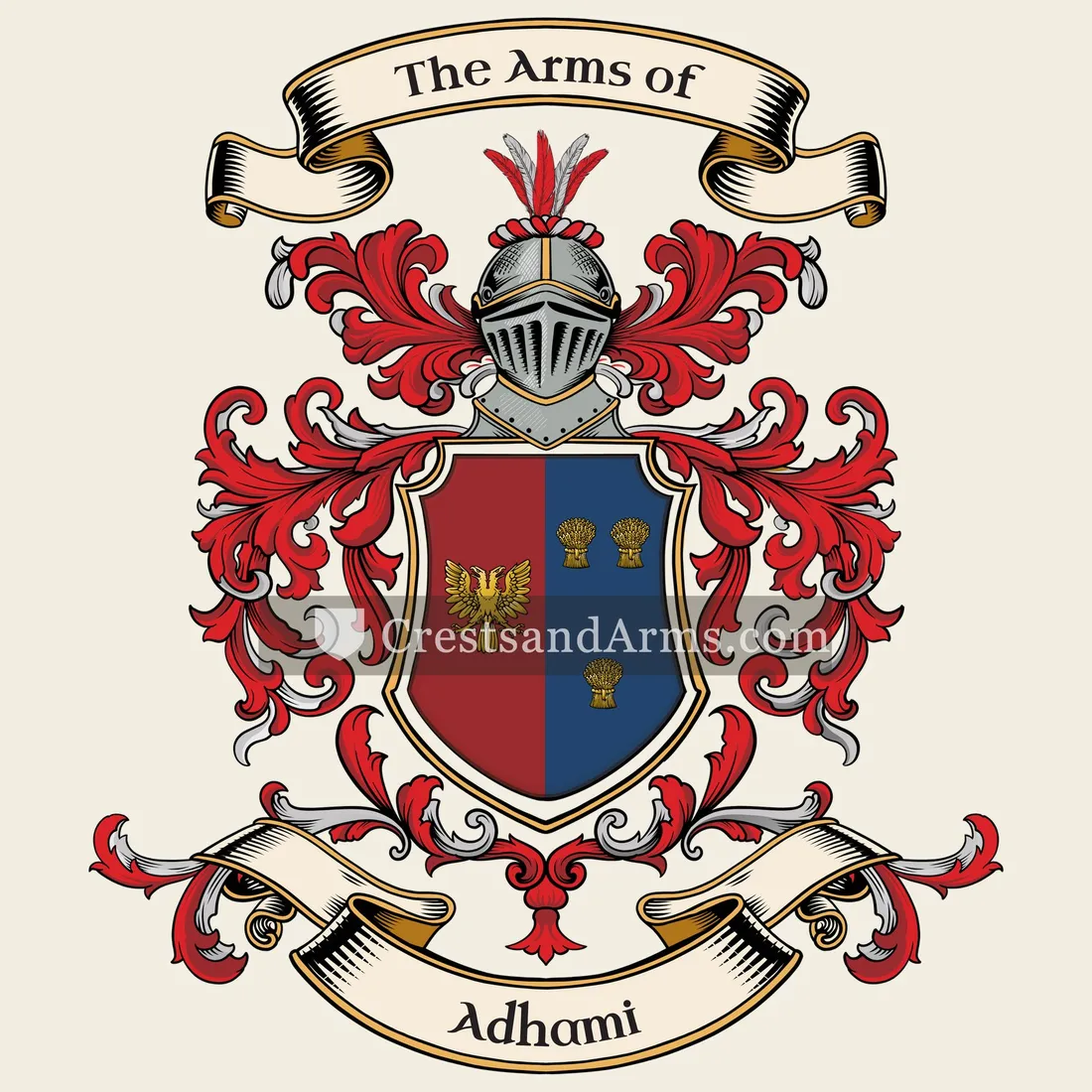
Symbols on this shield
eagleNobility, strength and a keen mind
wheatsheafPlenty, and the harvest of one's own labour
Colours
Red (Gules)Means: Military strength
Blue (Azure)Means: Loyalty and truth
Gold (Or)Means: Generosity
Historical info
Source
J. B. Rietstap, Armorial Général, Gouda: G. B. van Goor Zonen, 1884–87
Blazon (the actual original written record)
“Parti: au 1 de gu. à la demi-aigle d'or, mouv. du parti; au 2 d'azur à trois épis sur une seule tige, feuillée de deux pièces, le tout d'or. C.: les épis du 2.”
GermanyBrème, c. 1765
Digital archive packCoat of arms PNG, gold border print PDF, vector SVG and the certificate of authenticity. Sent to your email in minutes.
Map of Germany showing where the Adhami arms are recorded
The Adhami arms were recorded in Brème, c. 1765.
This is where the arms were entered in the register. Families often moved to other parts of the country, so the same name can turn up in more than one region.
The body that granted and recorded arms in Germany in this period.
Francis I, Holy Roman Emperor
Sovereign of the period
Francis I, Holy Roman Emperor
1745–1765
Reigning in Italy when the Adhami arms are first recorded.
How Arms Worked in Germany
In the Holy Roman Empire, coats of arms were often granted to individuals by the Emperor or his representatives. These arms were then passed down through the generations to all legitimate descendants of the original holder. Younger branches of a family usually kept the same shield design without needing to change it, as the arms belonged to the entire lineage.
Granting authority
The Holy Roman Emperor held the sole power to grant new coats of arms throughout his vast imperial territories.
How they got arms
Families typically obtained their coats of arms through a formal imperial grant or by proving their noble status to the authorities.
Where arms were recorded
These grants were officially recorded in the Imperial Chancery registers, which began keeping formal records of such honors during the Middle Ages.
The family's standing
Recorded among the armigerous families of Germany.
Origin & History of the Adhami Family in Germany
The history of the Adhami family in Germany is rooted in the vibrant trade culture of the eighteenth century. Records confirm that members of the family were established in the city of Bremen by 1765. During this period, Bremen served as a major hub for international commerce and maritime activity. Families like the Adhamis often settled in such port cities to participate in the growing exchange of goods and ideas between Northern Europe and the rest of the world. As residents of a free imperial city, the early Adhami family members likely navigated a society that valued mercantile skill and civic participation. Their presence in the city during this era suggests they were part of the middle class of merchants and professionals who helped shape the economic identity of the region. Over time, the family name became integrated into the local fabric of Bremen, reflecting the broader patterns of migration and social mobility that defined German urban life in the late 1700s.
Adhami Meaning & Related Branches
Root word
Adamo
Derived from the Hebrew word for earth or red clay.
This name
AdhamiA patronymic surname indicating descent from a person named Adam.
also spelled
Adamy
Documented Sources
J. B. Rietstap, Armorial Général, Gouda: G. B. van Goor Zonen, 1884–87
Archivio di Stato di Firenze, Stato Civile della Restaurazione (1775)
Bocci, Giovanni, La storia delle famiglie mercantili a Firenze, 1922
Crollalanza, Giovan Battista, Dizionario storico-blasonico delle famiglie nobili e notabili italiane, 1886
Digital archive packCoat of arms PNG, gold border print PDF, vector SVG and the certificate of authenticity. Sent to your email in minutes.


 maceAuthority, and the officer who bears it
 maceAuthority, and the officer who bears it



 eagleNobility, strength and a keen mind
 wheatsheafPlenty, and the harvest of one's own labour