Map of Netherlands showing where the Aerts arms are recorded
The Aerts arms were recorded in Rotterdam, c. 1815.
This is where the arms were entered in the register. Families often moved to other parts of the country, so the same name can turn up in more than one region.
Region
Rotterdam
Town
Rotterdam
First recorded
1815
Granting Authority for the Aerts Arms
Hoge Raad van Adel
Photograph made by me · CC BY-SA 3.0
The body that granted and recorded arms in Netherlands in this period.
William I of the Netherlands
Sovereign of the period
William I of the Netherlands
1815–1840
Reigning in Netherlands when the Aerts arms are first recorded.
How Arms Worked in Netherlands
In the Netherlands, coats of arms were often used by noble families and those who held specific public offices. These arms were passed down through the generations to legitimate descendants. Younger branches of a family usually kept the original design without needing to add special marks. This system ensured that the family identity remained clear and consistent over many years.
Granting authority
The Hoge Raad van Adel is the official body that regulates and manages noble titles and coats of arms in the Netherlands.
How they got arms
Families typically obtained their coats of arms through official royal grants or by proving their long-standing historical use of the symbols.
Where arms were recorded
Coats of arms are officially recorded in the registers held by the Hoge Raad van Adel, which began its work in 1814.
The family's standing
Recorded among the armigerous families of Netherlands.
Origin & History of the Aerts Family in Netherlands
The surname Aerts is a patronymic name, which means it originated as a way to identify a person as the son of someone named Aert. This given name is a shortened form of Aernout, which is the Dutch version of the name Arnold. By the time the family was firmly established in Rotterdam in 1815, the name had already been in use for several generations across the Netherlands. During this era, the city of Rotterdam was a bustling center for trade and maritime activity. Families like the Aerts were often part of the growing urban population that supported the city's rise as a major port. Because the name was based on a popular first name, it appeared independently in many different regions, meaning that people named Aerts were not always related to one another. Over time, the spelling became fixed in official records as the Dutch government began to require standardized surnames for tax and census purposes.
Coat of Arms & Family Crest Details
Symbols on this shield
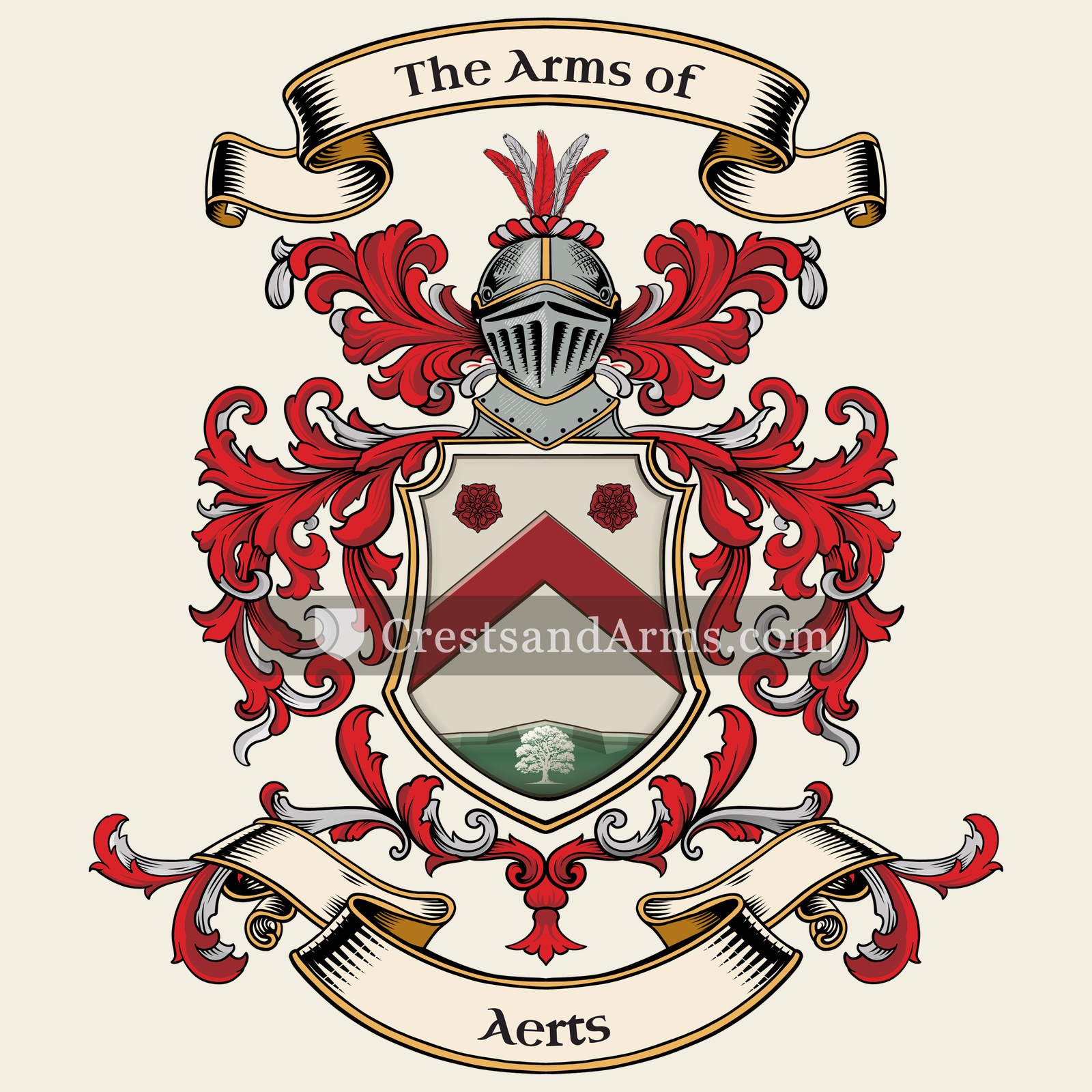
chevronProtection, and faithful service completed
mountThe ground held, and steadfastness upon it
roseThe seventh son, and beauty with grace
treeLife, endurance and deep roots
Colours
Silver (Argent)Means: Peace and sincerity
Red (Gules)Means: Military strength
Green (Vert)Means: Hope
Historical info
Source
J. B. Rietstap, Armorial Général, Gouda: G. B. van Goor Zonen, 1884–87
Blazon (the actual original written record)
“D'arg. au chev. de gu., acc. en chef de deux roses du même, tigées et feuillées de sin., et en p. d'un arbre terrassé du même.”
Belgiumc. 1737
Digital archive packCoat of arms PNG, gold border print PDF, vector SVG and the certificate of authenticity. Sent to your email in minutes.
Map of Belgium showing where the Aerts arms are recorded
The Aerts arms were recorded in Belgium, c. 1737.
Arms such as these were typically recorded in Brabant.
Brabant lay at the heart of the Low Countries, where the trade routes met. Its towns were wealthy and its landowners many, and both kinds of family kept arms, which is why the region is so heavily represented.
This is where the arms were entered in the register. Families often moved to other parts of the country, so the same name can turn up in more than one region.
The body that granted and recorded arms in Belgium in this period.
Charles VI, Holy Roman Emperor
Sovereign of the period
Charles VI, Holy Roman Emperor
1711–1740
Reigning in Netherlands when the Aerts arms are first recorded.
How Arms Worked in Belgium
In Belgium, a coat of arms is considered personal property that is passed down through the male line to legitimate descendants. Families often use the same shield design across generations to show their shared heritage. If a branch of the family wants to change the design, they must apply for an official update to their specific version of the arms.
Granting authority
The Conseil héraldique is the official body that regulates and approves all coats of arms in Belgium.
How they got arms
Families obtain their coats of arms through formal royal grants or by confirming their historical right to use existing designs.
Where arms were recorded
All approved coats of arms are officially recorded in the public registers of the Conseil héraldique since 1844.
The family's standing
Recorded among the armigerous families of Belgium.
Origin & History of the Aerts Family in Belgium
The surname Aerts is a patronymic name, which means it originated as a way to identify a person as the son of someone named Aert. This name is a shortened form of Arnold, a popular Germanic name that translates to the power of an eagle. By the time records confirm the family presence in the Brabant region of Belgium in 1737, the name had already become well-established among the local population. Families with this name were typically part of the working class, often serving as farmers or skilled tradespeople who helped shape the rural economy of the Low Countries. Because the name was tied to a common first name, it appeared independently in many different villages across the province. This led to several distinct family lines that shared the same name but were not necessarily related by blood. Over time, the Aerts family became a permanent fixture in the social fabric of Brabant, reflecting the deep roots of the Flemish people in their ancestral lands.
Aerts Meaning & Related Branches
Root word
Arn
Germanic element meaning eagle.
This name
AertsPatronymic form derived from the name Arnold, signifying son of the eagle ruler.
also spelled
Aertz
Arts
Related arms
Artssimilar arms
Aertzvariant spelling
Documented Sources
J. B. Rietstap, Armorial Général, Gouda: G. B. van Goor Zonen, 1884–87


 crescentHonour by the sovereign, and the second son
 trefoilPerpetuity, and the Trinity
 crescentHonour by the sovereign, and the second son
 trefoilPerpetuity, and the Trinity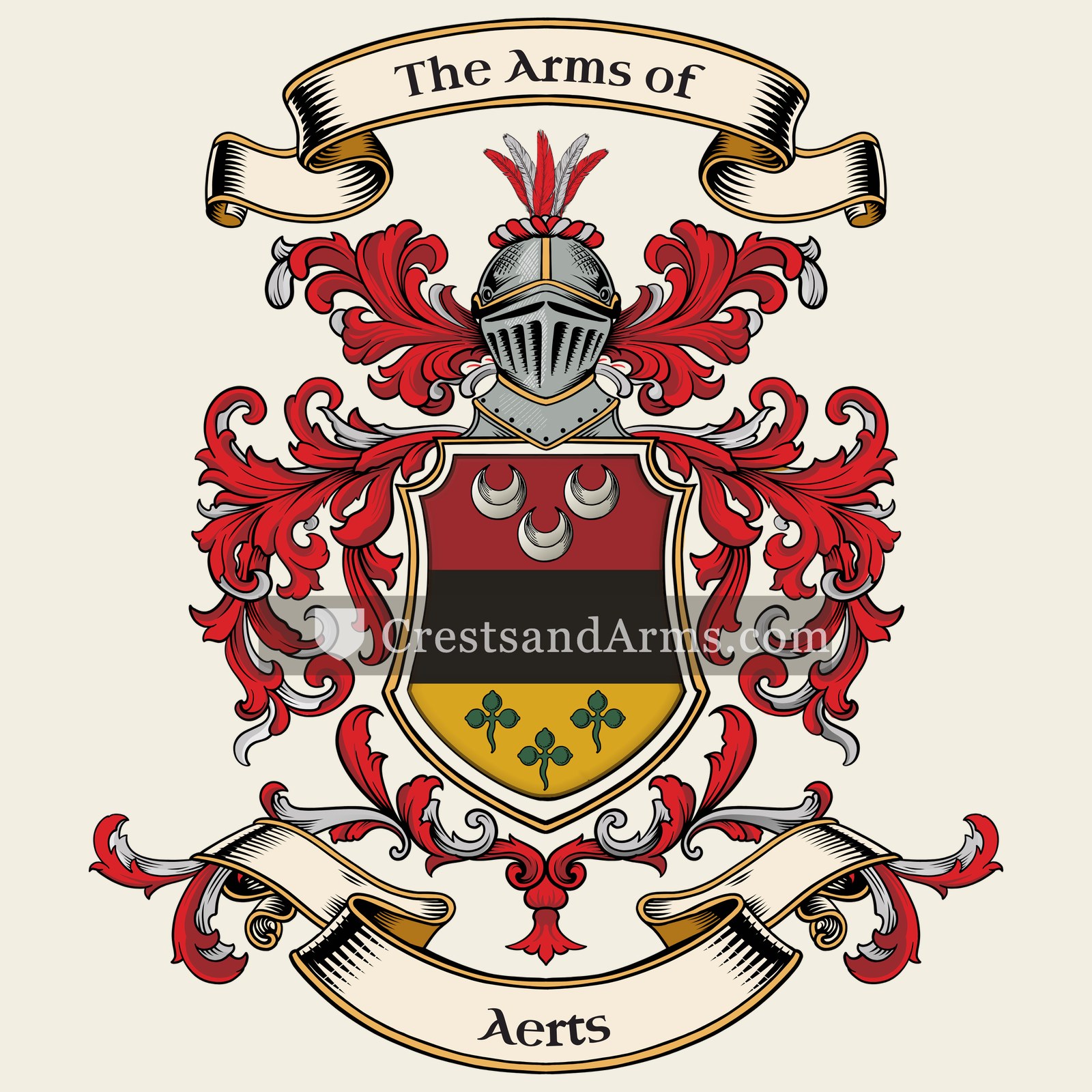


 chevronProtection, and faithful service completed
 mountThe ground held, and steadfastness upon it
 roseThe seventh son, and beauty with grace
 treeLife, endurance and deep roots