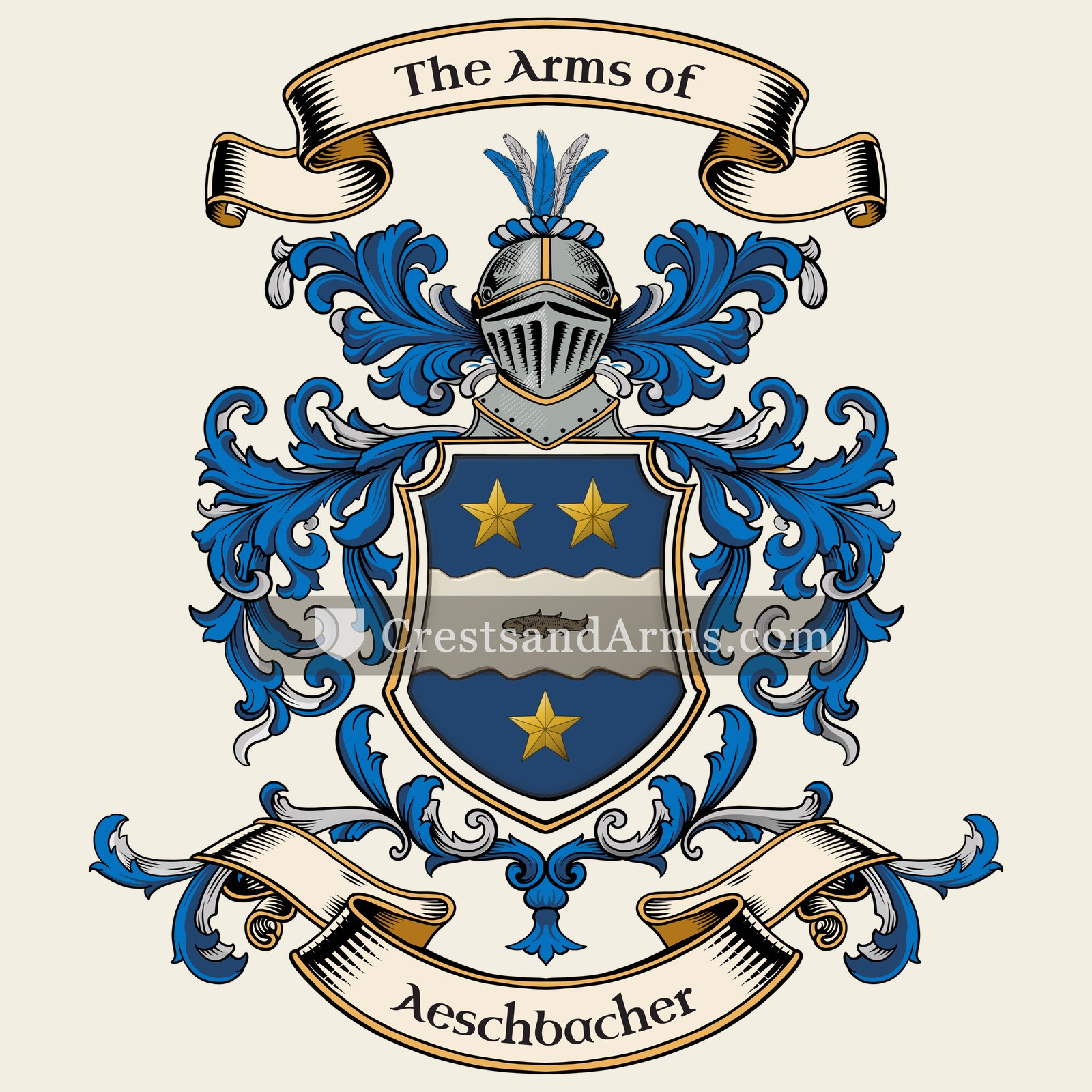
A record of documented arms, meaning and origin, researched for the Aeschbacher family of Austria.
Reg. 3247 · Austrian, A–C
Coat of Arms & Family Crest Details
Symbols on this shield
fessThe military belt, and readiness to serve
mountThe ground held, and steadfastness upon it
fishA true and generous mind, and Christian faith
mulletThe third son, and a divine quality from above
Colours
Blue (Azure)Means: Loyalty and truth
Silver (Argent)Means: Peace and sincerity
Gold (Or)Means: Generosity
Historical info
Source
J. B. Rietstap, Armorial Général, Gouda: G. B. van Goor Zonen, 1884–87
Blazon (the actual original written record)
“D'azur à la fasce ondée d'arg., ch. d'un poisson nageant au nat. et acc. de trois étoiles d'or. Deux cq. cour. C.: 1º un vol cont., l'aile de derrière d'arg. plein, l'aile de devant d'azur ch. d'une fasce ondée d'arg., surch. d'un poisson nageant cont. au nat.; 1. d'arg. et d'azur; 2º un rocher sommé d'un faucon, le tout au nat.; 1. d'or et d'azur. D.: MODUS IN REBUS.”
AustriaVienne, c. 1772
Digital archive packCoat of arms PNG, gold border print PDF, vector SVG and the certificate of authenticity. Sent to your email in minutes.
Map of Austria showing where the Aeschbacher arms are recorded
The Aeschbacher arms were recorded in Vienne, c. 1772.
This is where the arms were entered in the register. Families often moved to other parts of the country, so the same name can turn up in more than one region.
Region
Vienne
Town
Vienne
First recorded
1772
Granting Authority for the Aeschbacher Arms
Imperial and Royal chancery
Sodacan · CC BY-SA 3.0
The body that granted and recorded arms in Austria in this period.
Joseph II, Holy Roman Emperor
Sovereign of the period
Joseph II, Holy Roman Emperor
1765–1790
Reigning in Austria when the Aeschbacher arms are first recorded.
How Arms Worked in Austria
Austrian coats of arms were often linked directly to noble titles granted by the Emperor. These symbols belonged to the entire family line rather than just one individual. When a family grew, new branches kept the original design without needing to change it. This system allowed all members of a noble house to share the same identity across many generations.
Granting authority
The Imperial and Royal chancery managed all heraldic matters and controlled the official granting of arms throughout the Austrian lands.
How they got arms
Families typically received their arms through a formal imperial decree that often accompanied the elevation of a person to noble status.
Where arms were recorded
Official records of these grants were kept in the Imperial Register of Nobility which began its formal documentation process in 1453.
The family's standing
Recorded among the armigerous families of Austria.
Origin & History of the Aeschbacher Family in Austria
The surname Aeschbacher originates from the German-speaking regions of Europe, specifically deriving from the geographical term for a brook or stream lined with ash trees. Families bearing this name were historically tied to the landscape, often settling in rural areas where they worked as farmers or tradespeople. By the year 1772, records confirm that members of the Aeschbacher family were established in the region of Vienne. During this period, families often moved across borders in search of better agricultural land or new economic opportunities. As they settled into their new communities, these early ancestors helped shape the local culture through their participation in village life and regional trade. Their presence in Vienne reflects a broader history of migration where families carried their ancestral names into new territories to build lasting legacies.
Related Branches & Arms
Root word
Esch
A Germanic term referring to an ash tree.
This name
AeschbacherA topographic name for someone who lived near an ash tree or an ash grove.
also spelled
Ashbah
Documented Sources
J. B. Rietstap, Armorial Général, Gouda: G. B. van Goor Zonen, 1884–87
Bahlow, Hans, Deutsches Namenlexikon, 1967
Heintze, Albert, Die deutschen Familiennamen, 1903
Archives départementales de l'Isère, Registres paroissiaux et d'état civil de Vienne, 1772
Digital archive packCoat of arms PNG, gold border print PDF, vector SVG and the certificate of authenticity. Sent to your email in minutes.


 fessThe military belt, and readiness to serve
 mountThe ground held, and steadfastness upon it
 fishA true and generous mind, and Christian faith
 mulletThe third son, and a divine quality from above
 fessThe military belt, and readiness to serve
 mountThe ground held, and steadfastness upon it
 fishA true and generous mind, and Christian faith
 mulletThe third son, and a divine quality from above