Map of Switzerland showing where the Ahern arms are recorded
The Ahern arms were recorded in Switzerland, c. 1745.
Arms such as these were typically recorded in Bern.
Bern was the largest of the Swiss cantons and ran itself, with its own council and its own courts. Its governing families held office for generations, and office of that kind carried a shield with it.
This is where the arms were entered in the register. Families often moved to other parts of the country, so the same name can turn up in more than one region.
The body that granted and recorded arms in Switzerland in this period.
How Arms Worked in Switzerland
In Switzerland, coats of arms were not restricted to the nobility and were often adopted by common citizens and families. These symbols were passed down through generations to show family identity. When branches of a family grew, they often changed small details of the design to distinguish their own line from the original group.
Granting authority
Cantonal and civic authorities managed the use of coats of arms within their specific regions and local jurisdictions.
How they got arms
Families typically assumed their own coats of arms based on local custom rather than receiving them from a central monarch.
Where arms were recorded
Arms were recorded in various cantonal and civic registers starting from the fourteenth century throughout the Swiss region.
The family's standing
Recorded among the armigerous families of Switzerland.
Origin & History of the Ahern Family in Switzerland
The family name Ahern has deep roots that connect to the city of Bern, Switzerland, where records confirm members of the family were established by 1745. During the eighteenth century, Bern was a powerful city-state governed by a strict social hierarchy, and families living there were often integrated into the local craft guilds or the administrative systems of the region. The name likely evolved from local linguistic patterns in the German-speaking cantons, reflecting the movement of families across central Europe during a time of significant social and economic change. As these early ancestors settled into the urban life of Bern, they became part of a community defined by its commitment to trade, civic duty, and the preservation of local traditions. By maintaining a presence in such a prominent city, the family participated in the steady development of Swiss society throughout the middle of the century.
Ahern Meaning & Related Branches
Root word
Ó hEachthighearna
Descendant of the lord of horses.
This name
AhernDerived from Gaelic terms signifying a horse lord or master of horses.
Documented Sources
J. B. Rietstap, Armorial Général, Gouda: G. B. van Goor Zonen, 1884–87
Staatsarchiv des Kantons Bern, Bürgerrodel der Stadt Bern (1745)
Dubler, Anne-Marie, Stadt und Land in der Schweiz des 18. Jahrhunderts (1990)
Historischer Verein des Kantons Bern, Berner Zeitschrift für Geschichte und Heimatkunde (1945)
Digital archive packCoat of arms PNG, gold border print PDF, vector SVG and the certificate of authenticity. Sent to your email in minutes.


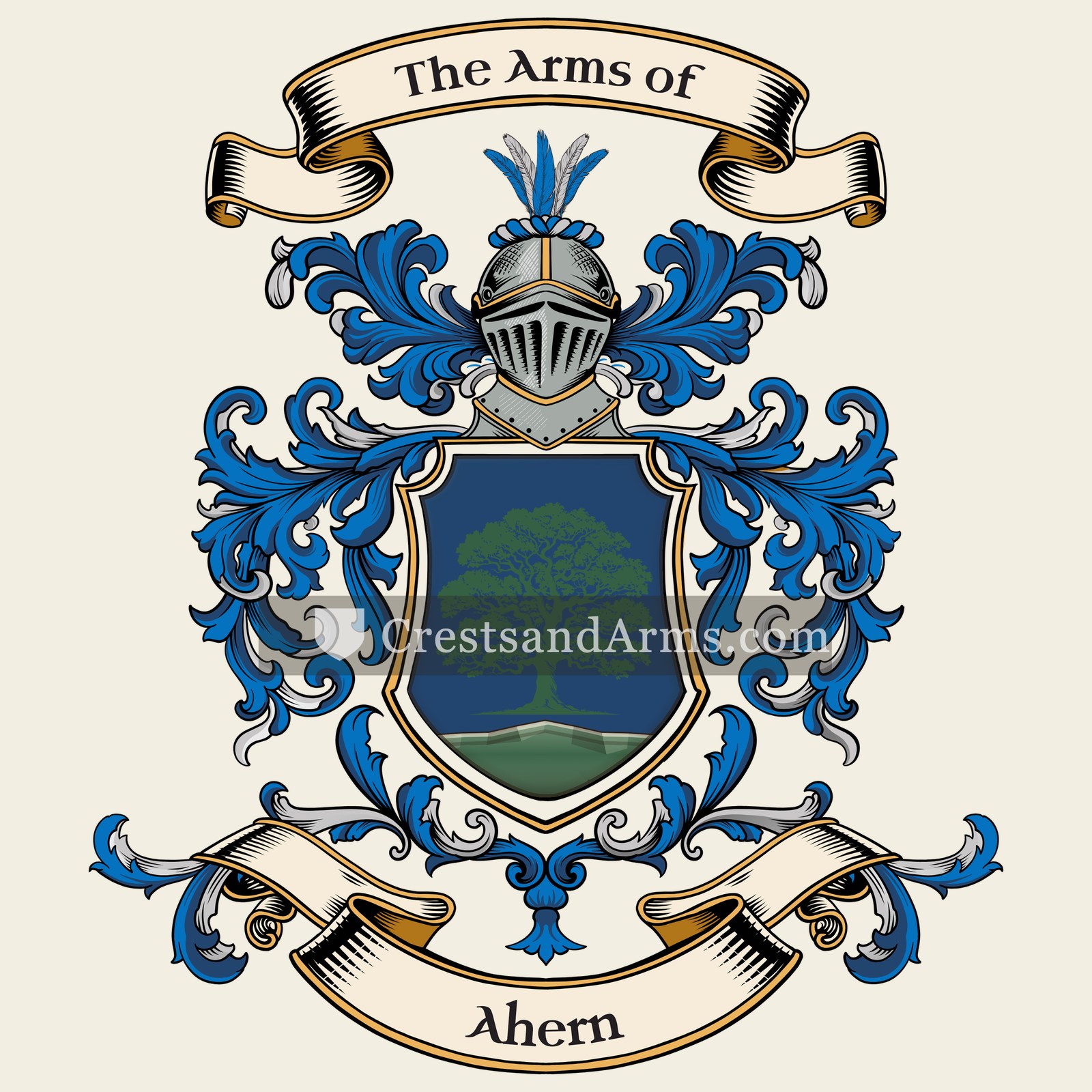
 mountThe ground held, and steadfastness upon it
 treeLife, endurance and deep roots
 mountThe ground held, and steadfastness upon it
 treeLife, endurance and deep roots