Map of Britain showing where the Ahrendt arms are recorded
The Ahrendt arms were recorded in Britain, c. 1700.
Arms such as these were typically recorded in Kent.
Kent sits between London and the short crossing to Europe, and the trade passing through made it wealthy. Merchant families bought land with that money, and it was landowners who took coats of arms.
This is where the arms were entered in the register. Families often moved to other parts of the country, so the same name can turn up in more than one region.
The body that granted and recorded arms in Britain in this period.
William III of England
Sovereign of the period
William III of England
1694–1702
Reigning in Britain when the Ahrendt arms are first recorded.
How Arms Worked in Britain
English heraldry allowed arms to be shared by all legitimate descendants of the original owner. These symbols were treated as personal property that moved through the generations to all children. While the eldest son kept the original design, other family members could use the same shield without needing to change it or register their own unique versions.
Granting authority
The College of Arms in London has regulated the use of coats of arms throughout England and Wales since 1484.
How they got arms
Families typically obtained their coats of arms through a formal grant from the Crown or by proving their ancient right to them.
Where arms were recorded
All official coats of arms are recorded in the registers kept at the College of Arms, which date back to the fifteenth century.
The family's standing
Recorded among the armigerous families of Britain.
Origin & History of the Ahrendt Family in Britain
The family name Ahrendt is a variation of the Germanic name Arnold, which carries the ancient meaning of an eagle ruler. While the name has deep roots in Northern Europe, its presence in Britain became more distinct by the turn of the 18th century. By 1700, records show that members of the Ahrendt family had established themselves in the county of Kent. This region was a common destination for migrants arriving from the continent due to its proximity to the English Channel and its bustling trade ports. Families settling in Kent during this period often integrated into local agricultural or maritime communities, gradually anglicizing their spelling and customs while maintaining the core identity of their surname. Over time, the name evolved from its continental origins to become a permanent part of the local history in Southeast England.
Coat of Arms & Family Crest Details
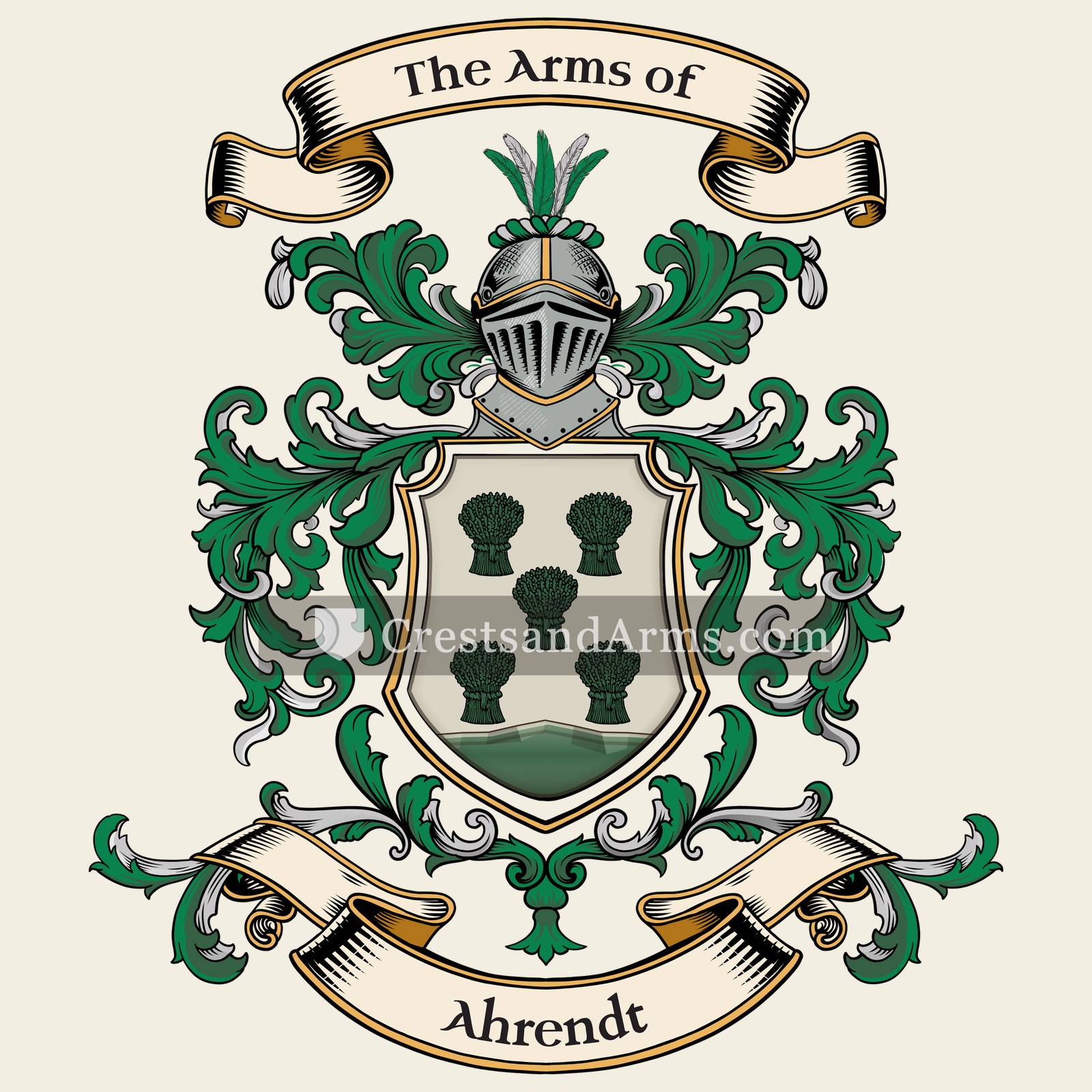
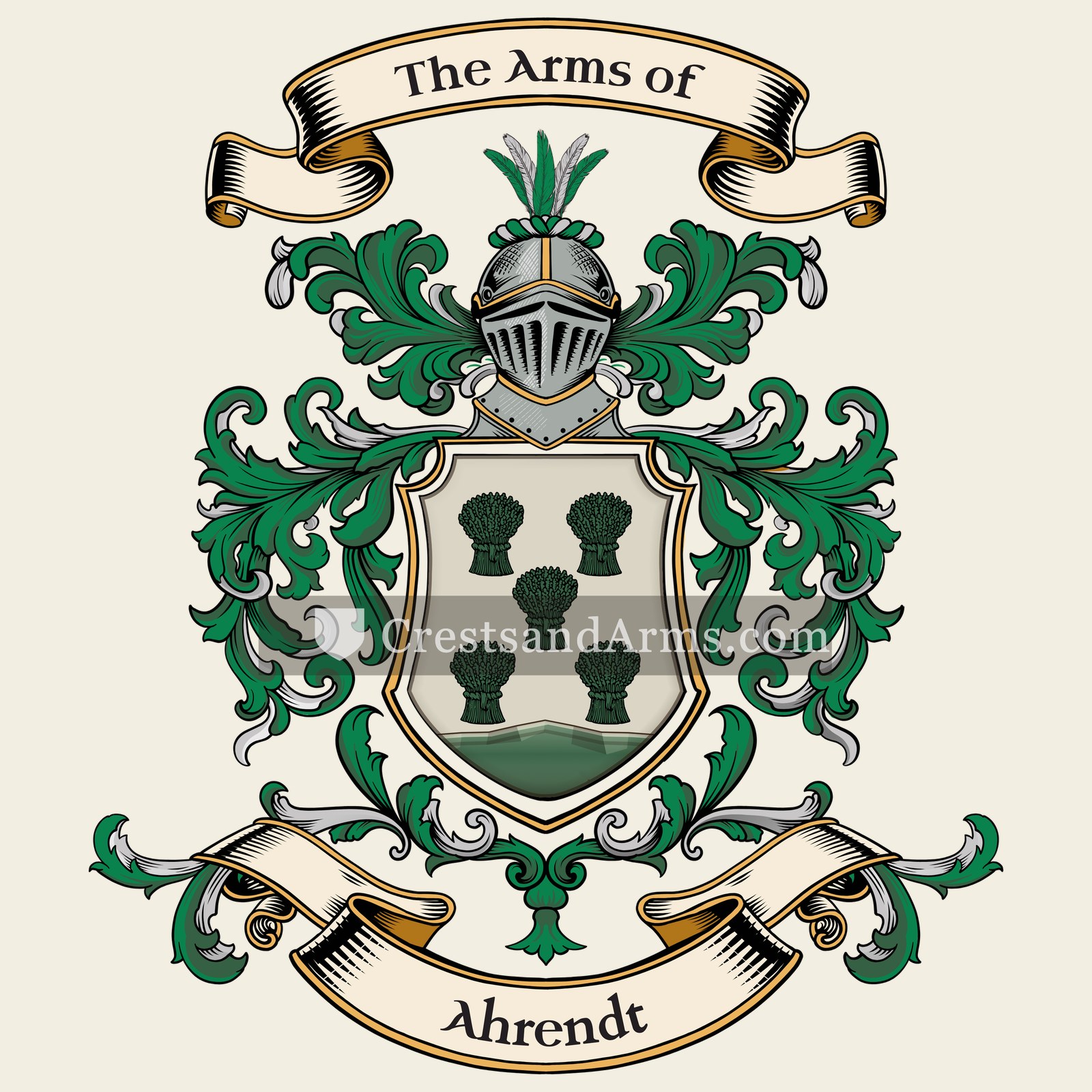
Symbols on this shield
wheatsheafPlenty, and the harvest of one's own labour
Colours
Silver (Argent)Means: Peace and sincerity
Green (Vert)Means: Hope
Historical info
Source
Sir Bernard Burke, The General Armory of England, Scotland, Ireland and Wales, London: Harrison & Sons, 1884
Blazon (the actual original written record)
“Ar. five stalks of rye growing out of ground in base vert”
Germanyc. 1765
Digital archive packCoat of arms PNG, gold border print PDF, vector SVG and the certificate of authenticity. Sent to your email in minutes.
Map of Germany showing where the Ahrendt arms are recorded
The Ahrendt arms were recorded in Germany, c. 1765.
Arms such as these were typically recorded in Bavaria.
Bavaria was a country of old landed families and walled market towns. Estates passed down the same line for centuries, and both the landowners and the leading townsmen kept arms, which is why so many Bavarian names sit in the registers.
This is where the arms were entered in the register. Families often moved to other parts of the country, so the same name can turn up in more than one region.
The body that granted and recorded arms in Germany in this period.
Francis I, Holy Roman Emperor
Sovereign of the period
Francis I, Holy Roman Emperor
1745–1765
Reigning in Britain when the Ahrendt arms are first recorded.
How Arms Worked in Germany
In the Holy Roman Empire, coats of arms were often granted to individuals by the Emperor or his representatives. These arms were then passed down through the generations to all legitimate descendants of the original holder. Younger branches of a family usually kept the same shield design without needing to change it, as the arms belonged to the entire lineage.
Granting authority
The Holy Roman Emperor held the sole power to grant new coats of arms throughout his vast imperial territories.
How they got arms
Families typically obtained their coats of arms through a formal imperial grant or by proving their noble status to the authorities.
Where arms were recorded
These grants were officially recorded in the Imperial Chancery registers, which began keeping formal records of such honors during the Middle Ages.
The family's standing
Recorded among the armigerous families of Germany.
Origin & History of the Ahrendt Family in Germany
The surname Ahrendt is a variant of the Germanic name Arnold, which traces its roots back to the Old High German words for eagle and power. By the time the family was established in Bavaria in 1765, the name had evolved through regional dialects to reflect the linguistic shifts common in southern Germany. During this period, families often lived in small agricultural communities where their surname served as a link to their ancestral heritage and their standing within the local parish. Because the name was tied to the concept of strength and leadership, it was frequently passed down through generations of families who worked as skilled tradespeople or landowners. As the family settled into the Bavarian landscape, they became part of the social fabric of the region, contributing to the local economy and the development of their village life. Their presence in 1765 marks a period of stability where record-keeping by local churches began to solidify the spelling and history of the name for future generations.
Related Branches & Arms
Root word
Arnwald
A combination of eagle and power or ruler.
This name
AhrendtDerived from a Germanic personal name meaning eagle ruler or eagle power.
also spelled
Arends
Ahrendes
Documented Sources
J. B. Rietstap, Armorial Général, Gouda: G. B. van Goor Zonen, 1884–87
Reaney, P.H. and Wilson, R.M., A Dictionary of English Surnames, 1991
The National Archives, Naturalization and Denization Records, HO 1 series
Kent Archives, Parish Registers of Kent, P series
Digital archive packCoat of arms PNG, gold border print PDF, vector SVG and the certificate of authenticity. Sent to your email in minutes.


 mountThe ground held, and steadfastness upon it
 wheatsheafPlenty, and the harvest of one's own labour
 mountThe ground held, and steadfastness upon it
 wheatsheafPlenty, and the harvest of one's own labour