Map of France showing where the Alagondar arms are recorded
The Alagondar arms were recorded in Provence, c. 1663.
Provence was old country, with towns dating to the Romans and families who traced their land back nearly as far. Its gentry were many and long-settled, and long settlement is what fills a register.
This is where the arms were entered in the register. Families often moved to other parts of the country, so the same name can turn up in more than one region.
The body that granted and recorded arms in France in this period.
Louis XIV of France
Sovereign of the period
Louis XIV of France
1643–1715
Reigning in France when the Alagondar arms are first recorded.
How Arms Worked in France
In France, a coat of arms was a mark of honor that passed down through the male line to all legitimate descendants. Families often used the same shield without changes to show their shared heritage. If a branch wanted to stand out, they could add a small mark to their shield to show their specific place in the family tree.
Granting authority
The Juge d'armes de France acted as the official authority that regulated and verified coats of arms across the country.
How they got arms
Families typically inherited their arms from ancestors, though they could also receive them through royal grants or by proving their noble status.
Where arms were recorded
Coats of arms were officially recorded in the Armorial Général de France, which began its main collection in the year 1696.
The family's standing
Recorded among the armigerous families of Provence.
Origin & History of the Alagondar Family in France
The history of the Alagondar family in France is rooted in the sun-drenched landscapes of Provence, where records confirm their presence as early as 1663. During this period, the region was a vibrant center of trade and agriculture, and families like the Alagondars were often deeply connected to the local land and the shifting social structures of the seventeenth century. The name itself suggests a connection to the linguistic traditions of Southern France, likely evolving from local dialects that blended Latin roots with regional influences. As residents of Provence, early family members lived through a time of significant cultural change as the French monarchy sought to centralize power over the independent-minded southern provinces. By settling in this area, the Alagondars became part of a long lineage of families who helped shape the rural and civic identity of the Mediterranean coast. Their presence in the historical record during the mid-1600s highlights their role as established members of a community that balanced traditional provincial life with the growing influence of the French state.
Coat of Arms & Family Crest Details
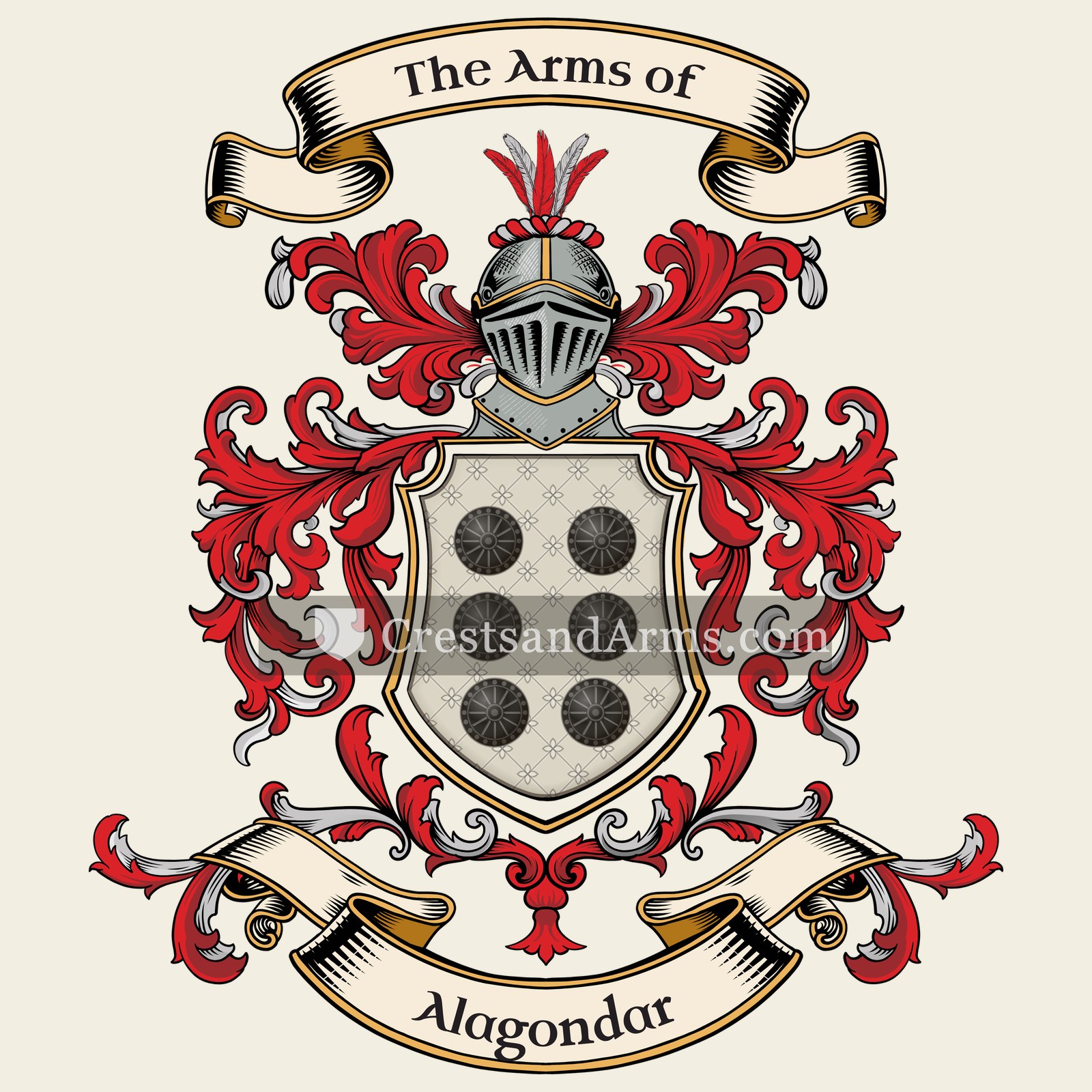
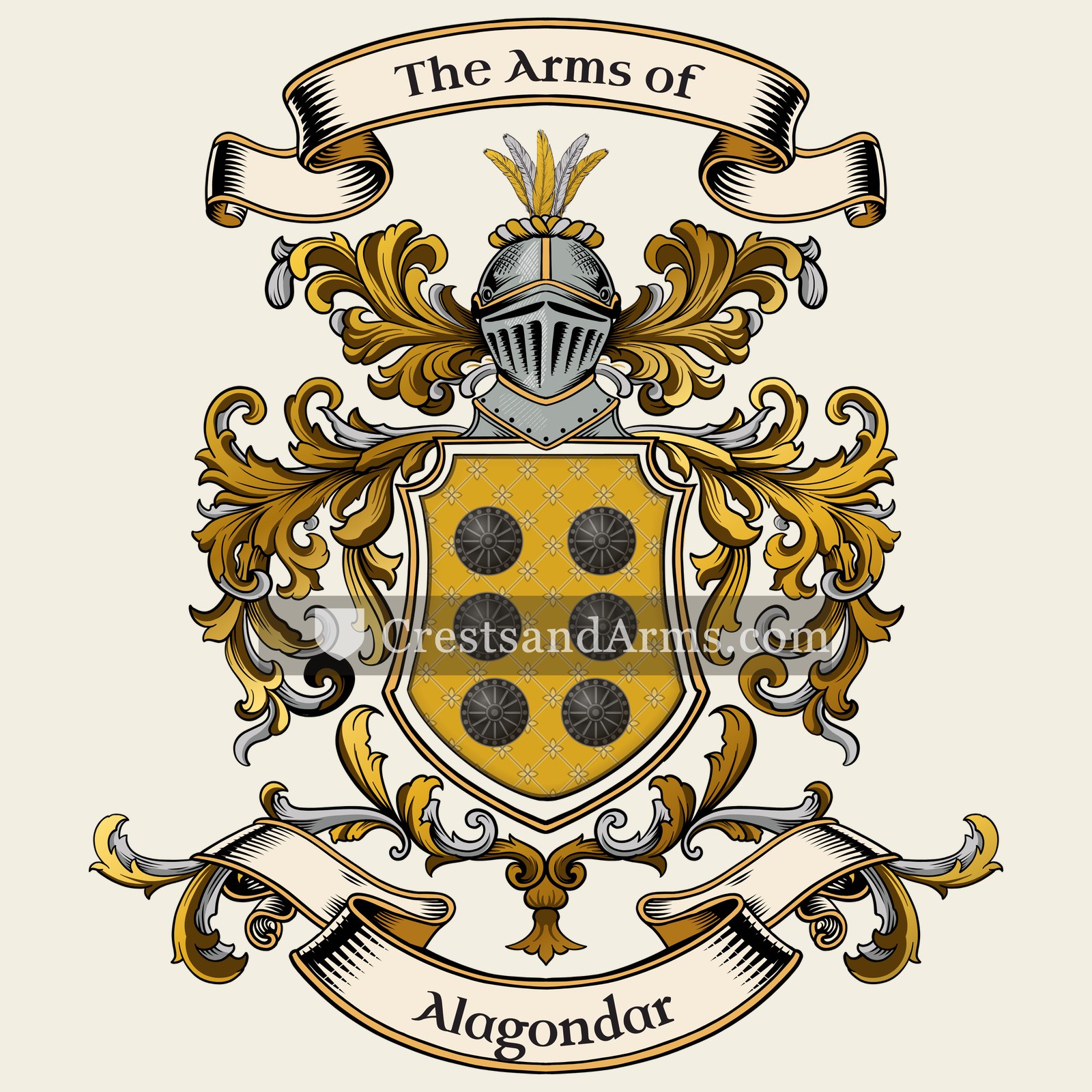
Symbols on this shield
roundelA coin, and one who has been to the crusades
Colours
Gold (Or)Means: Generosity
Black (Sable)Means: Constancy
Historical info
Source
J. B. Rietstap, Armorial Général, Gouda: G. B. van Goor Zonen, 1884–87
Blazon (the actual original written record)
“D'or à six tourt. de sa., 2, 2 et 2.”
SicilySicily, c. 1775
Digital archive packCoat of arms PNG, gold border print PDF, vector SVG and the certificate of authenticity. Sent to your email in minutes.
Map of Italy showing where the Alagondar arms are recorded
The Alagondar arms were recorded in Sicily, c. 1775.
Sicily was ruled in turn by Normans, Germans, French and Spanish, and each left landed families behind. The island kept formal lists of its noble houses, which is why so many Sicilian names carry recorded arms.
This is where the arms were entered in the register. Families often moved to other parts of the country, so the same name can turn up in more than one region.
The body that granted and recorded arms in Italy in this period.
Alvise Giovanni Mocenigo
Sovereign of the period
Alvise Giovanni Mocenigo
1763–1778
Reigning in France when the Alagondar arms are first recorded.
How Arms Worked in Italy
In the Italian states, coats of arms were often used by noble families to show their status and history. These symbols were passed down through the generations to all legitimate male descendants. Younger branches of a family usually kept the original design but sometimes added small changes to distinguish their specific line from the main branch.
Granting authority
Various local rulers and city governments controlled the use of coats of arms across the different Italian states.
How they got arms
Families often assumed their own arms or received them as official grants from local lords, popes, or city councils.
Where arms were recorded
Arms were recorded in local city archives or private family books rather than in one single national register.
The family's standing
Recorded among the armigerous families of Sicily.
Origin & History of the Alagondar Family in Italy
The Alagondar family name traces its roots to the sun-drenched landscapes of Sicily, where documented records confirm the presence of family members by 1775. During this period, Sicily was a crossroads of Mediterranean culture, influenced by centuries of shifting rule and agricultural tradition. Families like the Alagondars often lived in rural or semi-urban communities where they were deeply tied to the local land and the seasonal rhythms of the island. The name itself reflects the linguistic blending common in southern Italy, where local dialects often merged with influences from neighboring regions and historical settlers. While the exact origins of the surname remain a subject of local study, its appearance in eighteenth-century Sicilian records suggests that the family was well-established within the social fabric of the island long before the modern era. These early ancestors likely navigated the complexities of Sicilian life during the Bourbon period, contributing to the local economy and community development that defined the region at the time.
Related Branches & Arms
Root word
Ala-gondar
Derived from Germanic elements meaning all and battle or war.
This name
AlagondarA surname likely signifying a warrior or one who fights in all battles.
also spelled
Alagony
Alagonya
Alagonea
Documented Sources
J. B. Rietstap, Armorial Général, Gouda: G. B. van Goor Zonen, 1884–87
Archives départementales des Bouches-du-Rhône, Registres paroissiaux et d'état civil (1663)
Boyer, Jean, La vie quotidienne en Provence au XVIIe siècle, 1972
Cubells, Monique, La Provence des lumières: Les parlementaires d'Aix au XVIIIe siècle, 1984
Digital archive packCoat of arms PNG, gold border print PDF, vector SVG and the certificate of authenticity. Sent to your email in minutes.


 roundelA coin, and one who has been to the crusades
 roundelA coin, and one who has been to the crusades