A record of documented arms, meaning and origin, researched for the Albers family lines. Documented in 2 countries.
Reg. 3353 · German, A–C
Coat of Arms & Family Crest Details
Symbols on this shield
treeLife, endurance and deep roots
Colours
Silver (Argent)Means: Peace and sincerity
Green (Vert)Means: Hope
Historical info
Source
J. B. Rietstap, Armorial Général, Gouda: G. B. van Goor Zonen, 1884–87
Blazon (the actual original written record)
“D'arg. à l'arbre arr. de sin. C.: l'arbre; et un oiseau au nat., tenant en son bec une branche feuillée de sin., posé au pied dudit arbre, br. sur le fût.”
GermanyBrème, c. 1765
Digital archive packCoat of arms PNG, gold border print PDF, vector SVG and the certificate of authenticity. Sent to your email in minutes.
Map of Germany showing where the Albers arms are recorded
The Albers arms were recorded in Brème, c. 1765.
This is where the arms were entered in the register. Families often moved to other parts of the country, so the same name can turn up in more than one region.
The body that granted and recorded arms in Germany in this period.
Francis I, Holy Roman Emperor
Sovereign of the period
Francis I, Holy Roman Emperor
1745–1765
Reigning in Germany when the Albers arms are first recorded.
How Arms Worked in Germany
In the Holy Roman Empire, coats of arms were often granted to individuals by the Emperor or his representatives. These arms were then passed down through the generations to all legitimate descendants of the original holder. Younger branches of a family usually kept the same shield design without needing to change it, as the arms belonged to the entire lineage.
Granting authority
The Holy Roman Emperor held the sole power to grant new coats of arms throughout his vast imperial territories.
How they got arms
Families typically obtained their coats of arms through a formal imperial grant or by proving their noble status to the authorities.
Where arms were recorded
These grants were officially recorded in the Imperial Chancery registers, which began keeping formal records of such honors during the Middle Ages.
The family's standing
Recorded among the armigerous families of Germany.
Origin & History of the Albers Family in Germany
The surname Albers originated as a patronymic name, which means it was derived from the given name of a father or ancestor. It is a shortened form of the Germanic name Albert, which combines the elements for noble and bright. By the time members of the family were documented in the city of Bremen in 1765, the name had already been established across Northern Germany for several centuries. During the Middle Ages, families in this region often adopted these types of names to distinguish themselves within growing urban populations. As the Albers family settled in Bremen, they became part of a vibrant trading hub where such names were common among merchants and craftsmen. The persistence of the name in regional records suggests that the family maintained a stable presence in the area as the local culture transitioned through the early modern period.
Coat of Arms & Family Crest Details
Symbols on this shield
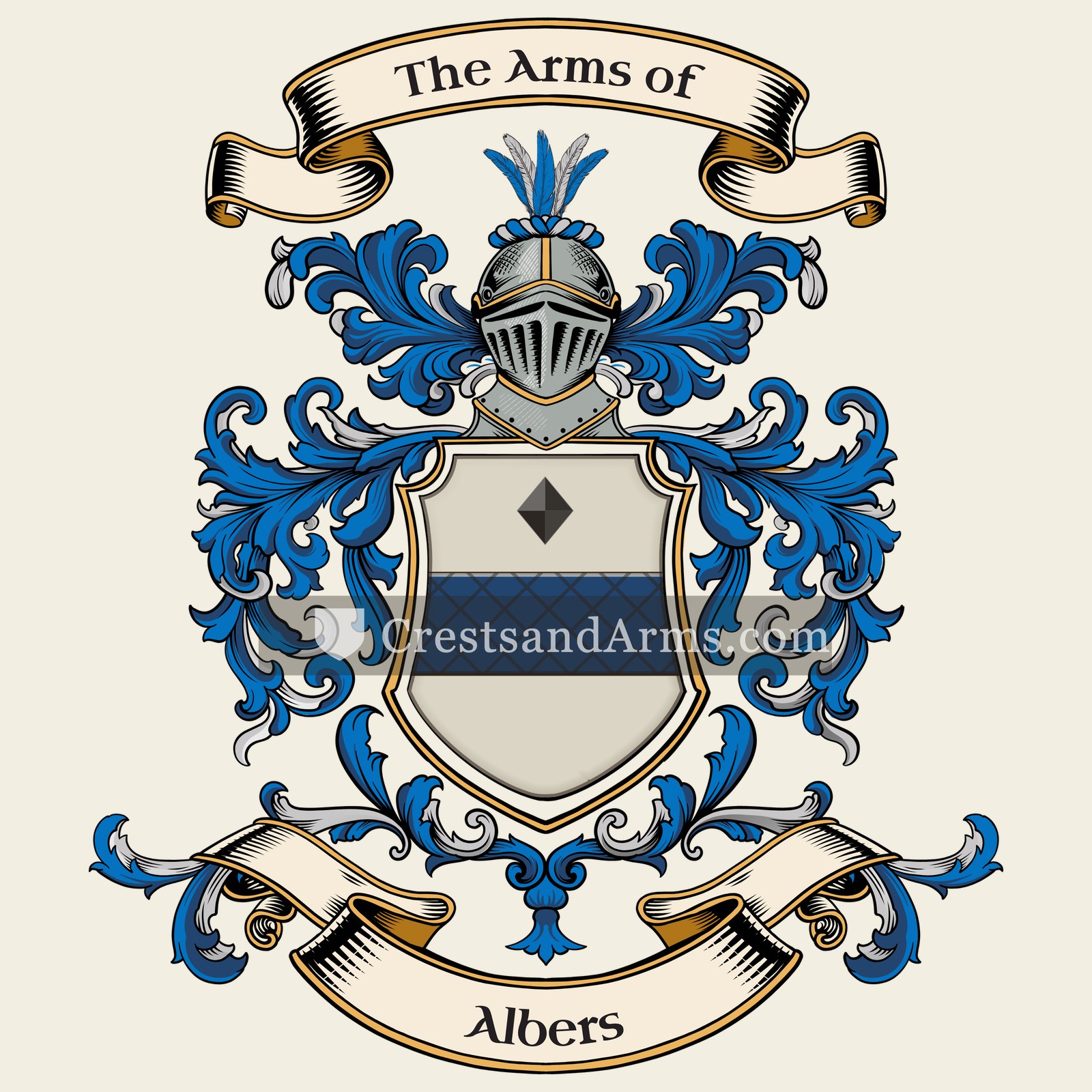
fessThe military belt, and readiness to serve
lozengeHonour and nobility, and the arms of a woman
Colours
Silver (Argent)Means: Peace and sincerity
Blue (Azure)Means: Loyalty and truth
Black (Sable)Means: Constancy
Historical info
Source
J. B. Rietstap, Armorial Général, Gouda: G. B. van Goor Zonen, 1884–87
Blazon (the actual original written record)
“D'arg. à la fasce d'azur, acc. en chef d'une los. de sa.”
Netherlandsc. 1815
Digital archive packCoat of arms PNG, gold border print PDF, vector SVG and the certificate of authenticity. Sent to your email in minutes.
Map of Netherlands showing where the Albers arms are recorded
The Albers arms were recorded in Netherlands, c. 1815.
Arms such as these were typically recorded in Friesland.
Friesland was low, wet country on the northern coast of the Netherlands, farmed by families who had held the same land for centuries. Free landholders were unusually common there, and a free landholder could carry arms.
This is where the arms were entered in the register. Families often moved to other parts of the country, so the same name can turn up in more than one region.
Region
Friesland
First recorded
1815
Granting Authority for the Albers Arms
Hoge Raad van Adel
Photograph made by me · CC BY-SA 3.0
The body that granted and recorded arms in Netherlands in this period.
William I of the Netherlands
Sovereign of the period
William I of the Netherlands
1815–1840
Reigning in Germany when the Albers arms are first recorded.
How Arms Worked in Netherlands
In the Netherlands, coats of arms were often used by noble families and those who held specific public offices. These arms were passed down through the generations to legitimate descendants. Younger branches of a family usually kept the original design without needing to add special marks. This system ensured that the family identity remained clear and consistent over many years.
Granting authority
The Hoge Raad van Adel is the official body that regulates and manages noble titles and coats of arms in the Netherlands.
How they got arms
Families typically obtained their coats of arms through official royal grants or by proving their long-standing historical use of the symbols.
Where arms were recorded
Coats of arms are officially recorded in the registers held by the Hoge Raad van Adel, which began its work in 1814.
The family's standing
Recorded among the armigerous families of Netherlands.
Origin & History of the Albers Family in Netherlands
The name Albers is a classic patronymic surname, which means it originated as a way to identify a person as the son of someone named Albert. In the Netherlands, particularly in the northern province of Friesland, these types of names became common as families sought to establish a clear identity within their local communities. By the early 19th century, the Napoleonic administration required citizens to register permanent surnames for tax and military purposes. Records from 1815 show that families bearing the name Albers were already well-established in the Frisian landscape, living as farmers or tradespeople who contributed to the regional economy. Because Friesland has a unique cultural and linguistic history, the name often blended into the local social fabric while maintaining its Germanic roots. These early ancestors lived through a time of great transition as the Netherlands moved from a collection of provinces into a unified kingdom.
Albers Meaning & Related Branches
Root word
Adalbert
Derived from Germanic elements meaning noble and bright or famous.
This name
AlbersA patronymic form signifying son of the noble and bright one.
also spelled
Alberz
Alberts
Documented Sources
J. B. Rietstap, Armorial Général, Gouda: G. B. van Goor Zonen, 1884–87
Bahlow, Hans, Deutsches Namenlexikon: Familien- und Vornamen nach Ursprung und Sinn erklärt, 1967
Heintze, Albert, Die deutschen Familiennamen: geschichtlich, geographisch, sprachlich, 1903
Staatsarchiv Bremen, Kirchenbücher der Stadt Bremen (St. Ansgarii), 1765
Digital archive packCoat of arms PNG, gold border print PDF, vector SVG and the certificate of authenticity. Sent to your email in minutes.


 treeLife, endurance and deep roots
 treeLife, endurance and deep roots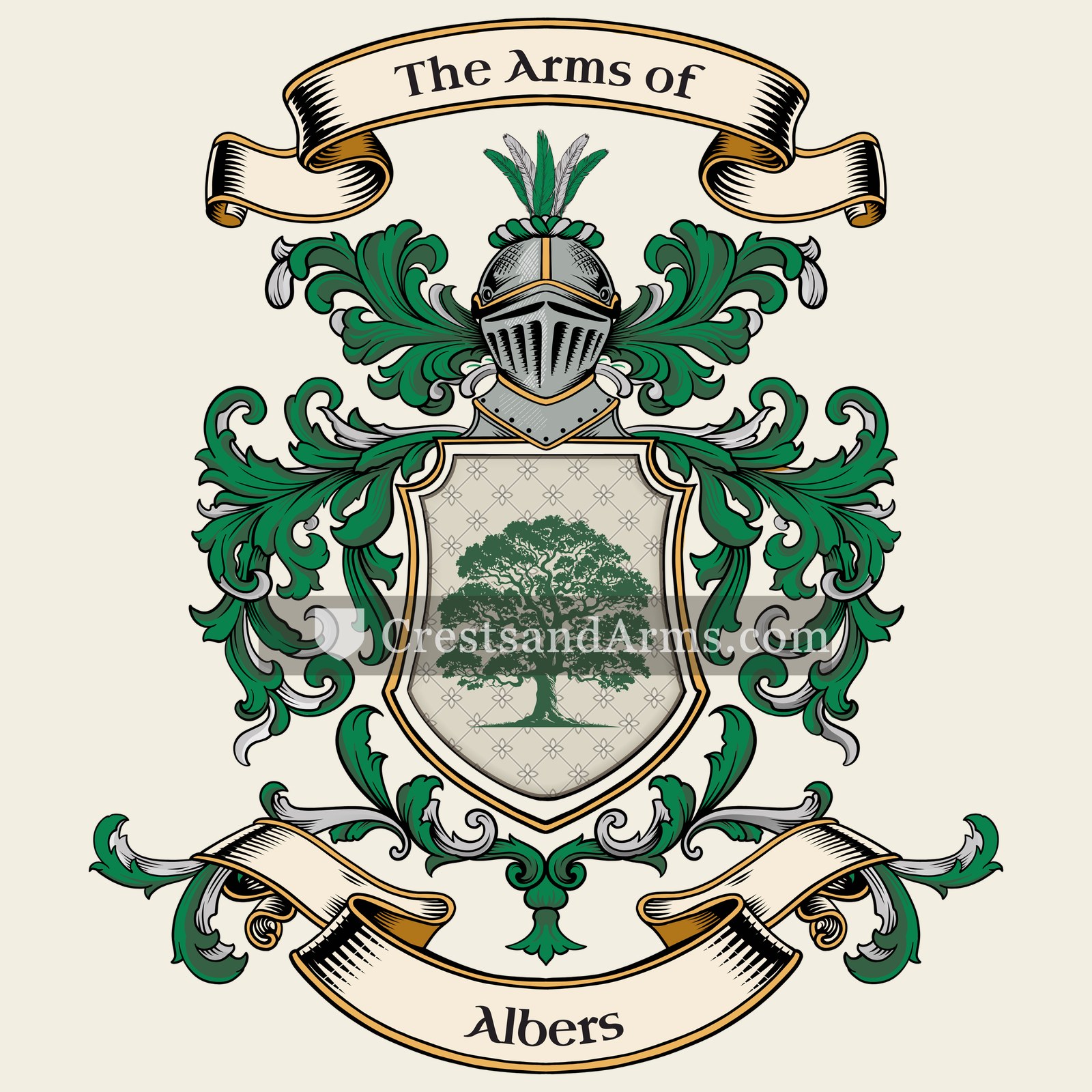


 fessThe military belt, and readiness to serve
 lozengeHonour and nobility, and the arms of a woman