Map of England showing where the Albery arms are recorded
The Albery arms were recorded in Berks, c. 1590.
Berkshire sat on the road west from London with the royal castle at Windsor in the middle of it. Court families bought estates within reach, and an estate near the court almost always came with a coat of arms.
This is where the arms were entered in the register. Families often moved to other parts of the country, so the same name can turn up in more than one region.
The body that granted and recorded arms in England in this period.
Elizabeth I of England
Sovereign of the period
Elizabeth I of England
1558–1603
Reigning in England when the Albery arms are first recorded.
How Arms Worked in England
English heraldry allowed arms to be shared by all legitimate descendants of the original owner. These symbols were treated as personal property that moved through the generations to all children. While the eldest son kept the original design, other family members could use the same shield without needing to change it or register their own unique versions.
Granting authority
The College of Arms in London has regulated the use of coats of arms throughout England and Wales since 1484.
How they got arms
Families typically obtained their coats of arms through a formal grant from the Crown or by proving their ancient right to them.
Where arms were recorded
All official coats of arms are recorded in the registers kept at the College of Arms, which date back to the fifteenth century.
The family's standing
Recorded among the armigerous families of Berks.
Origin & History of the Albery Family in England
The surname Albery is rooted in the ancient linguistic traditions of England, likely originating from a combination of Germanic personal names that evolved over several centuries. By the late sixteenth century, the family had established a clear presence in the county of Berkshire, with records confirming their residence there by 1590. During this period, families often lived in small rural communities where they were closely tied to the local land and parish life. The name itself likely served as a way to identify individuals within these tight-knit village settings as populations began to grow and move. As the family settled into the region, they became part of the local social fabric, leaving behind traces in administrative documents that help historians map their movement through the English countryside.
Albery Meaning & Related Branches
Root word
Adalberht
A Germanic compound meaning noble and bright.
This name
AlberyDerived from an Old English personal name signifying noble brilliance or illustrious nobility.
also spelled
Albury
Alberie
Related arms
Hobeckrecorded with Albery, same area
Documented Sources
Sir Bernard Burke, The General Armory of England, Scotland, Ireland and Wales, London: Harrison & Sons, 1884
Berkshire Record Office, Parish Registers of Berkshire, 1590
Reaney, P.H., A Dictionary of English Surnames, 1958
Digital archive packCoat of arms PNG, gold border print PDF, vector SVG and the certificate of authenticity. Sent to your email in minutes.


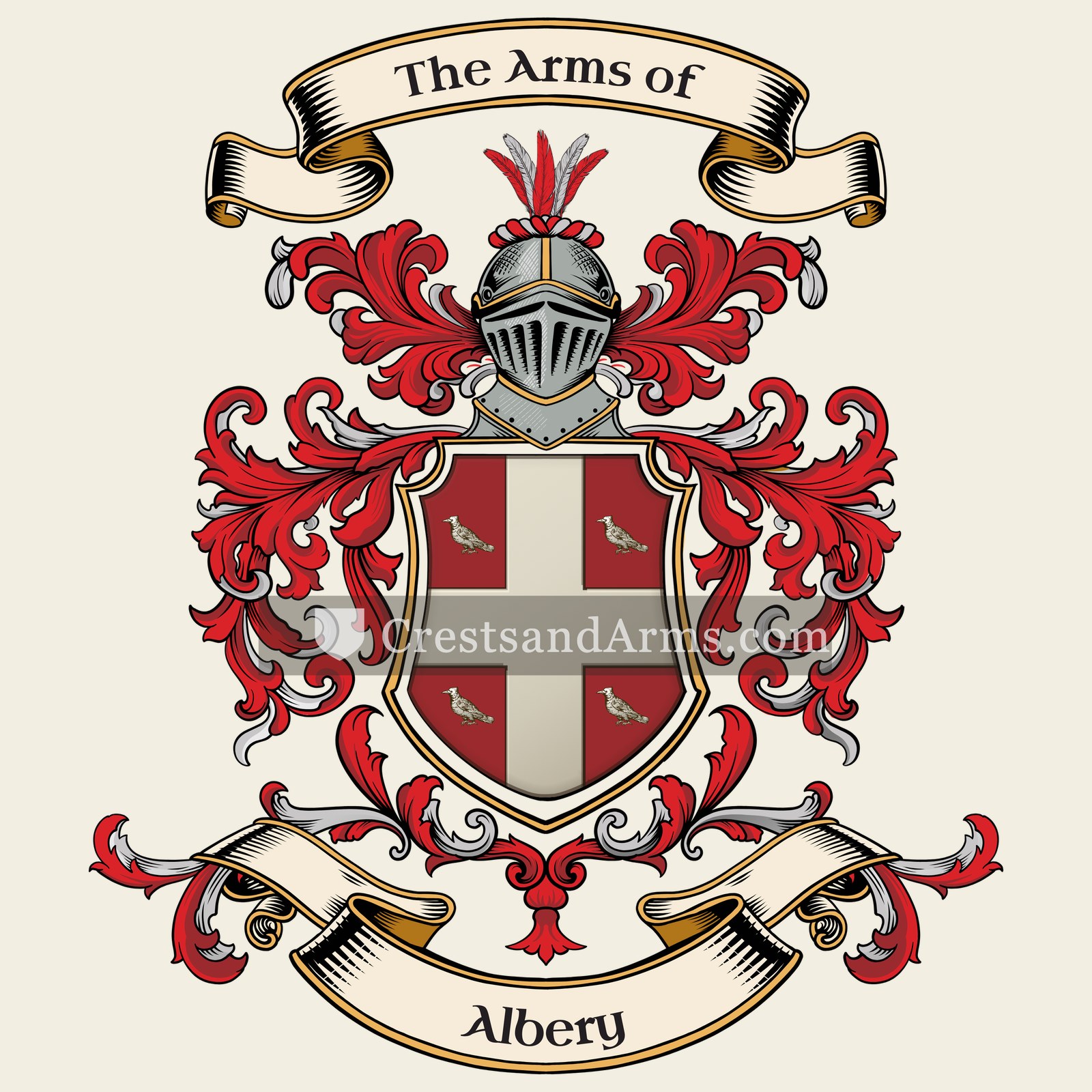
 cross symbolChristian faith and service
 dovePeace, love and the Holy Spirit
 cross symbolChristian faith and service
 dovePeace, love and the Holy Spirit