Map of Switzerland showing where the Albi arms are recorded
The Albi arms were recorded in Granges Valais, c. 1745.
This is where the arms were entered in the register. Families often moved to other parts of the country, so the same name can turn up in more than one region.
The body that granted and recorded arms in Switzerland in this period.
How Arms Worked in Switzerland
In Switzerland, coats of arms were not restricted to the nobility and were often adopted by common citizens and families. These symbols were passed down through generations to show family identity. When branches of a family grew, they often changed small details of the design to distinguish their own line from the original group.
Granting authority
Cantonal and civic authorities managed the use of coats of arms within their specific regions and local jurisdictions.
How they got arms
Families typically assumed their own coats of arms based on local custom rather than receiving them from a central monarch.
Where arms were recorded
Arms were recorded in various cantonal and civic registers starting from the fourteenth century throughout the Swiss region.
The family's standing
Recorded among the armigerous families of Switzerland.
Origin & History of the Albi Family in Switzerland
The family name Albi is deeply rooted in the historical landscape of the Alpine regions, with records confirming the presence of the family in the village of Granges as early as 1745. During this period, the name was likely tied to the geography of the area, as families often adopted surnames based on the specific mountain settlements or local landmarks where they lived and worked. Life in Granges during the eighteenth century revolved around subsistence farming and communal mountain traditions, which required families to be highly self-sufficient and closely connected to their neighbors. As the Albi family established themselves in this high-altitude environment, they became part of a tight-knit social structure that relied on shared resources and seasonal labor. Over generations, the name became a permanent fixture of the local community, reflecting the resilience and stability of those who built their lives in the challenging terrain of the Swiss Alps.
Albi Meaning & Related Branches
Root word
Albus
Latin word meaning white or bright.
This name
AlbiA topographical or descriptive name referring to someone who lived near white cliffs or had a fair complexion.
also spelled
Albie
Alby
Related arms
Albyvariant spelling
de Preuxrecorded with Albi, same area
Musardrecorded with Albi, same area
Torneryrecorded with Albi, same area
Documented Sources
J. B. Rietstap, Armorial Général, Gouda: G. B. van Goor Zonen, 1884–87
Archives de l'État du Valais, Registres paroissiaux de la commune de Granges (1745)
Guex, François, Histoire du Valais, 1920
Suter, Karl, Die schweizerischen Familiennamen, 1976
Digital archive packCoat of arms PNG, gold border print PDF, vector SVG and the certificate of authenticity. Sent to your email in minutes.


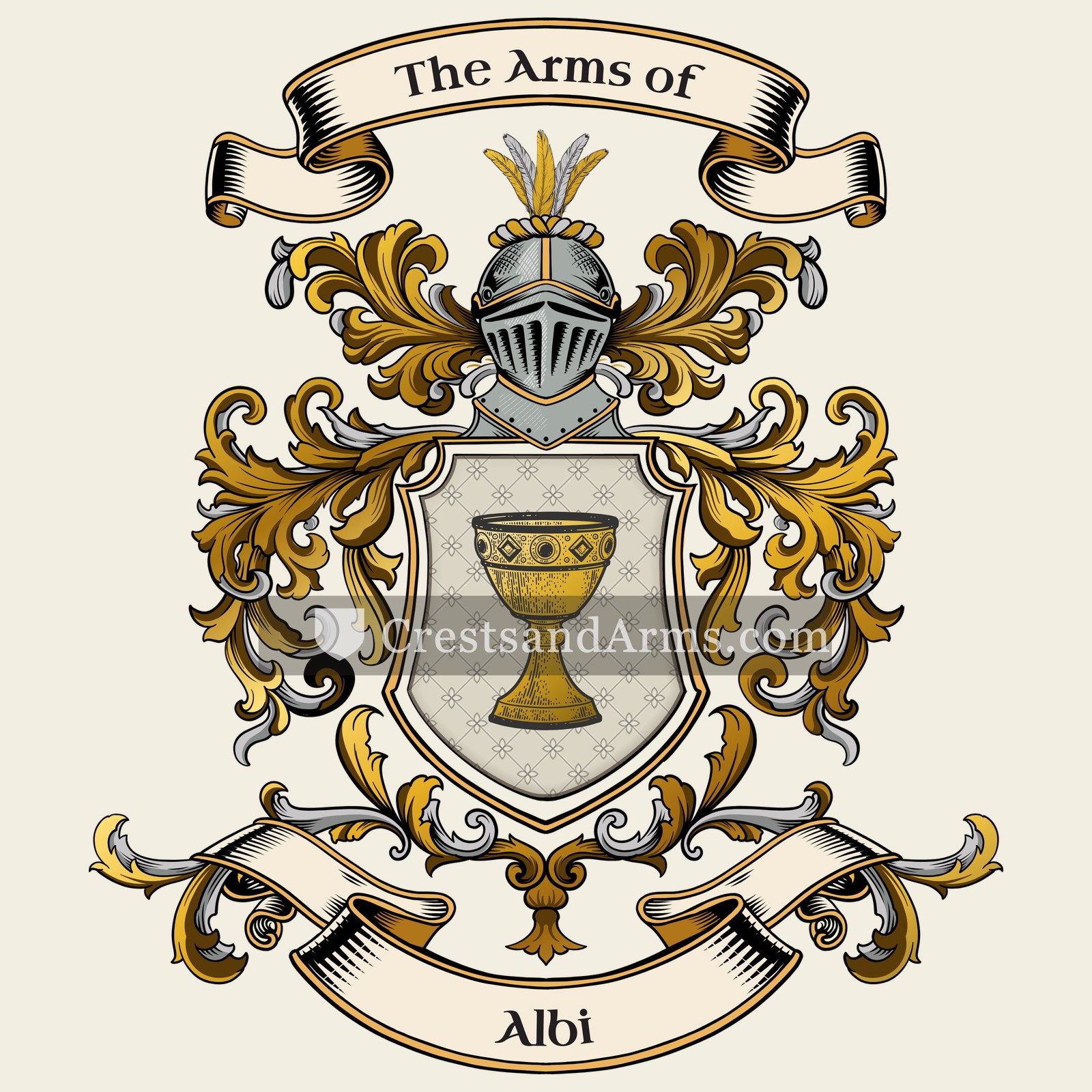
 cupFaith, office, and a trust discharged
 cupFaith, office, and a trust discharged