Map of France showing where the Albury arms are recorded
The Albury arms were recorded in Hertfordshire, c. 1621.
This is where the arms were entered in the register. Families often moved to other parts of the country, so the same name can turn up in more than one region.
The body that granted and recorded arms in France in this period.
Louis XIII of France
Sovereign of the period
Louis XIII of France
1617–1643
Reigning in France when the Albury arms are first recorded.
How Arms Worked in France
In France, a coat of arms was a mark of honor that passed down through the male line to all legitimate descendants. Families often used the same shield without changes to show their shared heritage. If a branch wanted to stand out, they could add a small mark to their shield to show their specific place in the family tree.
Granting authority
The Juge d'armes de France acted as the official authority that regulated and verified coats of arms across the country.
How they got arms
Families typically inherited their arms from ancestors, though they could also receive them through royal grants or by proving their noble status.
Where arms were recorded
Coats of arms were officially recorded in the Armorial Général de France, which began its main collection in the year 1696.
The family's standing
Recorded among the armigerous families of Hertfordshire.
Origin & History of the Albury Family in France
The surname Albury is a locative name, meaning it was originally taken from a specific place rather than a trade or a personal characteristic. The name is derived from the village of Albury located in the county of Hertfordshire, England. In Old English, the name translates to "old fort" or "old earthwork," which suggests that the original family members lived near an ancient defensive site. By the year 1621, records confirm that individuals bearing the name were well-established in this region. During this era, families often adopted the name of their home village as a way to identify themselves when they traveled or moved to neighboring towns. This practice helped local officials and neighbors distinguish between different groups living in the rural English countryside.
Albury Meaning & Related Branches
Root word
Alberic
Derived from the Germanic elements for elf and ruler.
This name
AlburyA locational surname referring to a settlement or fortress belonging to an elf-ruler.
also spelled
Hide
Albury
Hyde
Heed Dalbury
Documented Sources
J. B. Rietstap, Armorial Général, Gouda: G. B. van Goor Zonen, 1884–87
Gover, J.E.B., Mawer, A., and Stenton, F.M., The Place-Names of Hertfordshire, 1938
Hertfordshire Archives and Local Studies, Hertfordshire Parish Registers, 1621
Digital archive packCoat of arms PNG, gold border print PDF, vector SVG and the certificate of authenticity. Sent to your email in minutes.


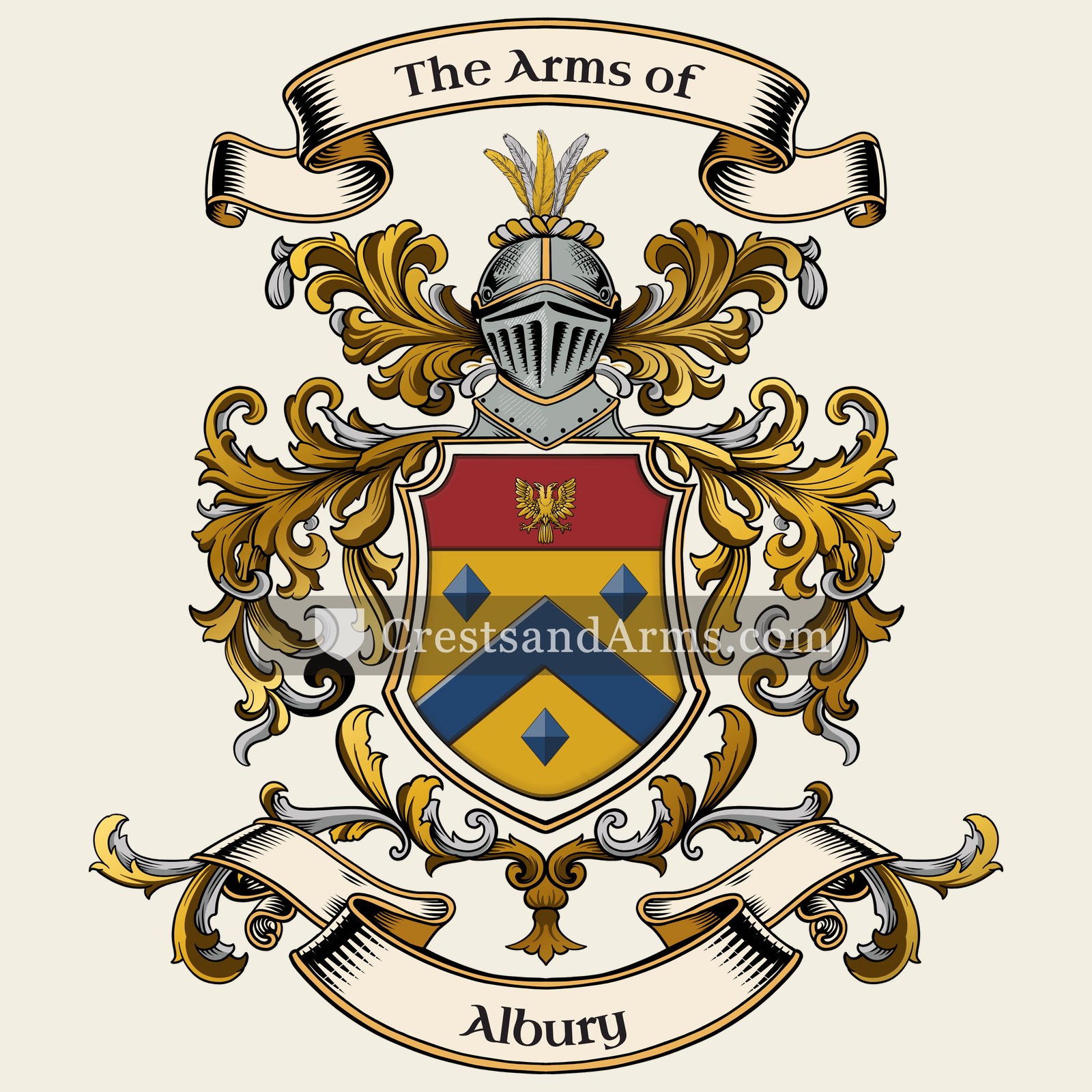
 chevronProtection, and faithful service completed
 chiefAuthority, wisdom and dominion
 lozengeHonour and nobility, and the arms of a woman
 eagleNobility, strength and a keen mind
 chevronProtection, and faithful service completed
 chiefAuthority, wisdom and dominion
 lozengeHonour and nobility, and the arms of a woman
 eagleNobility, strength and a keen mind