Map of England showing where the Alcocer arms are recorded
The Alcocer arms were recorded in Chester, c. 1449.
Cheshire was governed apart from the rest of England for much of its history, with its own courts and its own gentry. That separateness bred a strong local landed class, and landed families carried arms.
This is where the arms were entered in the register. Families often moved to other parts of the country, so the same name can turn up in more than one region.
The body that granted and recorded arms in England in this period.
Henry VI of England
Sovereign of the period
Henry VI of England
1422–1461
Reigning in England when the Alcocer arms are first recorded.
How Arms Worked in England
English heraldry allowed arms to be shared by all legitimate descendants of the original owner. These symbols were treated as personal property that moved through the generations to all children. While the eldest son kept the original design, other family members could use the same shield without needing to change it or register their own unique versions.
Granting authority
The College of Arms in London has regulated the use of coats of arms throughout England and Wales since 1484.
How they got arms
Families typically obtained their coats of arms through a formal grant from the Crown or by proving their ancient right to them.
Where arms were recorded
All official coats of arms are recorded in the registers kept at the College of Arms, which date back to the fifteenth century.
The family's standing
Recorded among the armigerous families of Chester.
Origin & History of the Alcocer Family in England
The family name Alcocer originates from the Iberian Peninsula and is rooted in the Arabic term al-qusayr, which translates to the little palace or the small fortress. This name was likely used as a topographical identifier for people who lived near a specific fortified site or a small castle. By the mid-15th century, the family had established a presence in England, with records confirming members of the Alcocer family were living in Chester by 1449. Their arrival in this historic city suggests they were part of the active trade networks connecting the Mediterranean world to the ports of Northwest England. Over time, the family integrated into the local community, transitioning from their origins as travelers or merchants into established residents of the region.
Related Branches & Arms
Root word
Al-Qusayr
Arabic for the small palace or the fortress.
This name
AlcocerA locational surname derived from Spanish place names referring to a small castle or fortified dwelling.
also spelled
Alcox
Documented Sources
Sir Bernard Burke, The General Armory of England, Scotland, Ireland and Wales, London: Harrison & Sons, 1884
Cheshire Archives and Local Studies, Chester City Guild Records (1449)
Pidal, Ramón Menéndez, Toponimia prerrománica hispana (1952)
García de Cortázar, José Ángel, La sociedad rural en la España medieval (1988)
Digital archive packCoat of arms PNG, gold border print PDF, vector SVG and the certificate of authenticity. Sent to your email in minutes.


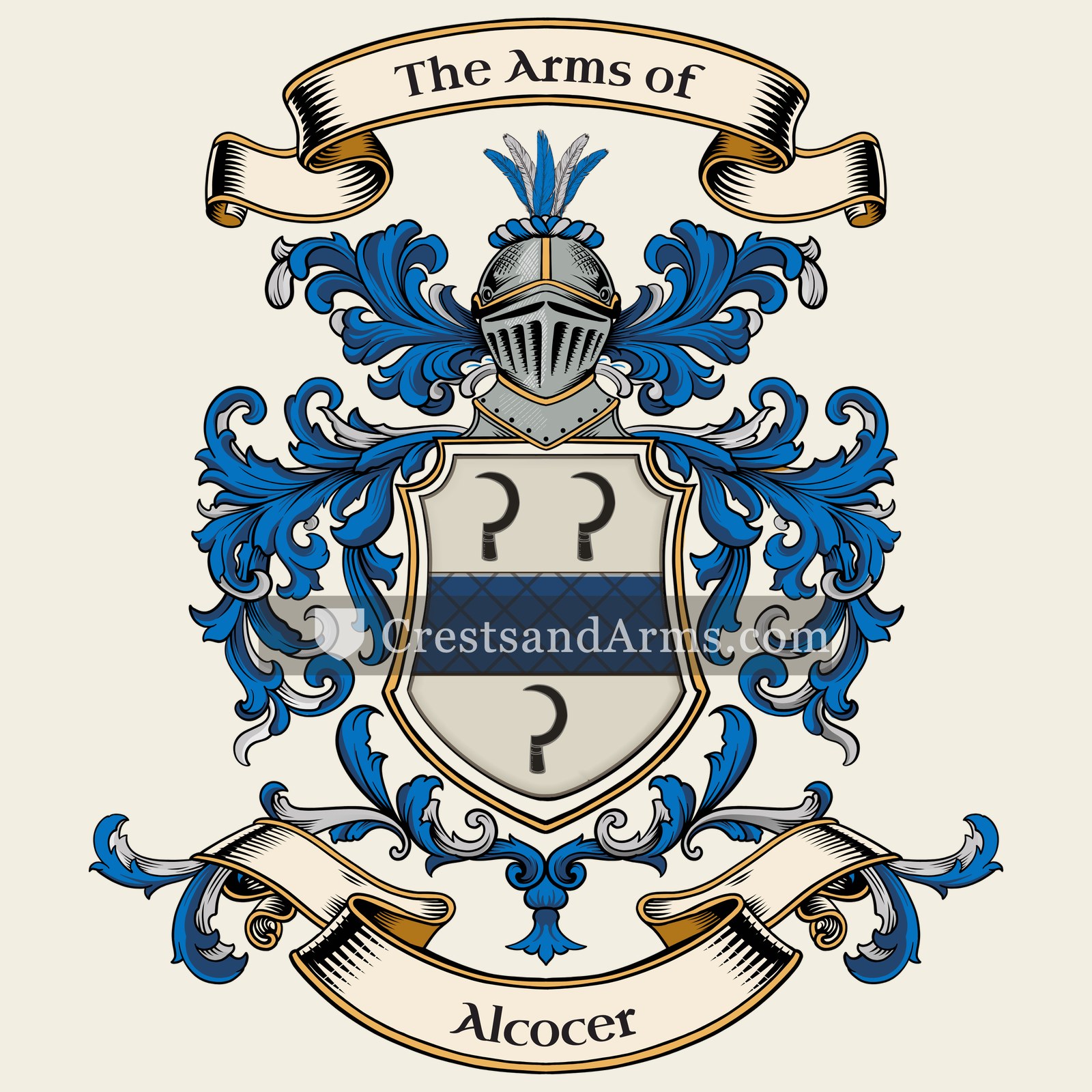
 fessThe military belt, and readiness to serve
 sickleThe harvest, and the reaping of what was sown
 fessThe military belt, and readiness to serve
 sickleThe harvest, and the reaping of what was sown