A record of documented arms, meaning and origin, researched for the Aledo family lines. Documented in 2 countries.
Reg. 6368 · Spanish, A–C
Coat of Arms & Family Crest Details
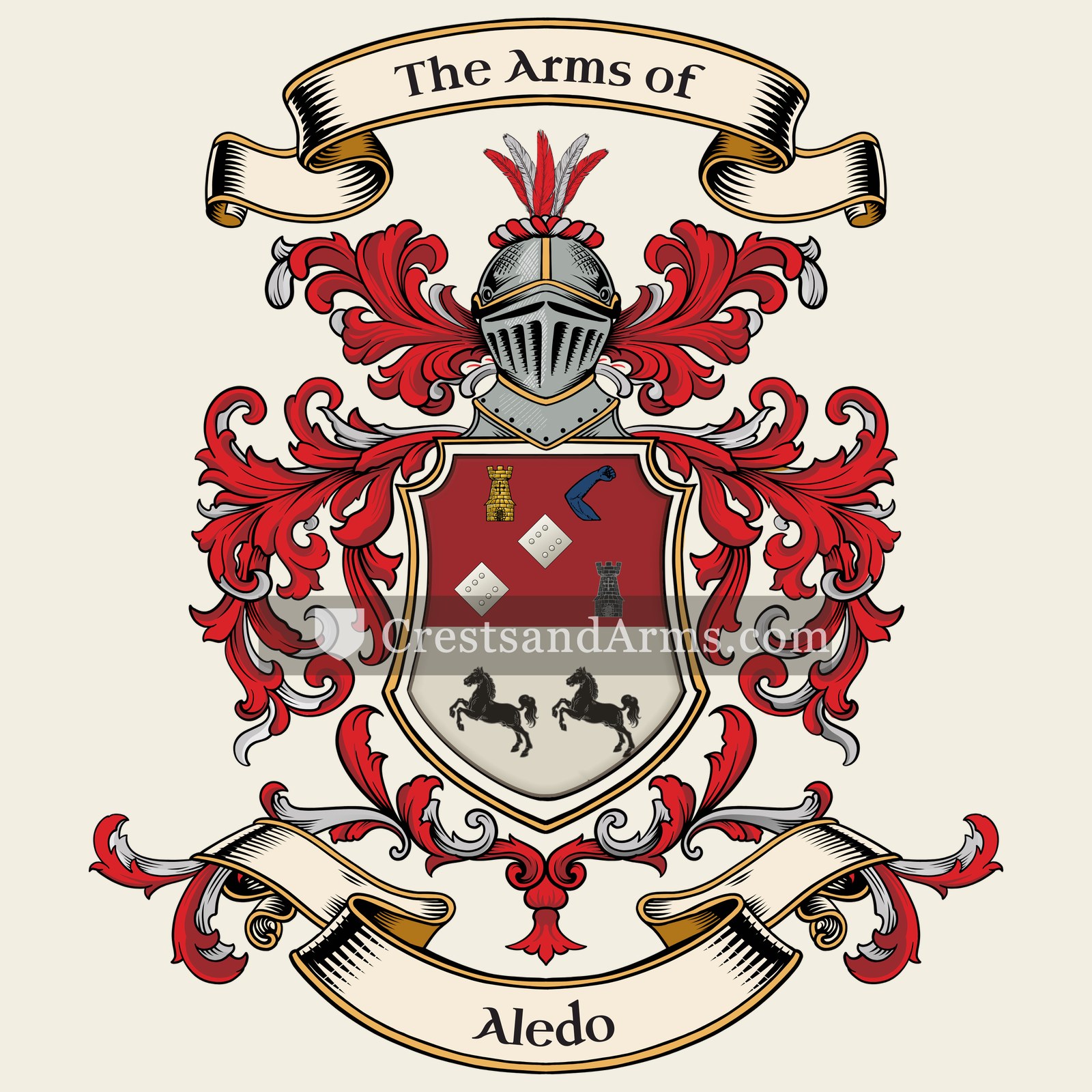
Symbols on this shield
towerGrandeur and solidity, and a stronghold defended
escutcheonA shield within a shield, and a claim inherited
Colours
Red (Gules)Means: Military strength
Silver (Argent)Means: Peace and sincerity
Historical info
Source
J. B. Rietstap, Armorial Général, Gouda: G. B. van Goor Zonen, 1884–87
Blazon (the actual original written record)
“Ec.: aux 1 et 4 de gu. à la tour d'arg., sommée d'une tourelle du même; aux 2 et 3 d'arg. à cinq écussons de gu., 2, 1 et 2, chacun ch. de cinq bes. d'arg., 2, 1 et 2.”
Spainc. 1722
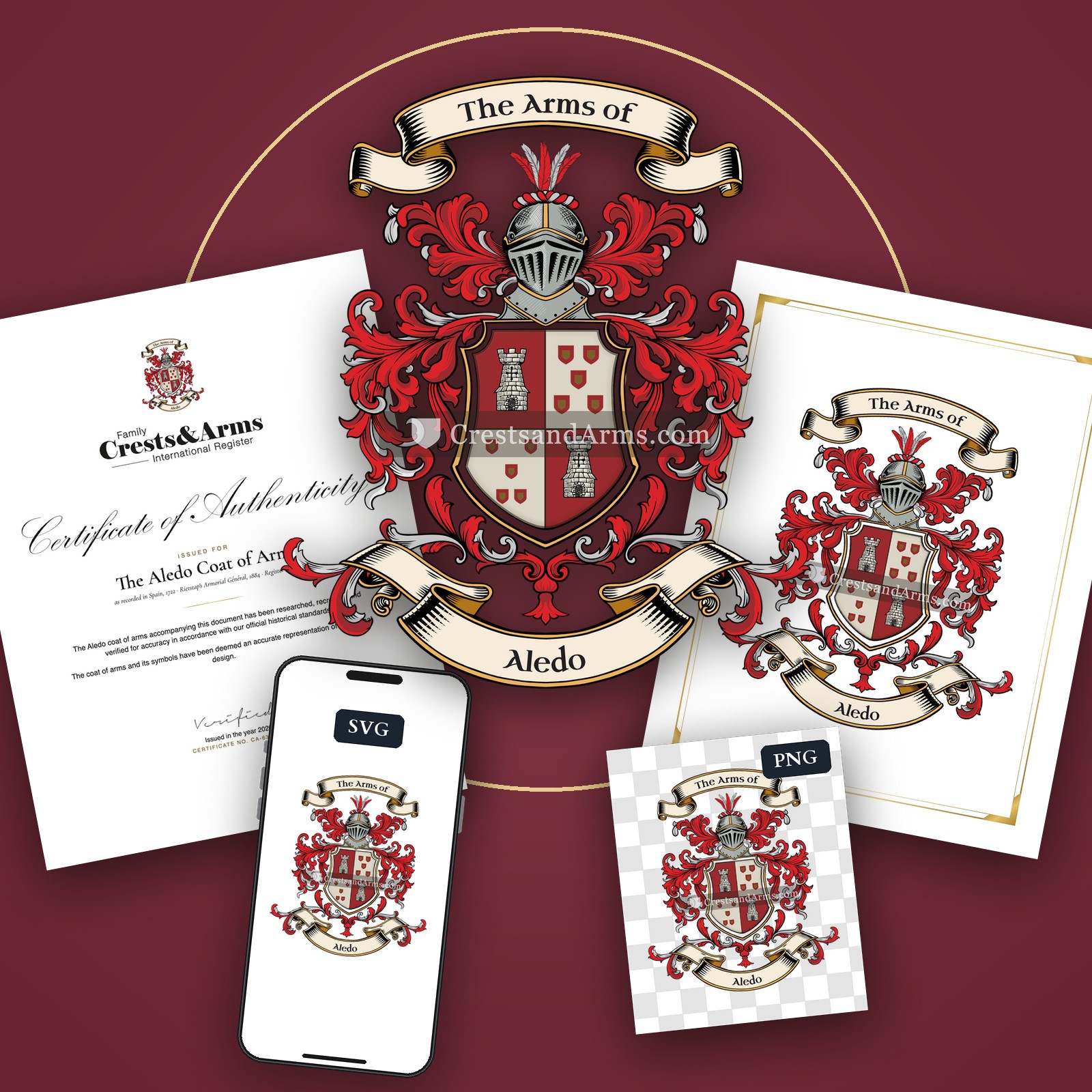
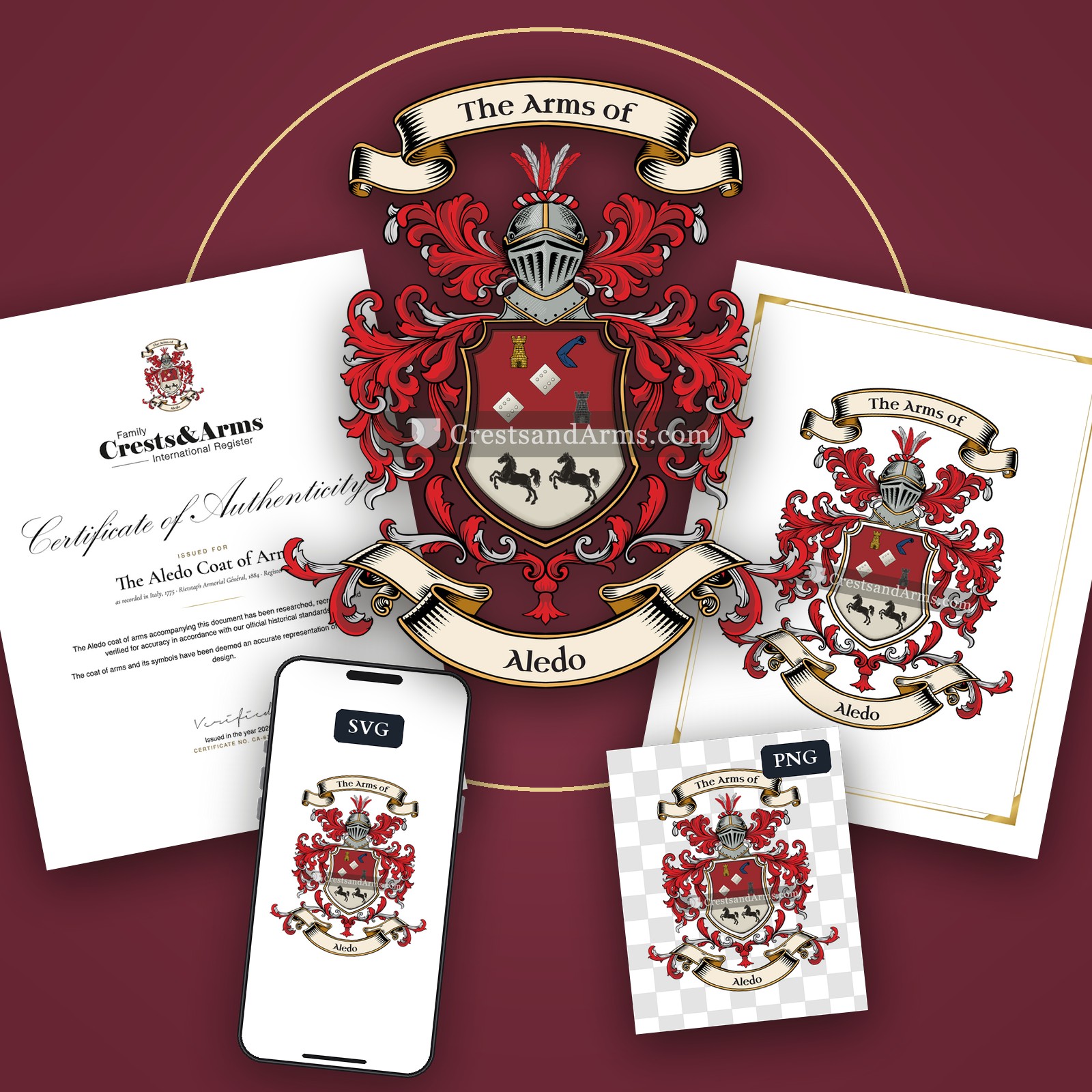
Digital archive packCoat of arms PNG, gold border print PDF, vector SVG and the certificate of authenticity. Sent to your email in minutes.
Map of Spain showing where the Aledo arms are recorded
The Aledo arms were recorded in Spain, c. 1722.
Arms such as these were typically recorded in Castile.
Castile was the heart of Spain and the source of most of its noble families. Land won in the long wars against the Moors was granted out to fighting men, and a man granted land was granted arms along with it.
This is where the arms were entered in the register. Families often moved to other parts of the country, so the same name can turn up in more than one region.
The body that granted and recorded arms in Spain in this period.
Philip V of Spain
Sovereign of the period
Philip V of Spain
1714–1724
Reigning in Spain when the Aledo arms are first recorded.
How Arms Worked in Spain
In Spain, a coat of arms was considered a form of property that belonged to the entire family line. These arms were passed down from a father to all his children equally. Younger branches of the family usually kept the original design without needing to add any special marks to distinguish their specific line.
Granting authority
The Cronista Rey de Armas was the official body that regulated and granted coats of arms throughout Spain.
How they got arms
Families often obtained their arms through royal grants or by proving their noble status to the official heraldic authority.
Where arms were recorded
Coats of arms were officially recorded in the registers of the Cronista Rey de Armas starting in 1496.
The family's standing
Recorded among the armigerous families of Spain.
Origin & History of the Aledo Family in Spain
The family name Aledo is deeply rooted in the geography of southeastern Spain, specifically taking its name from the historic town of Aledo in the Region of Murcia. During the medieval period, this area served as a vital frontier between Christian and Moorish territories, and the town itself was a strategic stronghold governed by the Order of Santiago. While the name originated from this specific location, members of the family eventually migrated north to the heart of the Spanish kingdom. By 1722, records confirm that the family had established a firm presence in the region of Castile. This migration was common for families seeking new opportunities in the administrative and agricultural centers of the Spanish interior during the eighteenth century. As the family settled into Castilian life, they integrated into the local social fabric, moving away from their origins in the southern borderlands to become part of the broader history of the Spanish plateau.
Coat of Arms & Family Crest Details
Symbols on this shield
towerGrandeur and solidity, and a stronghold defended
armA person of action, industrious and laborious
dieFortune met with a steady hand
horseReadiness to serve king and country
Colours
Red (Gules)Means: Military strength
Silver (Argent)Means: Peace and sincerity
Gold (Or)Means: Generosity
Blue (Azure)Means: Loyalty and truth
Black (Sable)Means: Constancy
Historical info
Source
J. B. Rietstap, Armorial Général, Gouda: G. B. van Goor Zonen, 1884–87
Blazon (the actual original written record)
“Coupé: au 1 de gu. à la tour d'or, ouv. de sa.; au dextrochère, arm. d'azur, sortant de la porte vers sen., tenant une épée; ladite tour accostée de deux dés d'arg. marqués chacun de cinq points de sa.; au 2 d'arg. à deux chevaux galopants de sa., l'un br. sur l'autre.”
SicilySicily, c. 1775
Digital archive packCoat of arms PNG, gold border print PDF, vector SVG and the certificate of authenticity. Sent to your email in minutes.
Map of Italy showing where the Aledo arms are recorded
The Aledo arms were recorded in Sicily, c. 1775.
Sicily was ruled in turn by Normans, Germans, French and Spanish, and each left landed families behind. The island kept formal lists of its noble houses, which is why so many Sicilian names carry recorded arms.
This is where the arms were entered in the register. Families often moved to other parts of the country, so the same name can turn up in more than one region.
The body that granted and recorded arms in Italy in this period.
Alvise Giovanni Mocenigo
Sovereign of the period
Alvise Giovanni Mocenigo
1763–1778
Reigning in Spain when the Aledo arms are first recorded.
How Arms Worked in Italy
In the Italian states, coats of arms were often used by noble families to show their status and history. These symbols were passed down through the generations to all legitimate male descendants. Younger branches of a family usually kept the original design but sometimes added small changes to distinguish their specific line from the main branch.
Granting authority
Various local rulers and city governments controlled the use of coats of arms across the different Italian states.
How they got arms
Families often assumed their own arms or received them as official grants from local lords, popes, or city councils.
Where arms were recorded
Arms were recorded in local city archives or private family books rather than in one single national register.
The family's standing
Recorded among the armigerous families of Sicily.
Origin & History of the Aledo Family in Italy
The family name Aledo carries a deep connection to the island of Sicily, where documented records confirm the presence of family members as early as 1775. During this period, Sicily was a vibrant crossroads of Mediterranean culture, shaped by centuries of shifting rule and agricultural development. Families living in the region at this time were often tied to the land or to the bustling trade networks that connected Sicilian ports to the rest of Italy and beyond. While the name likely evolved from local geographic markers or descriptive nicknames common in the Italian language, its survival through the late eighteenth century suggests a stable presence within the local community. By living in Sicily during the 1700s, the Aledo family participated in a society defined by its unique blend of traditions, religious customs, and the slow transition toward modern administrative record-keeping.
Aledo Meaning & Related Branches
Root word
Aletum
Latin term referring to a place where ale or grain is grown.
This name
AledoA topographic surname denoting someone who lived near a field of grain.
also spelled
Aleddo
Aledoh
Aledou
Documented Sources
J. B. Rietstap, Armorial Général, Gouda: G. B. van Goor Zonen, 1884–87
López de Coca Castañer, José Enrique. La frontera granadina en el siglo XV. 1989
Torres Fontes, Juan. El señorío de Aledo y Totana. 1974
Archivo Histórico Nacional, Órdenes Militares, Santiago
Archivo General de Simancas, Registro del Sello de Corte
Digital archive packCoat of arms PNG, gold border print PDF, vector SVG and the certificate of authenticity. Sent to your email in minutes.


 towerGrandeur and solidity, and a stronghold defended
 escutcheonA shield within a shield, and a claim inherited
 towerGrandeur and solidity, and a stronghold defended
 escutcheonA shield within a shield, and a claim inherited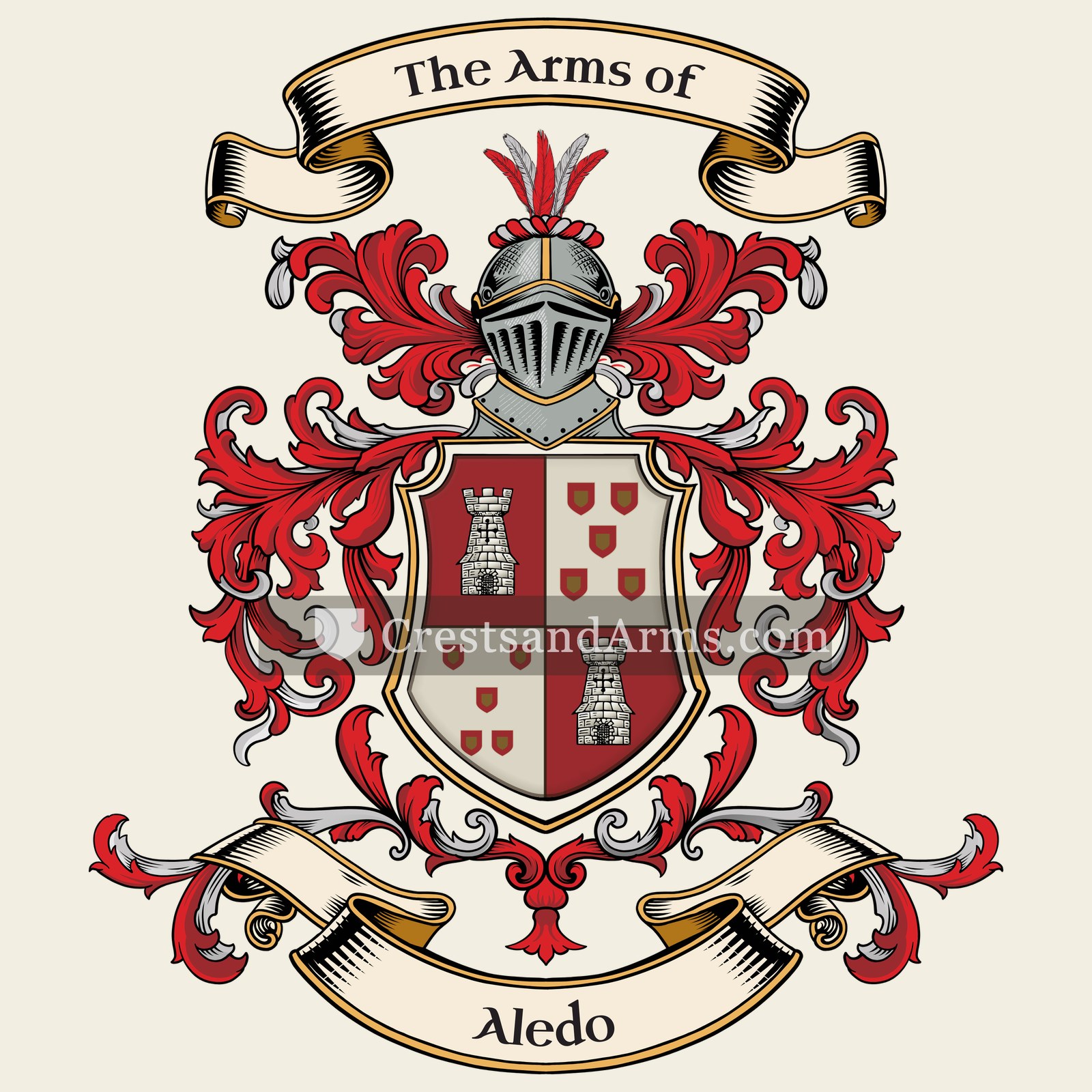


 armA person of action, industrious and laborious
 dieFortune met with a steady hand
 horseReadiness to serve king and country