Map of Germany showing where the Aler arms are recorded
The Aler arms were recorded in Germany, c. 1875.
Arms such as these were typically recorded in Bavaria.
Bavaria was a country of old landed families and walled market towns. Estates passed down the same line for centuries, and both the landowners and the leading townsmen kept arms, which is why so many Bavarian names sit in the registers.
This is where the arms were entered in the register. Families often moved to other parts of the country, so the same name can turn up in more than one region.
The body that granted and recorded arms in Germany in this period.
Wilhelm I
Sovereign of the period
Wilhelm I
1861–1888
Reigning in Germany when the Aler arms are first recorded.
How Arms Worked in Germany
Prussian heraldry was strictly tied to social rank and noble status rather than being a free choice for every citizen. These symbols were treated as permanent family property that moved through the generations to all legitimate heirs. If a family branch wanted to change their design to stand out, they had to apply for official permission to alter their specific version of the shield.
Granting authority
The Prussian Heroldsamt acted as the central state office that managed and strictly controlled all noble titles and coats of arms.
How they got arms
Families usually obtained their arms through formal royal grants or by proving their long-standing noble status to the state authorities.
Where arms were recorded
All official coats of arms were kept in the rolls of the Prussian Heroldsamt, which functioned from 1706 until 1918.
The family's standing
Recorded among the armigerous families of Germany.
Origin & History of the Aler Family in Germany
The surname Aler is deeply rooted in the historical landscape of Bavaria, where records confirm the family was well-established by 1875. The name likely evolved as a regional variation of older German occupational or locational descriptors, reflecting the linguistic shifts common in southern Germanic territories during the nineteenth century. Families bearing this name were often integrated into the agricultural and trade-based communities of the Bavarian countryside, where they contributed to the local economy and social structure. As the region underwent significant industrial and political changes during the late 1800s, the Aler family remained part of the traditional fabric of the area. Their presence in these historical records provides a clear link to the cultural heritage of the Bavarian people during a time of rapid national transformation.
Related Branches & Arms
Root word
Adal
Old High German term meaning noble or of noble descent.
This name
AlerDerived from a shortened form of noble names, signifying a person of noble birth or character.
also spelled
Alerz
Aler
Documented Sources
J. B. Rietstap, Armorial Général, Gouda: G. B. van Goor Zonen, 1884–87


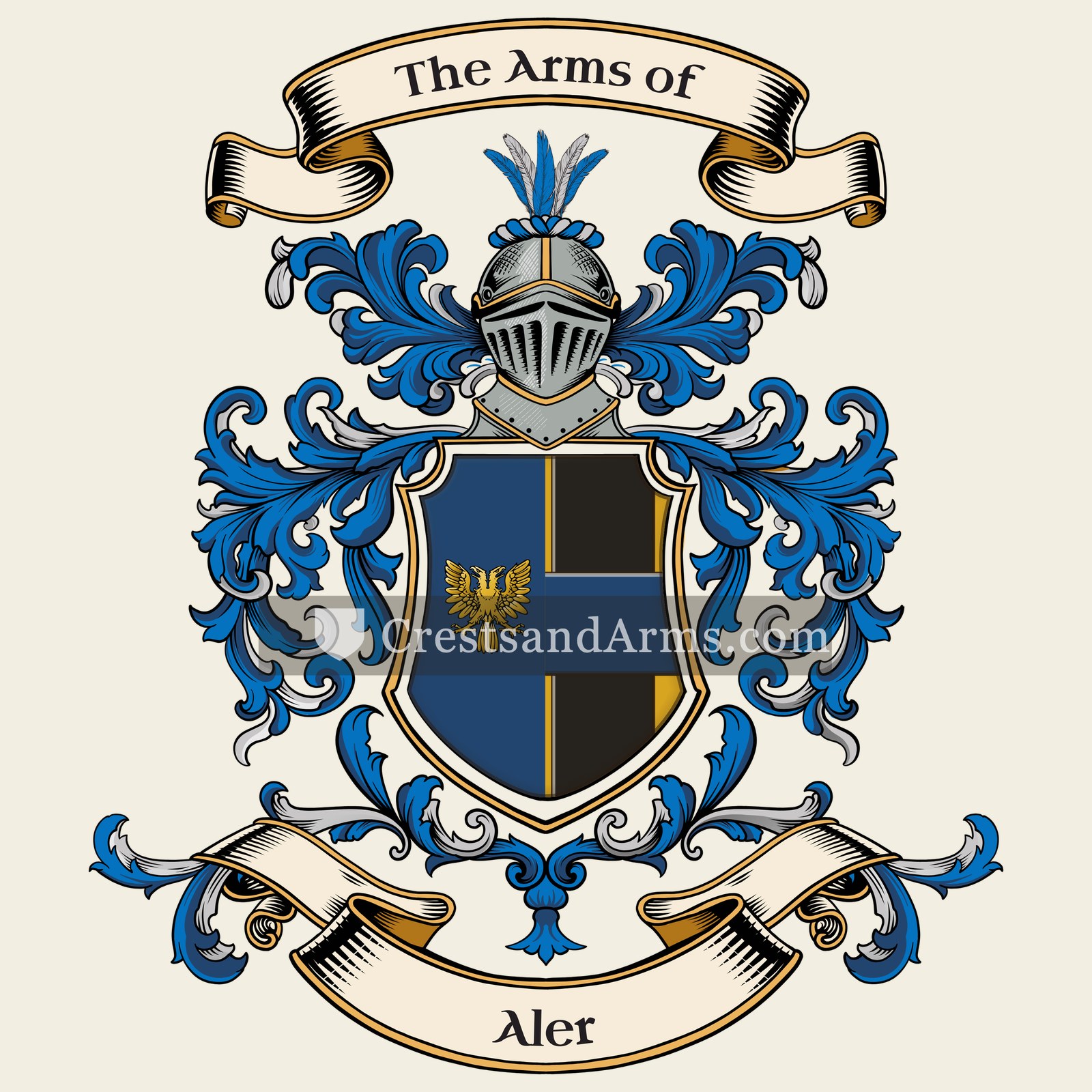
 fessThe military belt, and readiness to serve
 eagleNobility, strength and a keen mind
 fessThe military belt, and readiness to serve
 eagleNobility, strength and a keen mind