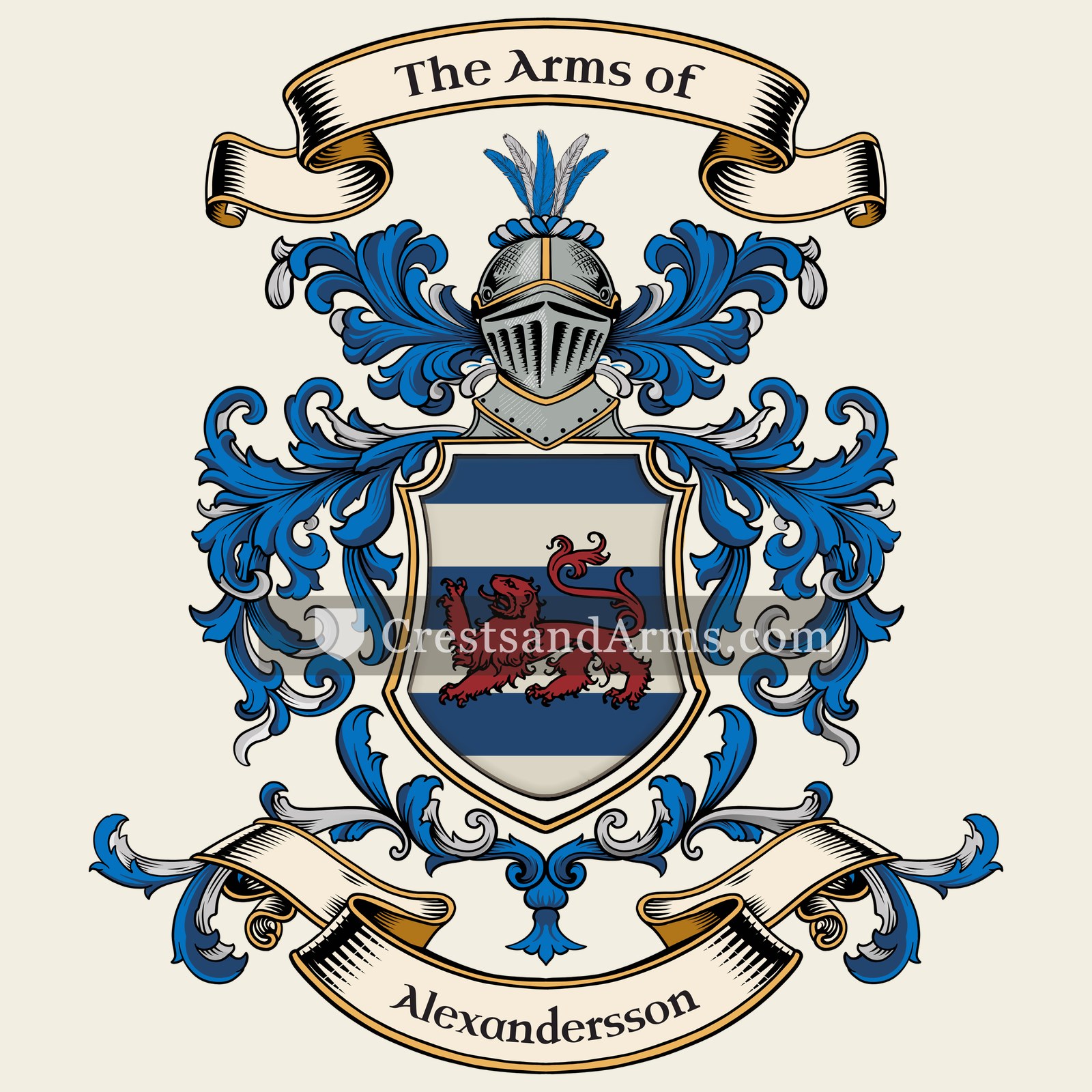
A record of documented arms, meaning and origin, researched for the Alexandersson family lines. Documented in 3 countries.
Reg. 2577 · French, A–C
Coat of Arms & Family Crest Details
Symbols on this shield
chevronProtection, and faithful service completed
cross symbolChristian faith and service
crescentHonour by the sovereign, and the second son
shipEnterprise, and a great voyage undertaken
Colours
Silver (Argent)Means: Peace and sincerity
Black (Sable)Means: Constancy
Red (Gules)Means: Military strength
Historical info
Source
J. B. Rietstap, Armorial Général, Gouda: G. B. van Goor Zonen, 1884–87
Blazon (the actual original written record)
“Ec.: aux 1 et 4 parti d'arg. et de sa.; au chev., acc. en p. d'un croiss., le tout de l'un en l'autre; aux 2 et 3 d'or à la galère de sa., les voiles ferlées, acc. de trois croix recr. au pied fiché de gu. C.: un ours assis, au nat. T.: à”
Francec. 1625
Digital archive packCoat of arms PNG, gold border print PDF, vector SVG and the certificate of authenticity. Sent to your email in minutes.
Map of France showing where the Alexandersson arms are recorded
The Alexandersson arms were recorded in France, c. 1625.
Arms such as these were typically recorded in Bretagne.
More families held coats of arms in Bretagne than anywhere else in France. The land was divided into many small estates rather than a few large ones, so far more households counted as gentry, and each needed a shield of its own to be told apart.
This is where the arms were entered in the register. Families often moved to other parts of the country, so the same name can turn up in more than one region.
The body that granted and recorded arms in France in this period.
Louis XIII of France
Sovereign of the period
Louis XIII of France
1617–1643
Reigning in France when the Alexandersson arms are first recorded.
How Arms Worked in France
In France, a coat of arms was a mark of honor that passed down through the male line to all legitimate descendants. Families often used the same shield without changes to show their shared heritage. If a branch wanted to stand out, they could add a small mark to their shield to show their specific place in the family tree.
Granting authority
The Juge d'armes de France acted as the official authority that regulated and verified coats of arms across the country.
How they got arms
Families typically inherited their arms from ancestors, though they could also receive them through royal grants or by proving their noble status.
Where arms were recorded
Coats of arms were officially recorded in the Armorial Général de France, which began its main collection in the year 1696.
The family's standing
Recorded among the armigerous families of France.
Origin & History of the Alexandersson Family in France
The family name Alexandersson carries a distinct history that traces back to the coastal region of Bretagne in 1625. While the name structure suggests a Nordic origin, its presence in northwestern France during the seventeenth century points to a period of significant maritime movement and cultural exchange between Scandinavia and the French Atlantic coast. During this era, Bretagne served as a vital hub for international trade, attracting sailors, merchants, and skilled laborers from across the North Sea. Families like the Alexanderssons likely settled in these port towns to facilitate commerce or naval logistics, eventually integrating into the local social fabric. By maintaining their traditional patronymic naming convention while living in a region dominated by French naming customs, these early family members preserved a unique link to their heritage. This persistence of their family name suggests that they held a strong sense of identity even as they adapted to the linguistic and cultural landscape of seventeenth-century France.
Coat of Arms & Family Crest Details
Symbols on this shield
paleMilitary strength, and a fortified defence
chevronProtection, and faithful service completed
mulletThe third son, and a divine quality from above
crescentHonour by the sovereign, and the second son
Colours
Silver (Argent)Means: Peace and sincerity
Black (Sable)Means: Constancy
Historical info
Source
Sir Bernard Burke, The General Armory of England, Scotland, Ireland and Wales, London: Harrison & Sons, 1884
Blazon (the actual original written record)
“Per pale ar. and sa. a chev. betw. two mullets in chief, and a crescent in base, all counterchanged”
AberdeenAuchmull · Aberdeen, c. 1748
Digital archive packCoat of arms PNG, gold border print PDF, vector SVG and the certificate of authenticity. Sent to your email in minutes.
Map of Scotland showing where the Alexandersson arms are recorded
The Alexandersson arms were recorded in Aberdeen, c. 1748.
Aberdeen was a granite trading town on the north-east coast with farming country behind it. Merchants who prospered bought estates inland, and buying an estate was what brought a family its arms.
This is where the arms were entered in the register. Families often moved to other parts of the country, so the same name can turn up in more than one region.
The body that granted and recorded arms in Scotland in this period.
George II of Great Britain
Sovereign of the period
George II of Great Britain
1727–1760
Reigning in France when the Alexandersson arms are first recorded.
How Arms Worked in Scotland
Scottish heraldry is unique because it treats a coat of arms as a piece of personal property protected by law. Only one person can own a specific design at any given time. When a family grows, the head keeps the original shield while other relatives must apply for their own distinct version with slight changes to prove their specific identity.
Granting authority
The Court of the Lord Lyon acts as the official body that regulates and controls all heraldic matters throughout Scotland.
How they got arms
Individuals obtain a legal right to their arms through a formal petition process that confirms their identity and family connection.
Where arms were recorded
All valid coats of arms are officially entered into the Public Register of All Arms and Bearings starting from 1672.
The family's standing
Recorded among the armigerous families of Aberdeen.
Origin & History of the Alexandersson Family in Scotland
The family name Alexandersson is a patronymic surname, meaning it was originally formed by combining the name Alexander with the suffix meaning son of. While this naming style is most commonly associated with Scandinavian cultures, the presence of the family in Aberdeen by 1748 suggests a history shaped by the long-standing maritime and trade connections across the North Sea. During the eighteenth century, Aberdeen served as a bustling hub for merchants and sailors traveling between Scotland and Northern Europe. It is likely that early ancestors arrived in the city through these active shipping routes, perhaps settling as traders or skilled craftsmen who integrated into the local Scottish community. Over time, the name transitioned from a descriptive reference to a permanent family identifier, marking the family as part of the diverse population that helped build the economic life of the Scottish northeast.
Coat of Arms & Family Crest Details
Symbols on this shield
lionCourage, strength and royalty
Colours
Silver (Argent)Means: Peace and sincerity
Red (Gules)Means: Military strength
Blue (Azure)Means: Loyalty and truth
Historical info
Source
Sir Bernard Burke, The General Armory of England, Scotland, Ireland and Wales, London: Harrison & Sons, 1884
Blazon (the actual original written record)
“Barry of ten (another fourteen) ar. and az. (another gu.) a lion ramp. gu. holding a battle-axe or”
KentDover · Kent, c. 1620
Digital archive packCoat of arms PNG, gold border print PDF, vector SVG and the certificate of authenticity. Sent to your email in minutes.
Map of England showing where the Alexandersson arms are recorded
The Alexandersson arms were recorded in Kent, c. 1620.
Kent sits between London and the short crossing to Europe, and the trade passing through made it wealthy. Merchant families bought land with that money, and it was landowners who took coats of arms.
This is where the arms were entered in the register. Families often moved to other parts of the country, so the same name can turn up in more than one region.
The body that granted and recorded arms in England in this period.
James VI and I
Sovereign of the period
James VI and I
1603–1625
Reigning in France when the Alexandersson arms are first recorded.
How Arms Worked in England
English heraldry allowed arms to be shared by all legitimate descendants of the original owner. These symbols were treated as personal property that moved through the generations to all children. While the eldest son kept the original design, other family members could use the same shield without needing to change it or register their own unique versions.
Granting authority
The College of Arms in London has regulated the use of coats of arms throughout England and Wales since 1484.
How they got arms
Families typically obtained their coats of arms through a formal grant from the Crown or by proving their ancient right to them.
Where arms were recorded
All official coats of arms are recorded in the registers kept at the College of Arms, which date back to the fifteenth century.
The family's standing
Recorded among the armigerous families of Kent.
Origin & History of the Alexandersson Family in England
The family name Alexandersson is a patronymic surname, which means it was originally formed to identify a person as the son of an individual named Alexander. While this naming style is deeply rooted in Scandinavian and Germanic traditions, the presence of the family in Kent by 1620 suggests a history of migration and integration into English society during the early seventeenth century. At this time, Kent served as a vital gateway for trade and travel between England and the European continent. Families arriving from abroad often adapted their surnames to fit local linguistic patterns, though many retained the original spelling to preserve their ancestral identity. Settling in Kent allowed these early family members to participate in the agricultural and merchant communities of the region, marking the beginning of their long-standing presence in English history.
Related Branches & Arms
Root word
Alexandros
Defender of men
This name
AlexanderssonPatronymic surname meaning son of the defender of men.
also spelled
Alexandre
Alexsander
Alisander
Alixander
Documented Sources
J. B. Rietstap, Armorial Général, Gouda: G. B. van Goor Zonen, 1884–87
Archives départementales du Finistère, Registres paroissiaux et d'état civil, 1625
Croix, Alain, La Bretagne aux 16e et 17e siècles: La vie, la mort, la foi, 1984
Tanguy, Bernard, Dictionnaire des noms de personnes bretons, 1992
Digital archive packCoat of arms PNG, gold border print PDF, vector SVG and the certificate of authenticity. Sent to your email in minutes.


 chevronProtection, and faithful service completed
 cross symbolChristian faith and service
 crescentHonour by the sovereign, and the second son
 shipEnterprise, and a great voyage undertaken
 chevronProtection, and faithful service completed
 cross symbolChristian faith and service
 crescentHonour by the sovereign, and the second son
 shipEnterprise, and a great voyage undertaken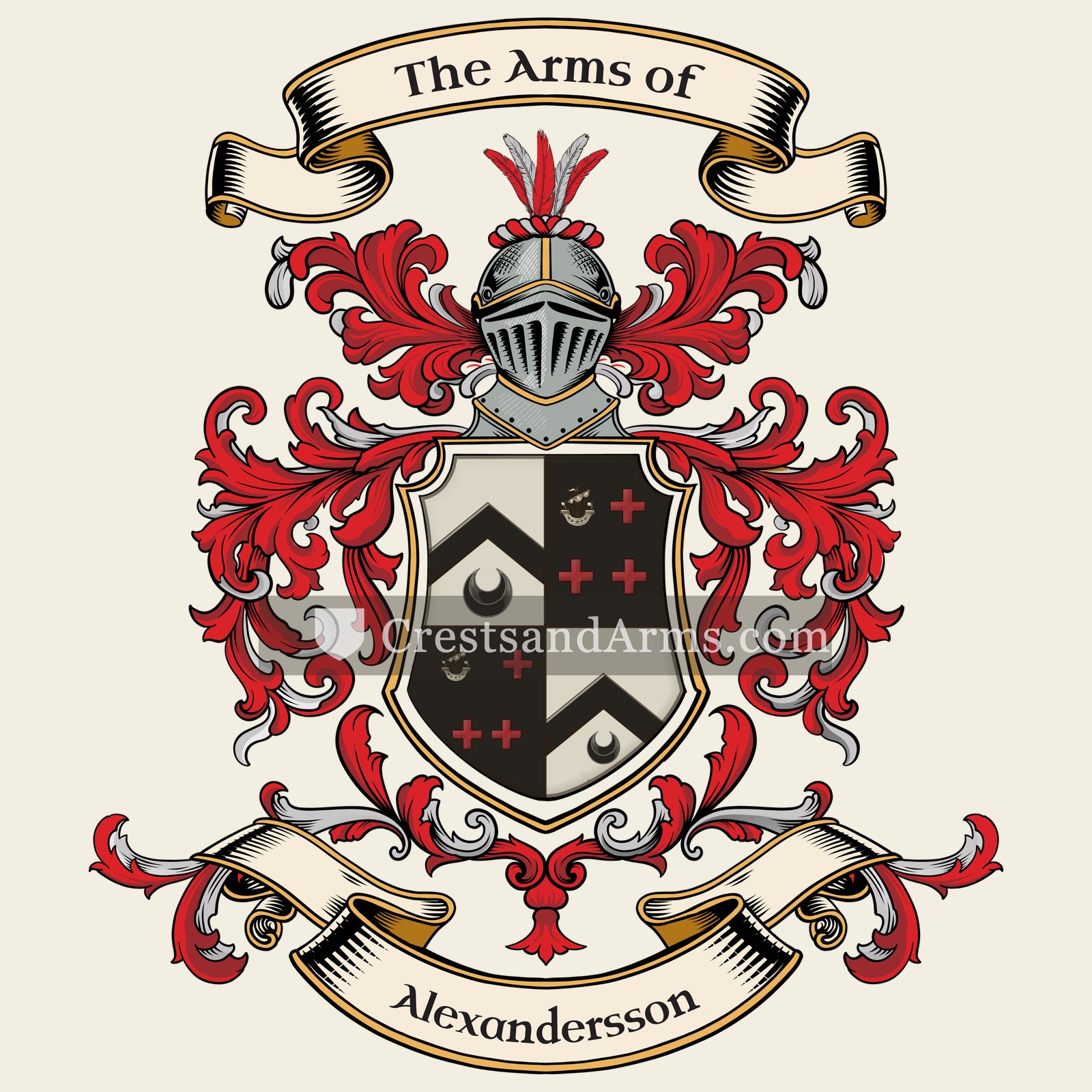


 paleMilitary strength, and a fortified defence
 mulletThe third son, and a divine quality from above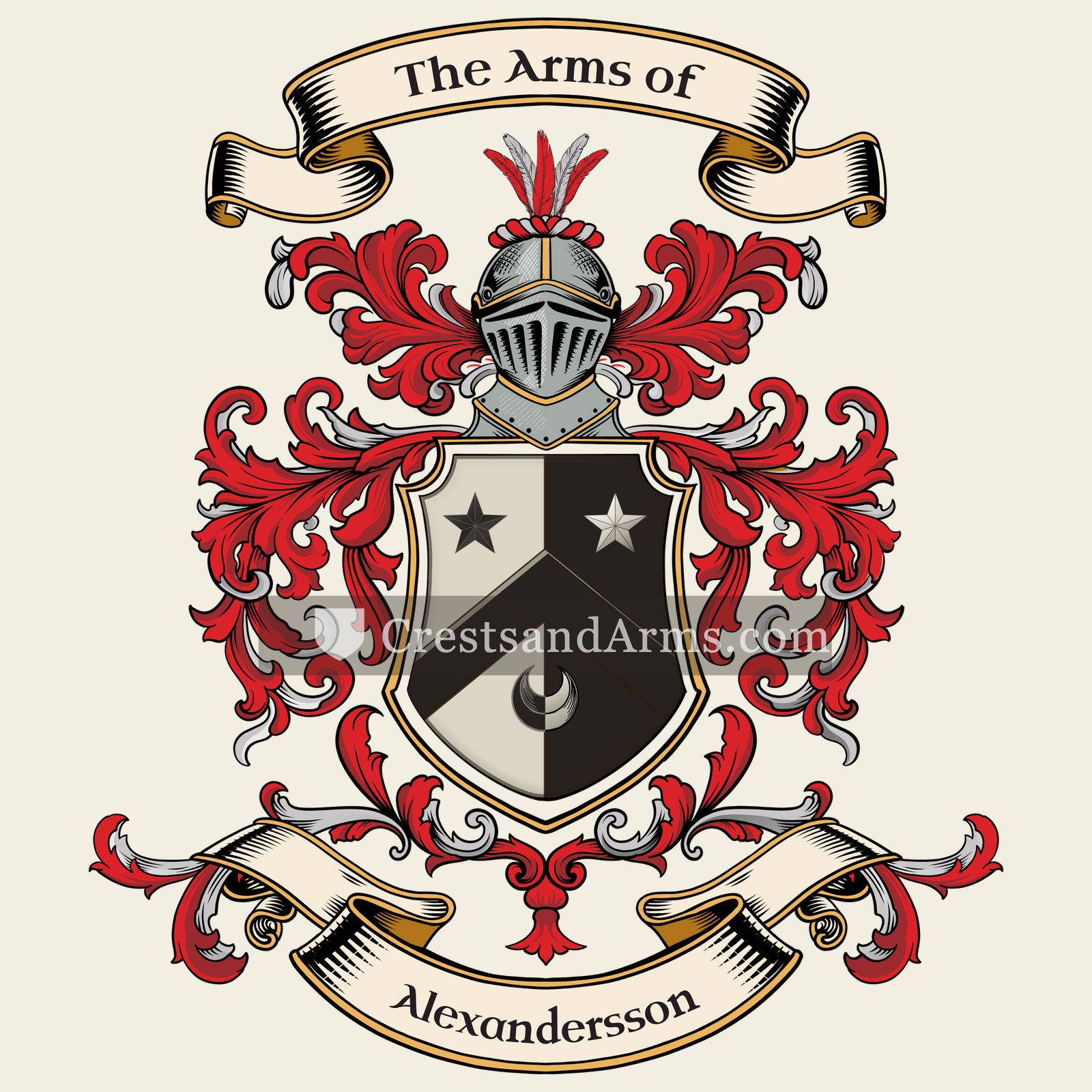


 lionCourage, strength and royalty