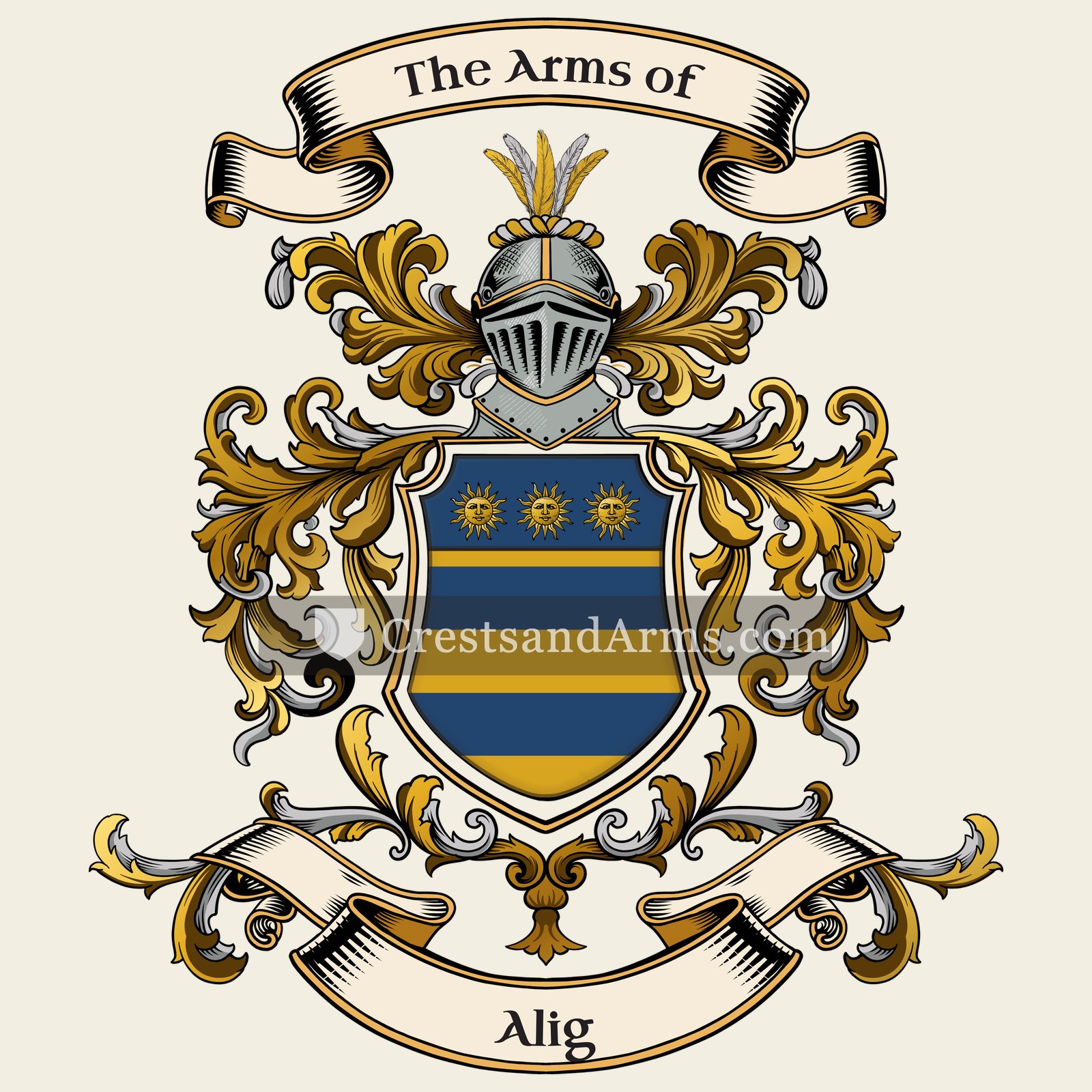
A record of documented arms, meaning and origin, researched for the Alig family of France.
Reg. 3197 · French, A–C
Coat of Arms & Family Crest Details
Symbols on this shield
chiefAuthority, wisdom and dominion
sunGlory, splendour and the source of life
Colours
Gold (Or)Means: Generosity
Blue (Azure)Means: Loyalty and truth
Historical info
Source
J. B. Rietstap, Armorial Général, Gouda: G. B. van Goor Zonen, 1884–87
Blazon (the actual original written record)
“Burelé d'or et d'azur; au chef du sec., ch. de trois soleils du premier. C.: un lion iss. au nat. S.: deux lions au nat., tenant chacun une bannière aux armes de l'écu. D.: NON UNO GENS SPLENDIDA SOLE [V. Pomereu d'Aligre.]”
FranceParis, c. 1752
Digital archive packCoat of arms PNG, gold border print PDF, vector SVG and the certificate of authenticity. Sent to your email in minutes.
Map of France showing where the Alig arms are recorded
The Alig arms were recorded in Paris, c. 1752.
This is where the arms were entered in the register. Families often moved to other parts of the country, so the same name can turn up in more than one region.
The body that granted and recorded arms in France in this period.
Louis XV of France
Sovereign of the period
Louis XV of France
1715–1774
Reigning in France when the Alig arms are first recorded.
How Arms Worked in France
In France, a coat of arms was a mark of honor that passed down through the male line to all legitimate descendants. Families often used the same shield without changes to show their shared heritage. If a branch wanted to stand out, they could add a small mark to their shield to show their specific place in the family tree.
Granting authority
The Juge d'armes de France acted as the official authority that regulated and verified coats of arms across the country.
How they got arms
Families typically inherited their arms from ancestors, though they could also receive them through royal grants or by proving their noble status.
Where arms were recorded
Coats of arms were officially recorded in the Armorial Général de France, which began its main collection in the year 1696.
The family's standing
Recorded among the armigerous families of France.
Origin & History of the Alig Family in France
The history of the Alig family name is rooted in the vibrant social and professional landscape of eighteenth-century Paris. By 1752, records confirm that members of the family were established residents of the city, participating in the complex urban life of the French capital. During this era, the name was associated with individuals who navigated the administrative and commercial circles of the Ancien Régime. While the exact origins of the name remain a subject of study, its presence in Paris suggests that early family members were integrated into the middle or professional classes of the time. These individuals likely worked as merchants, artisans, or minor officials, contributing to the daily operations of a city that served as the cultural heart of Europe. Through their presence in official registers, we gain a glimpse into a family that was already well-positioned within the bustling society of pre-revolutionary France.
Related Branches & Arms
Root word
Alis
Derived from the Germanic name Adalheidis meaning noble kind.
This name
AligA locative or patronymic surname likely referring to a descendant of someone named Alis.
also spelled
Aligree
Aligreh
Alig
Aligr
Documented Sources
J. B. Rietstap, Armorial Général, Gouda: G. B. van Goor Zonen, 1884–87
Archives Nationales, Minutier central des notaires de Paris, Series MC/ET/LXXII
Boudon, Françoise, Système de la ville de Paris, 1993
Roche, Daniel, Le Peuple de Paris, 1981
Digital archive packCoat of arms PNG, gold border print PDF, vector SVG and the certificate of authenticity. Sent to your email in minutes.


 chiefAuthority, wisdom and dominion
 sunGlory, splendour and the source of life
 chiefAuthority, wisdom and dominion
 sunGlory, splendour and the source of life