Map of France showing where the Alix arms are recorded
The Alix arms were recorded in Lorraine, c. 1554.
Lorraine sat on the border between France and the German lands, and border country bred soldiers. Families here held small estates and served in arms, and a fighting man was exactly the sort who carried a shield of his own.
This is where the arms were entered in the register. Families often moved to other parts of the country, so the same name can turn up in more than one region.
The body that granted and recorded arms in France in this period.
Henry II of France
Sovereign of the period
Henry II of France
1547–1559
Reigning in France when the Alix arms are first recorded.
How Arms Worked in France
In France, a coat of arms was a mark of honor that passed down through the male line to all legitimate descendants. Families often used the same shield without changes to show their shared heritage. If a branch wanted to stand out, they could add a small mark to their shield to show their specific place in the family tree.
Granting authority
The Juge d'armes de France acted as the official authority that regulated and verified coats of arms across the country.
How they got arms
Families typically inherited their arms from ancestors, though they could also receive them through royal grants or by proving their noble status.
Where arms were recorded
Coats of arms were officially recorded in the Armorial Général de France, which began its main collection in the year 1696.
The family's standing
Recorded among the armigerous families of Lorraine.
Origin & History of the Alix Family in France
The surname Alix traces its roots to the Germanic name Adalheidis, which eventually evolved into the French form Alix. By the mid-sixteenth century, the family established a notable presence in the Lorraine region of northeastern France. During this period, Lorraine was a crossroads of European culture and politics, situated between the French Kingdom and the Holy Roman Empire. Families living in this area often navigated complex social changes as the region transitioned through various shifts in power and religious reform. The Alix family likely lived as part of the local agrarian or merchant classes, contributing to the development of the duchy through their daily work and community involvement. Their settlement in Lorraine by 1554 suggests they were well-integrated into the local society during a time when the region was becoming a significant center for trade and intellectual growth.
Alix Meaning & Related Branches
Root word
Adalheidis
A Germanic compound meaning noble and kind or noble sort.
This name
AlixA French diminutive form signifying nobility and graceful character.
also spelled
Alix
Aliks
Allicks
Alicks
Documented Sources
J. B. Rietstap, Armorial Général, Gouda: G. B. van Goor Zonen, 1884–87
Albert Dauzat, Dictionnaire étymologique des noms et prénoms de France, 1951
Archives départementales de Meurthe-et-Moselle, Série B: Cours et juridictions (Chambre des comptes de Lorraine)
Jean-Marie Pierret, Dictionnaire des noms de famille de Belgique francophone, 1996
Digital archive packCoat of arms PNG, gold border print PDF, vector SVG and the certificate of authenticity. Sent to your email in minutes.


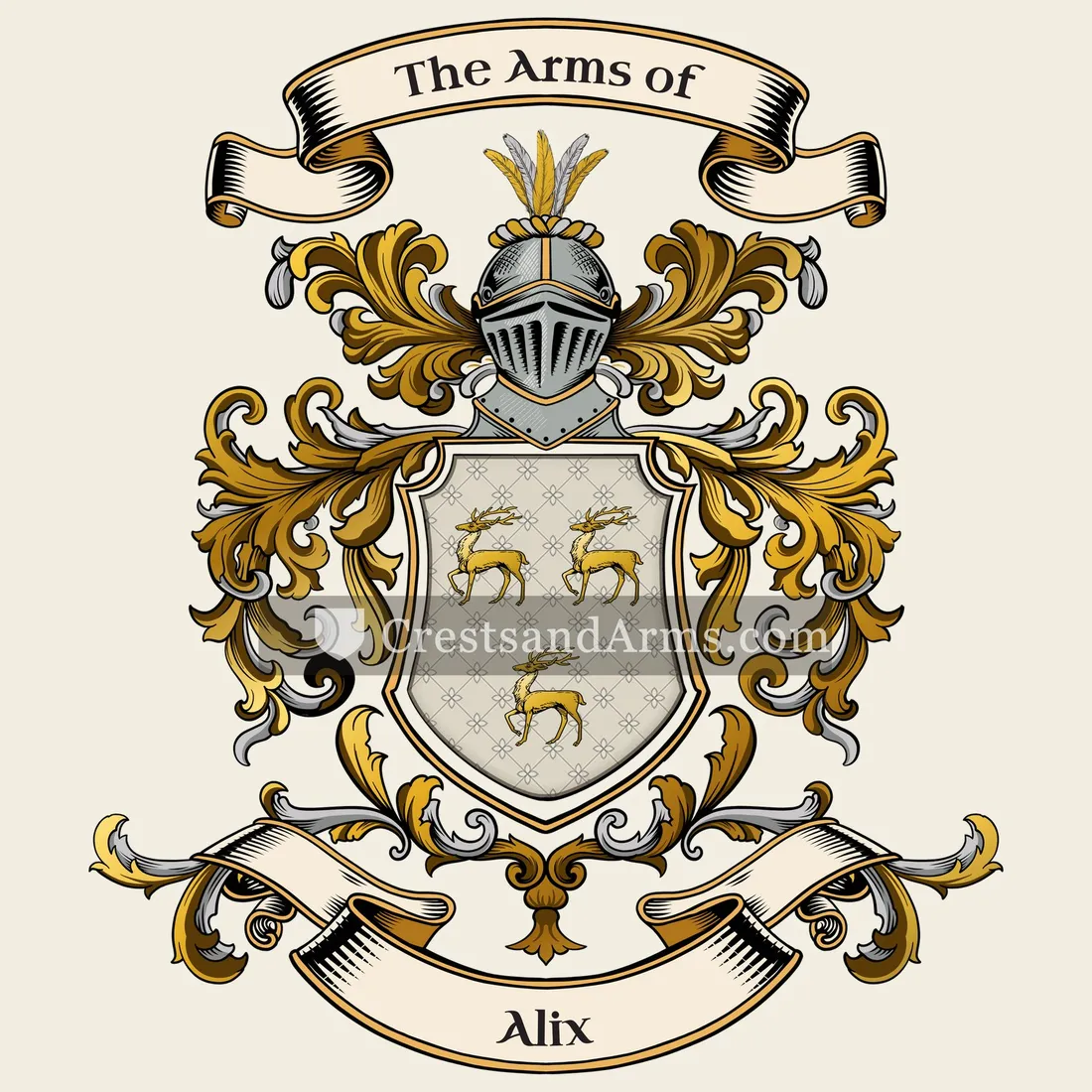
 stagPeace and harmony, and one who will not fight unprovoked
 stagPeace and harmony, and one who will not fight unprovoked