Map of England showing where the Allain arms are recorded
The Allain arms were recorded in Suffolk, c. 1620.
Suffolk was wool country, and its cloth towns were among the wealthiest in England. Clothier families bought manors with their profits, and holding a manor was the ordinary route to a coat of arms.
This is where the arms were entered in the register. Families often moved to other parts of the country, so the same name can turn up in more than one region.
The body that granted and recorded arms in England in this period.
James VI and I
Sovereign of the period
James VI and I
1603–1625
Reigning in England when the Allain arms are first recorded.
How Arms Worked in England
English heraldry allowed arms to be shared by all legitimate descendants of the original owner. These symbols were treated as personal property that moved through the generations to all children. While the eldest son kept the original design, other family members could use the same shield without needing to change it or register their own unique versions.
Granting authority
The College of Arms in London has regulated the use of coats of arms throughout England and Wales since 1484.
How they got arms
Families typically obtained their coats of arms through a formal grant from the Crown or by proving their ancient right to them.
Where arms were recorded
All official coats of arms are recorded in the registers kept at the College of Arms, which date back to the fifteenth century.
The family's standing
Recorded among the armigerous families of Suffolk.
Origin & History of the Allain Family in England
The surname Allain is a variation of the ancient name Alan, which is rooted in the Old Breton language and means harmony or peace. While the name gained significant popularity across Europe following the Norman Conquest, its presence in Suffolk by 1620 suggests that families bearing this name were well-established in the English countryside during the early seventeenth century. During this period, people in Suffolk often worked as farmers, tradesmen, or artisans, contributing to the local economy of the region. As the name moved through different generations and regions, the spelling evolved from the original Alan to variations like Allain, reflecting how names were often written down phonetically by local clerks. By the time the family was documented in Suffolk, they were part of a long tradition of English settlers who helped shape the rural landscape and community life of East Anglia.
Allain Meaning & Related Branches
Root word
Alain
Derived from the ancient Celtic tribe known as the Alani.
This name
AllainA variant of Alan, believed to mean little rock or handsome.
also spelled
Allen
Allan
Allyn
Alyn
Alyne
Documented Sources
Sir Bernard Burke, The General Armory of England, Scotland, Ireland and Wales, London: Harrison & Sons, 1884
Reaney, P.H., A Dictionary of English Surnames, 1958
Hanks, Patrick and Hodges, Flavia, A Dictionary of Surnames, 1988
The National Archives, Probate records of the Prerogative Court of Canterbury, 1620
Suffolk Archives, Parish registers of Suffolk, 1620
Digital archive packCoat of arms PNG, gold border print PDF, vector SVG and the certificate of authenticity. Sent to your email in minutes.


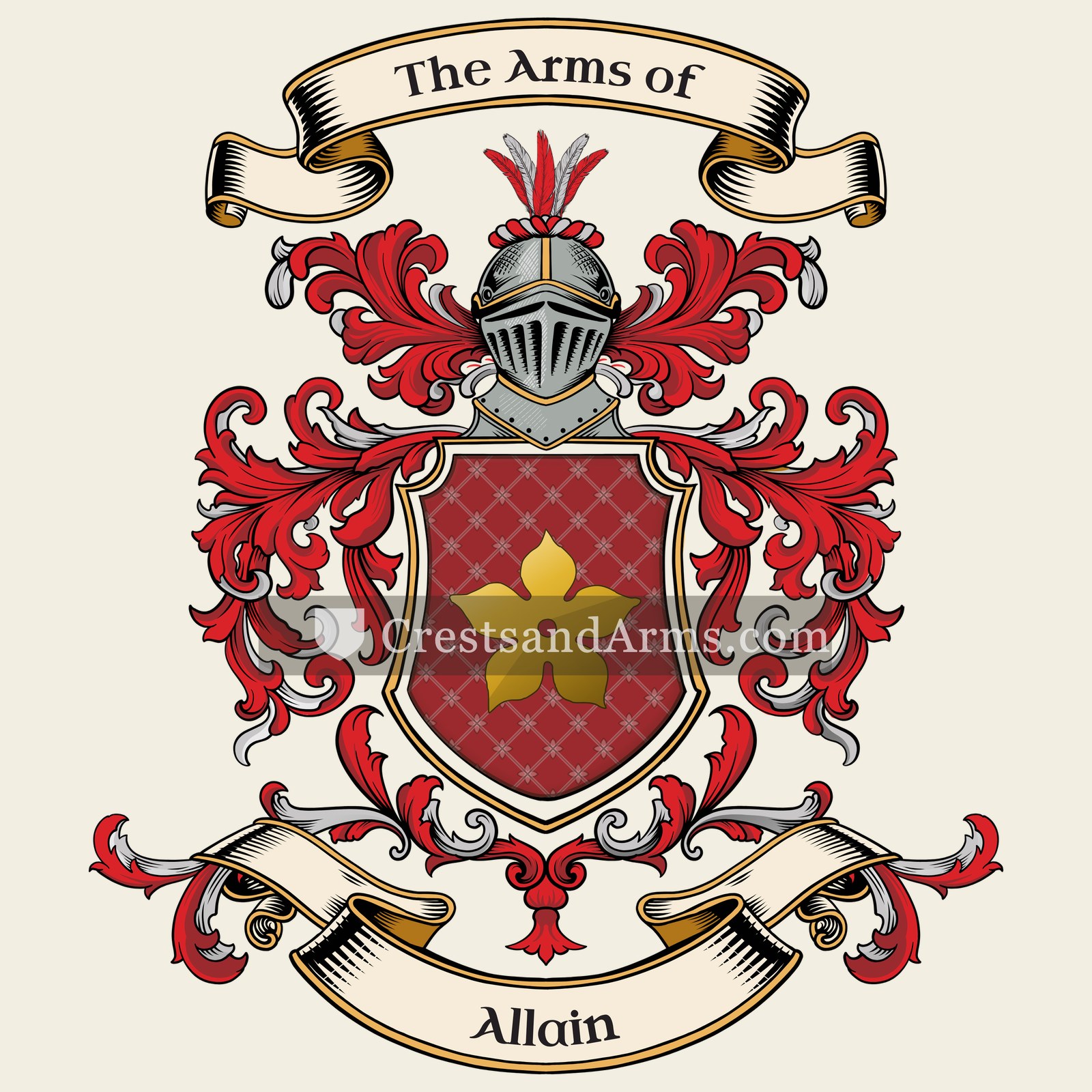
 cinquefoilHope and joy
 cinquefoilHope and joy