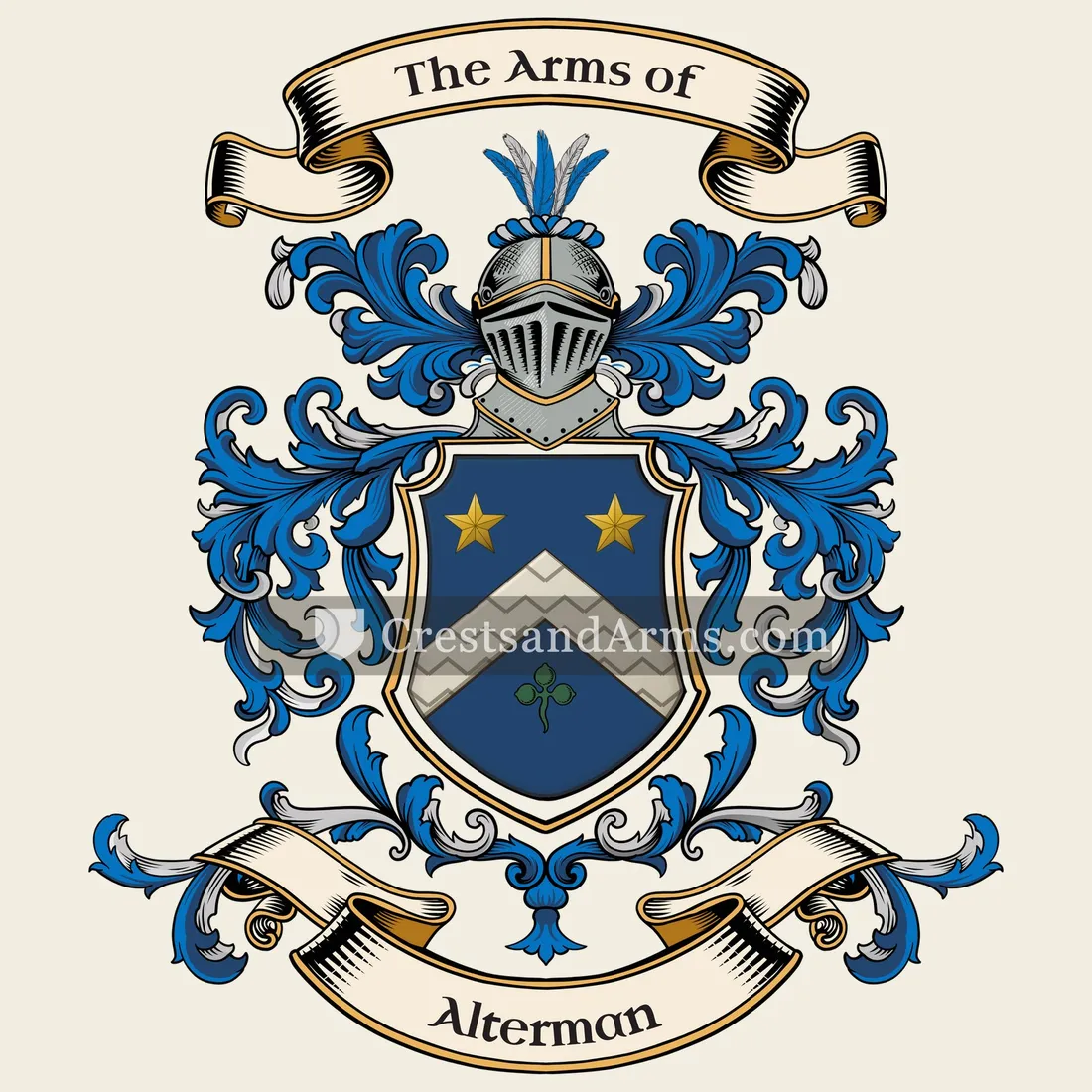
A record of documented arms, meaning and origin, researched for the Alterman family of Switzerland.
Reg. 2785 · Swiss, A–C
Meaning of the Alterman family crest colors & symbols
Symbols on this shield
chevronProtection, and faithful service completed
mulletThe third son, and a divine quality from above
trefoilPerpetuity, and the Trinity
Colours
Blue (Azure)Means: Loyalty and truth
Silver (Argent)Means: Peace and sincerity
Gold (Or)Means: Generosity
Green (Vert)Means: Hope
Historical info
Source
J. B. Rietstap, Armorial Général, Gouda: G. B. van Goor Zonen, 1884–87
Blazon (the actual original written record)
“D'azur au chev. d'arg., acc. en chef de deux étoiles d'or et en p. d'un trèfle de sin. C.: un trèfle de sin., sommé d'une étoile d'or. L. d'or, d'azur et d'arg.”
SwitzerlandSoleure, c. 1745
Digital archive packCoat of arms PNG, gold border print PDF, vector SVG and the certificate of authenticity. Sent to your email in minutes.
Map of Switzerland showing where the Alterman arms are recorded
The Alterman arms were recorded in Soleure, c. 1745.
This is where the arms were entered in the register. Families often moved to other parts of the country, so the same name can turn up in more than one region.
The body that granted and recorded arms in Switzerland in this period.
How Arms Worked in Switzerland
In Switzerland, coats of arms were not restricted to the nobility and were often adopted by common citizens and families. These symbols were passed down through generations to show family identity. When branches of a family grew, they often changed small details of the design to distinguish their own line from the original group.
Granting authority
Cantonal and civic authorities managed the use of coats of arms within their specific regions and local jurisdictions.
How they got arms
Families typically assumed their own coats of arms based on local custom rather than receiving them from a central monarch.
Where arms were recorded
Arms were recorded in various cantonal and civic registers starting from the fourteenth century throughout the Swiss region.
The family's standing
Recorded among the armigerous families of Switzerland.
Origin & History of the Alterman Family in Switzerland
The family name Alterman is deeply rooted in the historical landscape of Central Europe, with documented evidence placing members of the family in the Swiss city of Solothurn, also known as Soleure, by the year 1745. The name itself is derived from the German words "alt," meaning old, and "mann," meaning man. Historically, this type of surname was often used as a descriptive nickname to identify an elder or a respected senior member of a community. In the context of 18th-century Switzerland, the family likely integrated into the local urban structure, where surnames were becoming increasingly important for tax records, legal documentation, and guild memberships. By settling in a significant administrative center like Solothurn, the early Altermans were part of a period of transition where families began to establish permanent roots in specific municipalities, moving away from the more nomadic lifestyles of earlier centuries.
Alterman Meaning & Related Branches
Root word
Alt
Germanic root meaning old or aged.
This name
AltermanAn occupational surname for an elder or a respected senior member of a community.
also spelled
Altermate
Documented Sources
J. B. Rietstap, Armorial Général, Gouda: G. B. van Goor Zonen, 1884–87
Staatsarchiv des Kantons Solothurn, Bürgerrodel der Stadt Solothurn (1745)
Bahlow, Hans, Deutsches Namenlexikon: Familien- und Vornamen nach Ursprung und Sinn erklärt (1967)
Gottschald, Max, Deutsche Namenkunde: Unsere Familiennamen (1971)
Digital archive packCoat of arms PNG, gold border print PDF, vector SVG and the certificate of authenticity. Sent to your email in minutes.


 chevronProtection, and faithful service completed
 mulletThe third son, and a divine quality from above
 trefoilPerpetuity, and the Trinity
 chevronProtection, and faithful service completed
 mulletThe third son, and a divine quality from above
 trefoilPerpetuity, and the Trinity