Map of France showing where the Am arms are recorded
The Am arms were recorded in Paris, c. 1663.
This is where the arms were entered in the register. Families often moved to other parts of the country, so the same name can turn up in more than one region.
The body that granted and recorded arms in France in this period.
Louis XIV of France
Sovereign of the period
Louis XIV of France
1643–1715
Reigning in France when the Am arms are first recorded.
How Arms Worked in France
In France, a coat of arms was a mark of honor that passed down through the male line to all legitimate descendants. Families often used the same shield without changes to show their shared heritage. If a branch wanted to stand out, they could add a small mark to their shield to show their specific place in the family tree.
Granting authority
The Juge d'armes de France acted as the official authority that regulated and verified coats of arms across the country.
How they got arms
Families typically inherited their arms from ancestors, though they could also receive them through royal grants or by proving their noble status.
Where arms were recorded
Coats of arms were officially recorded in the Armorial Général de France, which began its main collection in the year 1696.
The family's standing
Recorded among the armigerous families of France.
Origin & History of the Am Family in France
The history of the Am family in France is deeply rooted in the urban landscape of seventeenth-century Paris. By 1663, records confirm that members of the family were already established within the capital, living during a time when the city was undergoing massive social and architectural changes under the reign of Louis XIV. During this era, families with short, distinct surnames often occupied specific roles in the growing bureaucracy or the skilled trades that supported the royal court. Living in Paris during the 1660s meant that the Am family was part of a vibrant period of French history, witnessing the expansion of the Louvre and the rise of a centralized national identity. While the name is brief, it reflects the tradition of early modern French naming conventions where families were often identified by simple, memorable labels that allowed them to be easily tracked in parish registers and tax documents. Their presence in the heart of France at this time suggests they were integrated into the daily life and commerce of a city that was rapidly becoming the cultural center of Europe.
Meaning of the Am family crest colors & symbols
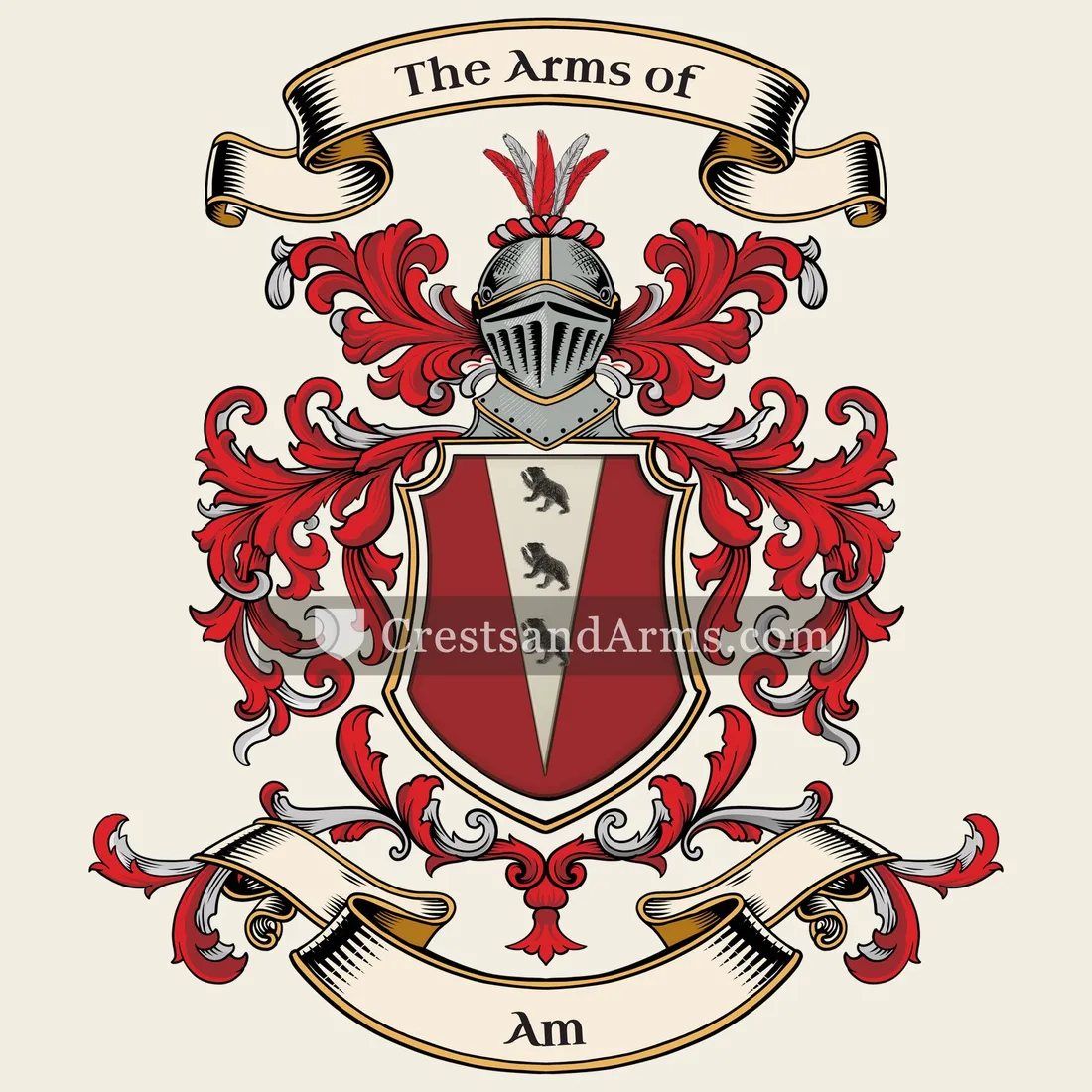
Symbols on this shield
pileWell-doing, and a mark of distinction
bearStrength, cunning and protection of kin
Colours
Red (Gules)Means: Military strength
Silver (Argent)Means: Peace and sincerity
Black (Sable)Means: Constancy
Historical info
Source
Sir Bernard Burke, The General Armory of England, Scotland, Ireland and Wales, London: Harrison & Sons, 1884
Blazon (the actual original written record)
“Gu. on a pile ar. three bears' heads couped sa. muzzled or”
CornwallCornwall, c. 1620
Digital archive packCoat of arms PNG, gold border print PDF, vector SVG and the certificate of authenticity. Sent to your email in minutes.
Map of England showing where the Am arms are recorded
The Am arms were recorded in Cornwall, c. 1620.
Cornwall was a county apart, with its own language and its own tight-knit gentry. Tin and the sea made money there, and families who made it bought land, which is what brought arms with it.
This is where the arms were entered in the register. Families often moved to other parts of the country, so the same name can turn up in more than one region.
The body that granted and recorded arms in England in this period.
James VI and I
Sovereign of the period
James VI and I
1603–1625
Reigning in France when the Am arms are first recorded.
How Arms Worked in England
English heraldry allowed arms to be shared by all legitimate descendants of the original owner. These symbols were treated as personal property that moved through the generations to all children. While the eldest son kept the original design, other family members could use the same shield without needing to change it or register their own unique versions.
Granting authority
The College of Arms in London has regulated the use of coats of arms throughout England and Wales since 1484.
How they got arms
Families typically obtained their coats of arms through a formal grant from the Crown or by proving their ancient right to them.
Where arms were recorded
All official coats of arms are recorded in the registers kept at the College of Arms, which date back to the fifteenth century.
The family's standing
Recorded among the armigerous families of Cornwall.
Origin & History of the Am Family in England
The surname Am is a rare and distinct name that first appears in the historical record of Cornwall during the early 17th century. By 1620, families bearing this name were established in the rugged landscape of southwestern England, a region known for its unique cultural identity and isolation from the rest of the country. During this period, the name likely functioned as a localized identifier for a small group of people living within the parish systems of the Cornish coast. Because the name is so short, it is possible that it originated as a phonetic shorthand for a longer occupational or locational name that evolved over time as families moved between villages. Life for these early settlers revolved around the local church and the demands of the land, and their presence in the 1620 records suggests they were part of the stable, working population that helped define the social structure of rural Cornwall before the onset of the English Civil War.
Am Meaning & Related Branches
Root word
Amare
Latin verb meaning to love or to be fond of.
This name
AmA locative or occupational surname derived from Old French terms for love or affection.
also spelled
Amie
Amee
Amyas
Amias
Documented Sources
J. B. Rietstap, Armorial Général, Gouda: G. B. van Goor Zonen, 1884–87
Archives Nationales, Minutier central des notaires de Paris, Series ET/LXXIII
Boudon, Françoise, Le système des places royales, 1977
Foisil, Madeleine, La vie quotidienne au temps de Louis XIV, 1980
Digital archive packCoat of arms PNG, gold border print PDF, vector SVG and the certificate of authenticity. Sent to your email in minutes.


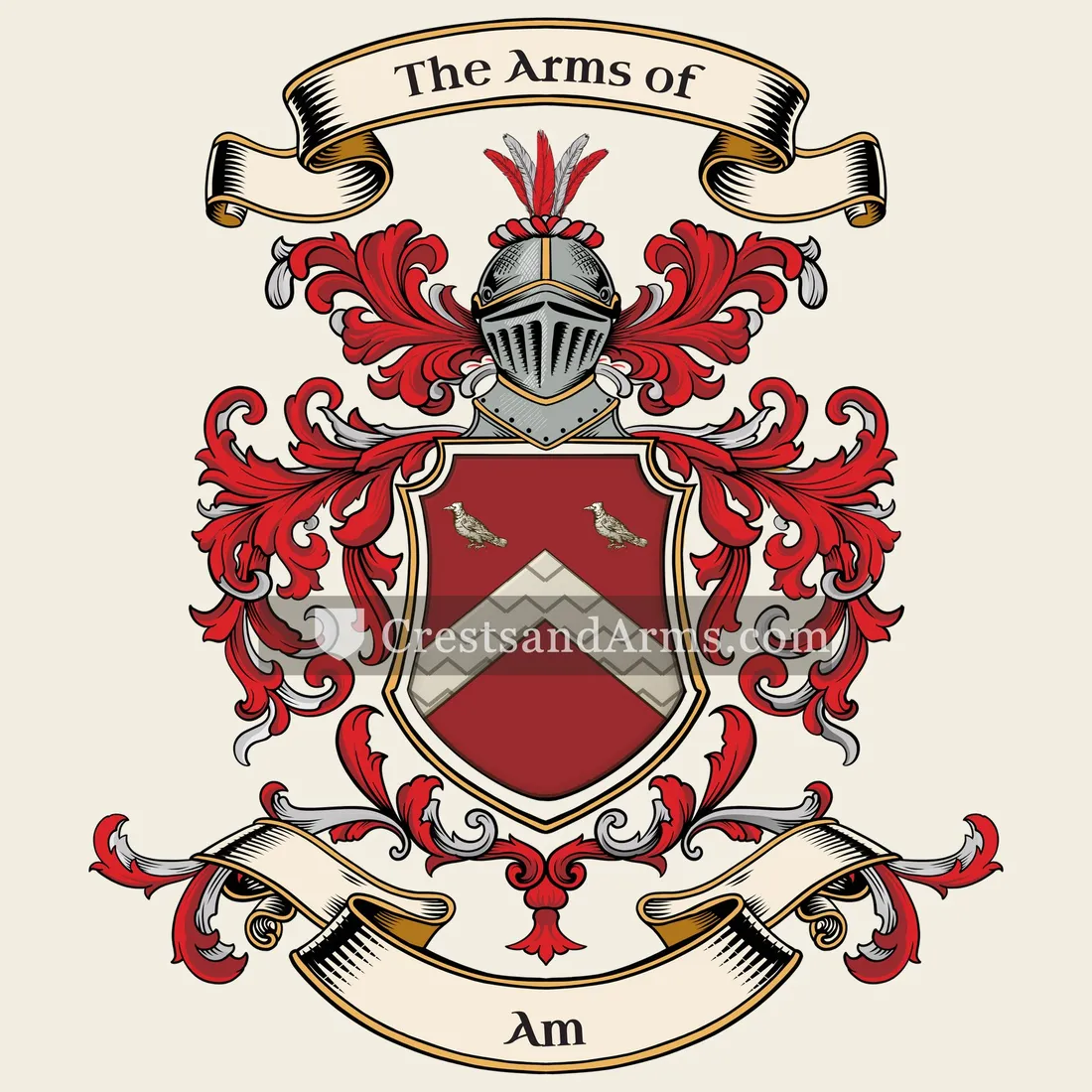
 chevronProtection, and faithful service completed
 dovePeace, love and the Holy Spirit
 chevronProtection, and faithful service completed
 dovePeace, love and the Holy Spirit


 pileWell-doing, and a mark of distinction
 bearStrength, cunning and protection of kin