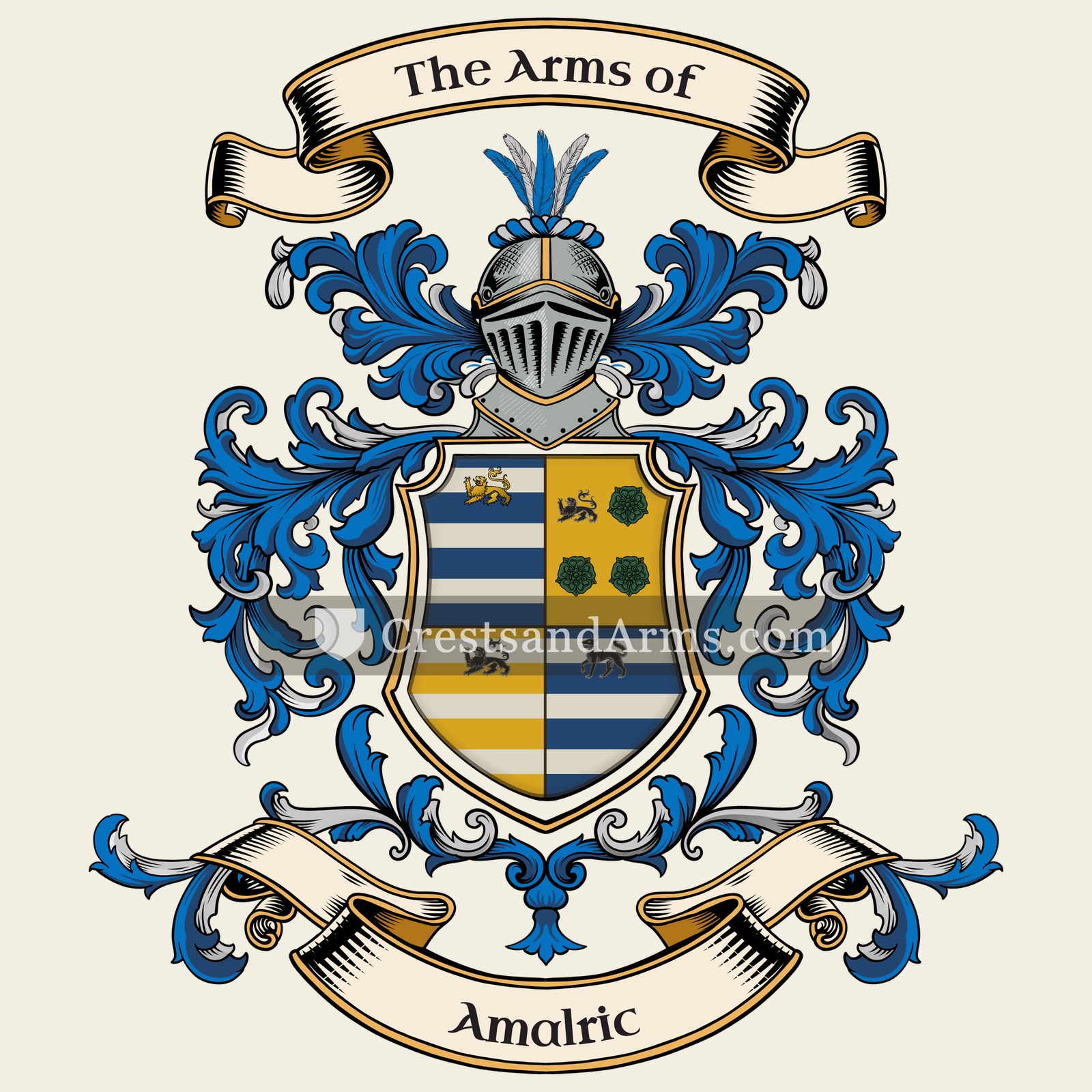
A record of documented arms, meaning and origin, researched for the Amalric family of France.
Reg. 2955 · French, A–C
Coat of Arms & Family Crest Details
Symbols on this shield
fessThe military belt, and readiness to serve
lionCourage, strength and royalty
roseThe seventh son, and beauty with grace
wolfReward from long service and hard work
Colours
Blue (Azure)Means: Loyalty and truth
Gold (Or)Means: Generosity
Silver (Argent)Means: Peace and sincerity
Green (Vert)Means: Hope
Black (Sable)Means: Constancy
Historical info
Source
J. B. Rietstap, Armorial Général, Gouda: G. B. van Goor Zonen, 1884–87
Blazon (the actual original written record)
“Ec.: aux 1 et 4 d'azur à trois fasces d'arg.; aux 2 et 3 d'azur au lion d'or, arm. et lamp. de gu. — Ou: Ec.: au 1 d'azur au lion d'or, arm. et lamp. de gu.; au 2 d'or à trois soucis de sin.; au 3 d'azur à trois fasces d'arg.; au 4 d'arg. au loup de sa.”
LanguedocLanguedoc, c. 1663
Digital archive packCoat of arms PNG, gold border print PDF, vector SVG and the certificate of authenticity. Sent to your email in minutes.
Map of France showing where the Amalric arms are recorded
The Amalric arms were recorded in Languedoc, c. 1663.
Languedoc stretched across the south of France, a country of small towns, vineyards and old local families. Its gentry were numerous rather than grand, and a great many of them held arms even where their estates were modest.
This is where the arms were entered in the register. Families often moved to other parts of the country, so the same name can turn up in more than one region.
The body that granted and recorded arms in France in this period.
Louis XIV of France
Sovereign of the period
Louis XIV of France
1643–1715
Reigning in France when the Amalric arms are first recorded.
How Arms Worked in France
In France, a coat of arms was a mark of honor that passed down through the male line to all legitimate descendants. Families often used the same shield without changes to show their shared heritage. If a branch wanted to stand out, they could add a small mark to their shield to show their specific place in the family tree.
Granting authority
The Juge d'armes de France acted as the official authority that regulated and verified coats of arms across the country.
How they got arms
Families typically inherited their arms from ancestors, though they could also receive them through royal grants or by proving their noble status.
Where arms were recorded
Coats of arms were officially recorded in the Armorial Général de France, which began its main collection in the year 1696.
The family's standing
Recorded among the armigerous families of Languedoc.
Origin & History of the Amalric Family in France
The name Amalric finds its roots in the ancient Germanic language, combining the words for "work" and "ruler" to signify a powerful leader. By the mid-seventeenth century, the family was firmly established in the Languedoc region of southern France. During this period, the area was a hub of cultural and religious transition, and families like the Amalrics often held positions of local influence or managed agricultural estates. Records from 1663 confirm their presence in this landscape, placing them within a society that valued lineage and land ownership. As the family grew, they became part of the social fabric of the French provinces, navigating the complex political changes that defined the era of King Louis XIV. Their history reflects the broader movement of families who settled in the fertile plains of the south and contributed to the development of regional trade and governance.
Amalric Meaning & Related Branches
Root word
Amal-ric
Derived from the Germanic elements amal meaning work and ric meaning ruler.
This name
AmalricA name signifying a powerful or industrious ruler.
also spelled
Amalrik
Documented Sources
J. B. Rietstap, Armorial Général, Gouda: G. B. van Goor Zonen, 1884–87
Bouchard, Constance Brittain, Those of My Blood: Constructing Noble Families in Medieval Francia, 2001
Le Roy Ladurie, Emmanuel, Les Paysans de Languedoc, 1966
Archives Départementales de l'Hérault, Série E: Familles et seigneuries, 1663
Digital archive packCoat of arms PNG, gold border print PDF, vector SVG and the certificate of authenticity. Sent to your email in minutes.


 fessThe military belt, and readiness to serve
 lionCourage, strength and royalty
 roseThe seventh son, and beauty with grace
 wolfReward from long service and hard work
 fessThe military belt, and readiness to serve
 lionCourage, strength and royalty
 roseThe seventh son, and beauty with grace
 wolfReward from long service and hard work