Map of France showing where the Amat arms are recorded
The Amat arms were recorded in Bretagne, c. 1663.
More families held coats of arms in Bretagne than anywhere else in France. The land was divided into many small estates rather than a few large ones, so far more households counted as gentry, and each needed a shield of its own to be told apart.
This is where the arms were entered in the register. Families often moved to other parts of the country, so the same name can turn up in more than one region.
The body that granted and recorded arms in France in this period.
Louis XIV of France
Sovereign of the period
Louis XIV of France
1643–1715
Reigning in France when the Amat arms are first recorded.
How Arms Worked in France
In France, a coat of arms was a mark of honor that passed down through the male line to all legitimate descendants. Families often used the same shield without changes to show their shared heritage. If a branch wanted to stand out, they could add a small mark to their shield to show their specific place in the family tree.
Granting authority
The Juge d'armes de France acted as the official authority that regulated and verified coats of arms across the country.
How they got arms
Families typically inherited their arms from ancestors, though they could also receive them through royal grants or by proving their noble status.
Where arms were recorded
Coats of arms were officially recorded in the Armorial Général de France, which began its main collection in the year 1696.
The family's standing
Recorded among the armigerous families of Bretagne.
Origin & History of the Amat Family in France
The family name Amat has deep roots in the French landscape, with historical documentation confirming the presence of family members in the region of Bretagne as early as 1663. The name itself is believed to derive from the Latin word amatus, which translates to beloved or dear. In the context of medieval France, such names often began as descriptive nicknames given to individuals who were well-regarded by their local communities. As the family established itself in the western provinces, they likely integrated into the rural social structures of the seventeenth century, where they would have participated in the agricultural and trade activities typical of the Breton countryside. Over time, the name transitioned from a personal descriptor into a hereditary surname, marking the family as a stable part of the regional population during a period of significant social change in France.
Coat of Arms & Family Crest Details
Symbols on this shield
dragonA most valiant defender of treasure
Colours
Gold (Or)Means: Generosity
Blue (Azure)Means: Loyalty and truth
Historical info
Source
J. B. Rietstap, Armorial Général, Gouda: G. B. van Goor Zonen, 1884–87
Blazon (the actual original written record)
“D'or à une hydre à sept têtes d'azur.”
CataloniaCatalonia, c. 1722
Digital archive packCoat of arms PNG, gold border print PDF, vector SVG and the certificate of authenticity. Sent to your email in minutes.
Map of Spain showing where the Amat arms are recorded
The Amat arms were recorded in Catalonia, c. 1722.
Catalonia lived by sea trade, and its merchant houses were as powerful as its landowners. Both sorts of family took arms, and Barcelona kept records of the houses entitled to bear them.
This is where the arms were entered in the register. Families often moved to other parts of the country, so the same name can turn up in more than one region.
The body that granted and recorded arms in Spain in this period.
Philip V of Spain
Sovereign of the period
Philip V of Spain
1714–1724
Reigning in France when the Amat arms are first recorded.
How Arms Worked in Spain
In Spain, a coat of arms was considered a form of property that belonged to the entire family line. These arms were passed down from a father to all his children equally. Younger branches of the family usually kept the original design without needing to add any special marks to distinguish their specific line.
Granting authority
The Cronista Rey de Armas was the official body that regulated and granted coats of arms throughout Spain.
How they got arms
Families often obtained their arms through royal grants or by proving their noble status to the official heraldic authority.
Where arms were recorded
Coats of arms were officially recorded in the registers of the Cronista Rey de Armas starting in 1496.
The family's standing
Recorded among the armigerous families of Catalonia.
Origin & History of the Amat Family in Spain
The family name Amat has deep roots in the Catalonia region of Spain, where it has been documented for centuries. While records confirm the family’s established presence in the area by 1722, the name itself is linked to the linguistic evolution of the region. It is derived from the Latin word amatus, which means beloved or dear. In the medieval period, this term was often used as a given name before it eventually transitioned into a hereditary surname. Families bearing this name were frequently involved in the social and economic life of Catalan towns, often serving as landowners or local officials. The name reflects a time when surnames were chosen to highlight personal traits or religious devotion, and its survival through the centuries demonstrates the family's long-standing connection to the cultural identity of northeastern Spain.
Coat of Arms & Family Crest Details
Symbols on this shield
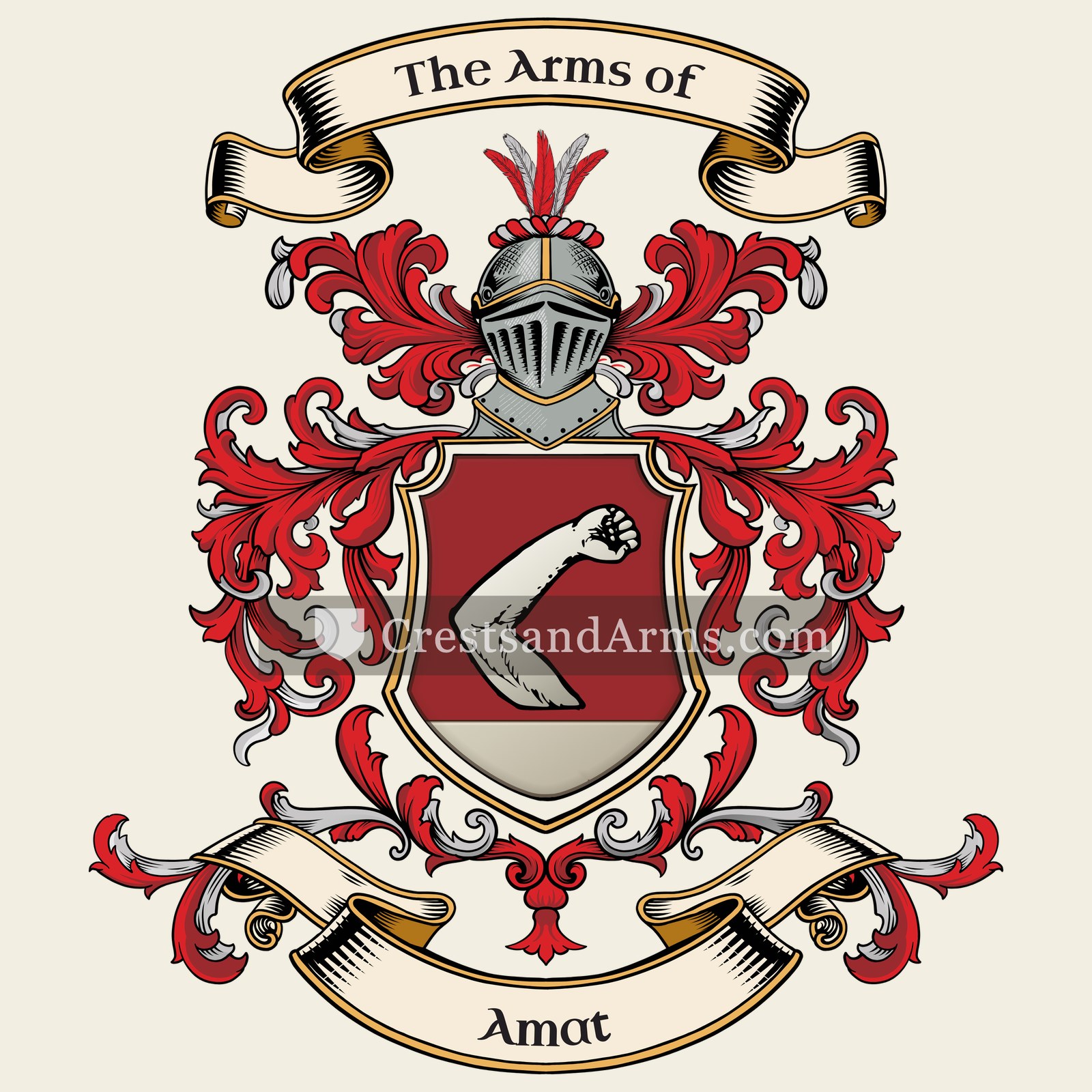
armA person of action, industrious and laborious
Colours
Red (Gules)Means: Military strength
Silver (Argent)Means: Peace and sincerity
Historical info
Source
J. B. Rietstap, Armorial Général, Gouda: G. B. van Goor Zonen, 1884–87
Blazon (the actual original written record)
“De gu. à un senestrochère de carn., mouv. du flanc, tenant une épée d'arg. en pal, le tout surmontant une mer d'arg., agitée d'azur, en p. D.: DOMAT OMNIA VIRTUS; ou: LOQUEBAR DE TESTIMONIIS TUIS IN CONSPECTU REGUM.”
ItalyRome, c. 1775
Digital archive packCoat of arms PNG, gold border print PDF, vector SVG and the certificate of authenticity. Sent to your email in minutes.
Map of Italy showing where the Amat arms are recorded
The Amat arms were recorded in Rome, c. 1775.
This is where the arms were entered in the register. Families often moved to other parts of the country, so the same name can turn up in more than one region.
The body that granted and recorded arms in Italy in this period.
Alvise Giovanni Mocenigo
Sovereign of the period
Alvise Giovanni Mocenigo
1763–1778
Reigning in France when the Amat arms are first recorded.
How Arms Worked in Italy
In the Italian states, coats of arms were often used by noble families to show their status and history. These symbols were passed down through the generations to all legitimate male descendants. Younger branches of a family usually kept the original design but sometimes added small changes to distinguish their specific line from the main branch.
Granting authority
Various local rulers and city governments controlled the use of coats of arms across the different Italian states.
How they got arms
Families often assumed their own arms or received them as official grants from local lords, popes, or city councils.
Where arms were recorded
Arms were recorded in local city archives or private family books rather than in one single national register.
The family's standing
Recorded among the armigerous families of Italy.
Origin & History of the Amat Family in Italy
The Amat family name carries a deep history rooted in the social and cultural landscape of Italy. By the year 1775, records confirm that members of the family were well-established residents of Rome, a city that served as a central hub for influential families during the eighteenth century. The name itself is thought to be linked to the Latin word amatus, which translates to beloved or dear. This suggests that the name likely began as a descriptive nickname for a person who was well-regarded within their community. As the family grew in prominence, they became integrated into the urban life of Rome, participating in the professional and civic circles that defined the capital at the time. Their presence in the city during this period highlights a long-standing connection to the administrative and social traditions of the Italian peninsula.
Amat Meaning & Related Branches
Root word
Amatus
Latin for beloved or dear one.
This name
AmatA surname derived from a medieval personal name signifying a beloved or cherished individual.
Documented Sources
J. B. Rietstap, Armorial Général, Gouda: G. B. van Goor Zonen, 1884–87
Dauzat, Albert. Dictionnaire étymologique des noms et prénoms de France. 1951
Morlet, Marie-Thérèse. Dictionnaire étymologique des noms de famille. 1991
Digital archive packCoat of arms PNG, gold border print PDF, vector SVG and the certificate of authenticity. Sent to your email in minutes.


 heronPatience and quiet watchfulness
 heronPatience and quiet watchfulness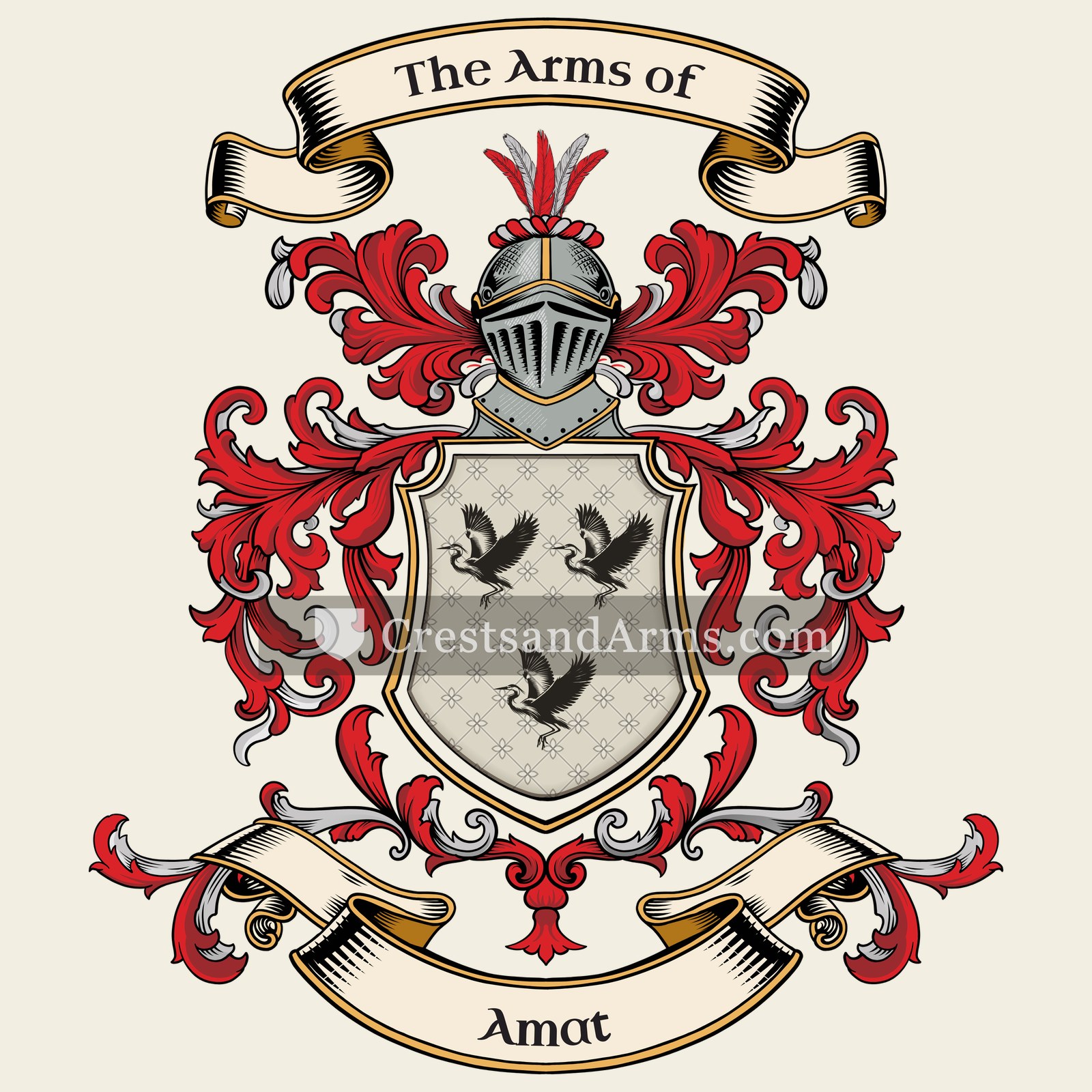


 dragonA most valiant defender of treasure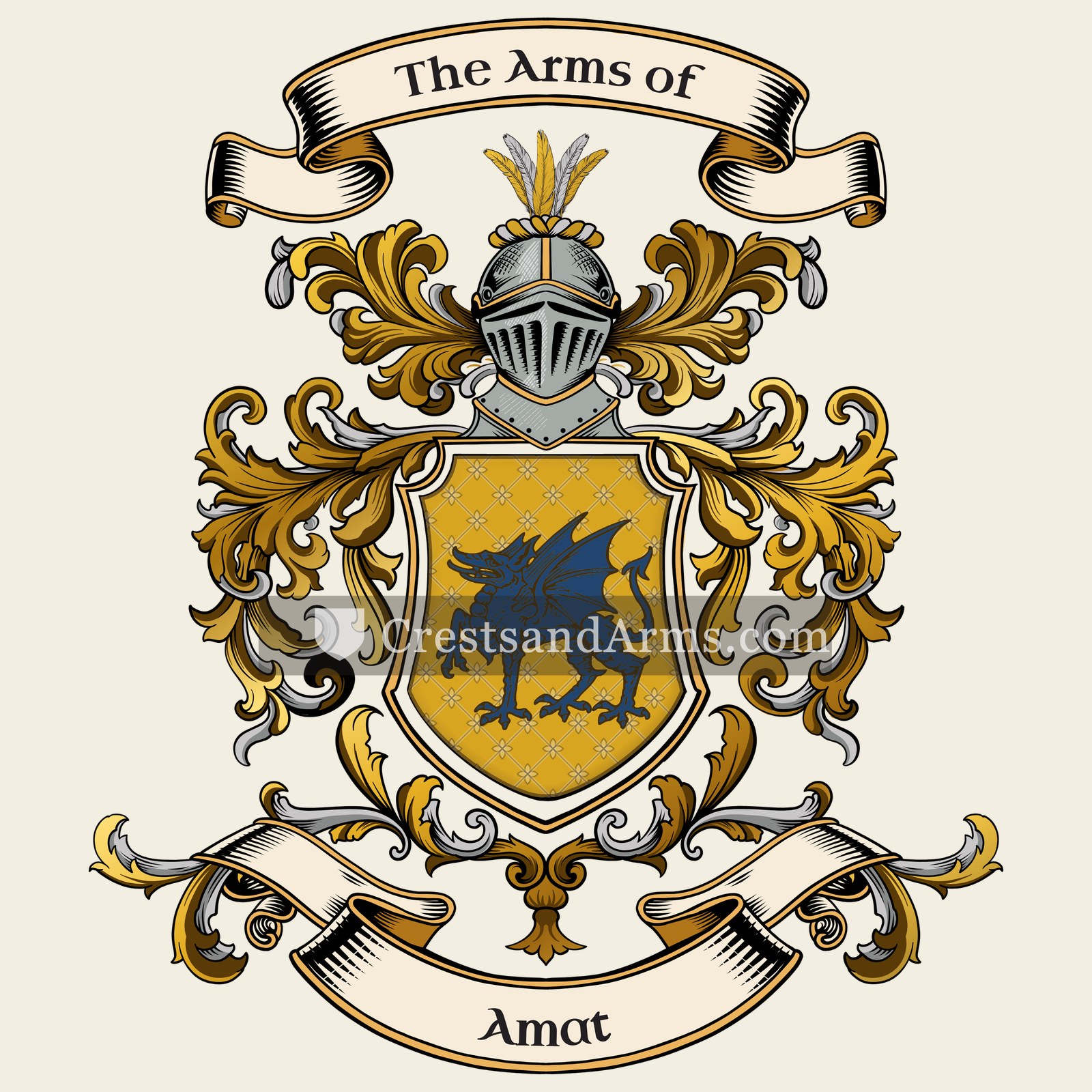


 armA person of action, industrious and laborious