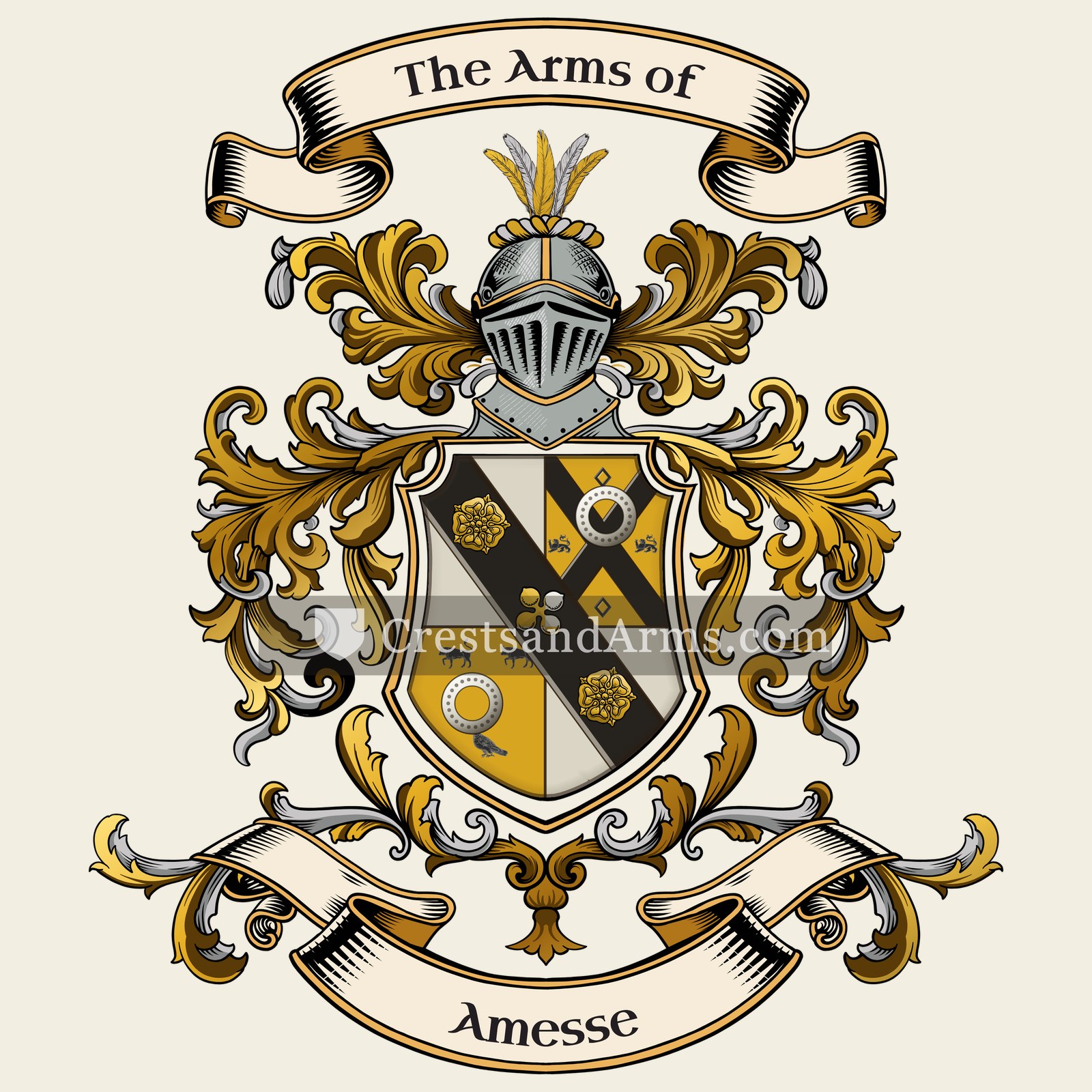
A record of documented arms, meaning and origin, researched for the Amesse family of England.
Reg. 4046 · English, A–C
Coat of Arms & Family Crest Details
Symbols on this shield
bendDefence, and the scarf of a commander
saltireResolution, and St Andrew's cross
plant quatrefoilGood fortune and the fourfold gospel
ringFidelity, and a promise kept
roseThe seventh son, and beauty with grace
masclePersuasion and the mail of a knight's coat
lionCourage, strength and royalty
bullValour and generosity
dovePeace, love and the Holy Spirit
Colours
Silver (Argent)Means: Peace and sincerity
Gold (Or)Means: Generosity
Black (Sable)Means: Constancy
Historical info
Source
Sir Bernard Burke, The General Armory of England, Scotland, Ireland and Wales, London: Harrison & Sons, 1884
Blazon (the actual original written record)
“Ar. on a bend cottised between two annulets sa. a quatrefoil betw. two roses of the field; quartering for POOLE, per pale or and gu. a saltier betw. two mascles in pale and in fesse as many leopards' faces jessant de lis, counterchanged, and for METCALF, per fesse or and sa. in chief two calves statant and in base a dove volant counterchanged”
NorthumberlandLindon · Northumberland, c. 1620
Digital archive packCoat of arms PNG, gold border print PDF, vector SVG and the certificate of authenticity. Sent to your email in minutes.
Map of England showing where the Amesse arms are recorded
The Amesse arms were recorded in Northumberland, c. 1620.
Northumberland was border country facing Scotland, raided and fought over for three hundred years. Families held their land in return for defending it, and a defending household carried a shield.
This is where the arms were entered in the register. Families often moved to other parts of the country, so the same name can turn up in more than one region.
The body that granted and recorded arms in England in this period.
James VI and I
Sovereign of the period
James VI and I
1603–1625
Reigning in England when the Amesse arms are first recorded.
How Arms Worked in England
English heraldry allowed arms to be shared by all legitimate descendants of the original owner. These symbols were treated as personal property that moved through the generations to all children. While the eldest son kept the original design, other family members could use the same shield without needing to change it or register their own unique versions.
Granting authority
The College of Arms in London has regulated the use of coats of arms throughout England and Wales since 1484.
How they got arms
Families typically obtained their coats of arms through a formal grant from the Crown or by proving their ancient right to them.
Where arms were recorded
All official coats of arms are recorded in the registers kept at the College of Arms, which date back to the fifteenth century.
The family's standing
Recorded among the armigerous families of Northumberland.
Origin & History of the Amesse Family in England
The family name Amesse has roots that stretch back to the northern regions of England, with records confirming that members of the family were established in Northumberland by 1620. During this period, Northumberland was a rugged borderland defined by its proximity to Scotland and its unique social structure. Families living in this area often played a vital role in local agricultural life or served in the defense of the northern frontier. The name itself likely evolved from older linguistic traditions, potentially serving as a variant of names linked to early religious or occupational roles in the region. As the family grew, they became part of the local fabric of the county, living through the significant social and political shifts that defined seventeenth-century England. Their presence in the historical record during this time suggests a family that was well-integrated into the rural communities of the north.
Related Branches & Arms
Root word
Amis
Derived from the Old French word for friend.
This name
AmesseA patronymic or occupational surname indicating a descendant of a friend or beloved person.
also spelled
Amest
Amys
Amos
Documented Sources
Sir Bernard Burke, The General Armory of England, Scotland, Ireland and Wales, London: Harrison & Sons, 1884


 bendDefence, and the scarf of a commander
 saltireResolution, and St Andrew's cross
 plant quatrefoilGood fortune and the fourfold gospel
 ringFidelity, and a promise kept
 roseThe seventh son, and beauty with grace
 masclePersuasion and the mail of a knight's coat
 lionCourage, strength and royalty
 bullValour and generosity
 dovePeace, love and the Holy Spirit
 bendDefence, and the scarf of a commander
 saltireResolution, and St Andrew's cross
 plant quatrefoilGood fortune and the fourfold gospel
 ringFidelity, and a promise kept
 roseThe seventh son, and beauty with grace
 masclePersuasion and the mail of a knight's coat
 lionCourage, strength and royalty
 bullValour and generosity
 dovePeace, love and the Holy Spirit