Map of Germany showing where the Amire arms are recorded
The Amire arms were recorded in Bavaria, c. 1810.
Bavaria was a country of old landed families and walled market towns. Estates passed down the same line for centuries, and both the landowners and the leading townsmen kept arms, which is why so many Bavarian names sit in the registers.
This is where the arms were entered in the register. Families often moved to other parts of the country, so the same name can turn up in more than one region.
The body that granted and recorded arms in Germany in this period.
Frederick William III of Prussia
Sovereign of the period
Frederick William III of Prussia
1797–1840
Reigning in Germany when the Amire arms are first recorded.
How Arms Worked in Germany
Prussian heraldry was strictly tied to social rank and noble status rather than being a free choice for every citizen. These symbols were treated as permanent family property that moved through the generations to all legitimate heirs. If a family branch wanted to change their design to stand out, they had to apply for official permission to alter their specific version of the shield.
Granting authority
The Prussian Heroldsamt acted as the central state office that managed and strictly controlled all noble titles and coats of arms.
How they got arms
Families usually obtained their arms through formal royal grants or by proving their long-standing noble status to the state authorities.
Where arms were recorded
All official coats of arms were kept in the rolls of the Prussian Heroldsamt, which functioned from 1706 until 1918.
The family's standing
Recorded among the armigerous families of Bavaria.
Origin & History of the Amire Family in Germany
The family name Amire traces its historical roots to the southern German region of Bavaria, where members of the family were firmly established by the year 1810. During this period, Bavaria was undergoing significant political transformation as it transitioned into a kingdom under the influence of Napoleonic reforms. Families living in this area were often tied to the land or specialized trades, reflecting the agrarian and artisanal economy that defined the region at the start of the nineteenth century. As the family settled into their local communities, they likely participated in the traditional social structures of the Bavarian countryside, which emphasized close-knit village life and regional loyalty. By documenting their presence in official records during this era, the Amire family became part of the broader narrative of German migration and social development that shaped central Europe during the early modern period.
Amire Meaning & Related Branches
Root word
Amal
A Germanic root meaning work, labor, or effort.
This name
AmireA derivative indicating a descendant of someone known for their industrious or hardworking nature.
also spelled
Amirah
Amirae
Documented Sources
J. B. Rietstap, Armorial Général, Gouda: G. B. van Goor Zonen, 1884–87
Bavarian State Archives (Bayerisches Hauptstaatsarchiv), Königreich Bayern: Zivilstandsregister
Bavarian State Archives (Bayerisches Hauptstaatsarchiv), General-Landes-Direktion Akten
Reinhard Heydenreuter, Geschichte Bayerns, 2003
Digital archive packCoat of arms PNG, gold border print PDF, vector SVG and the certificate of authenticity. Sent to your email in minutes.


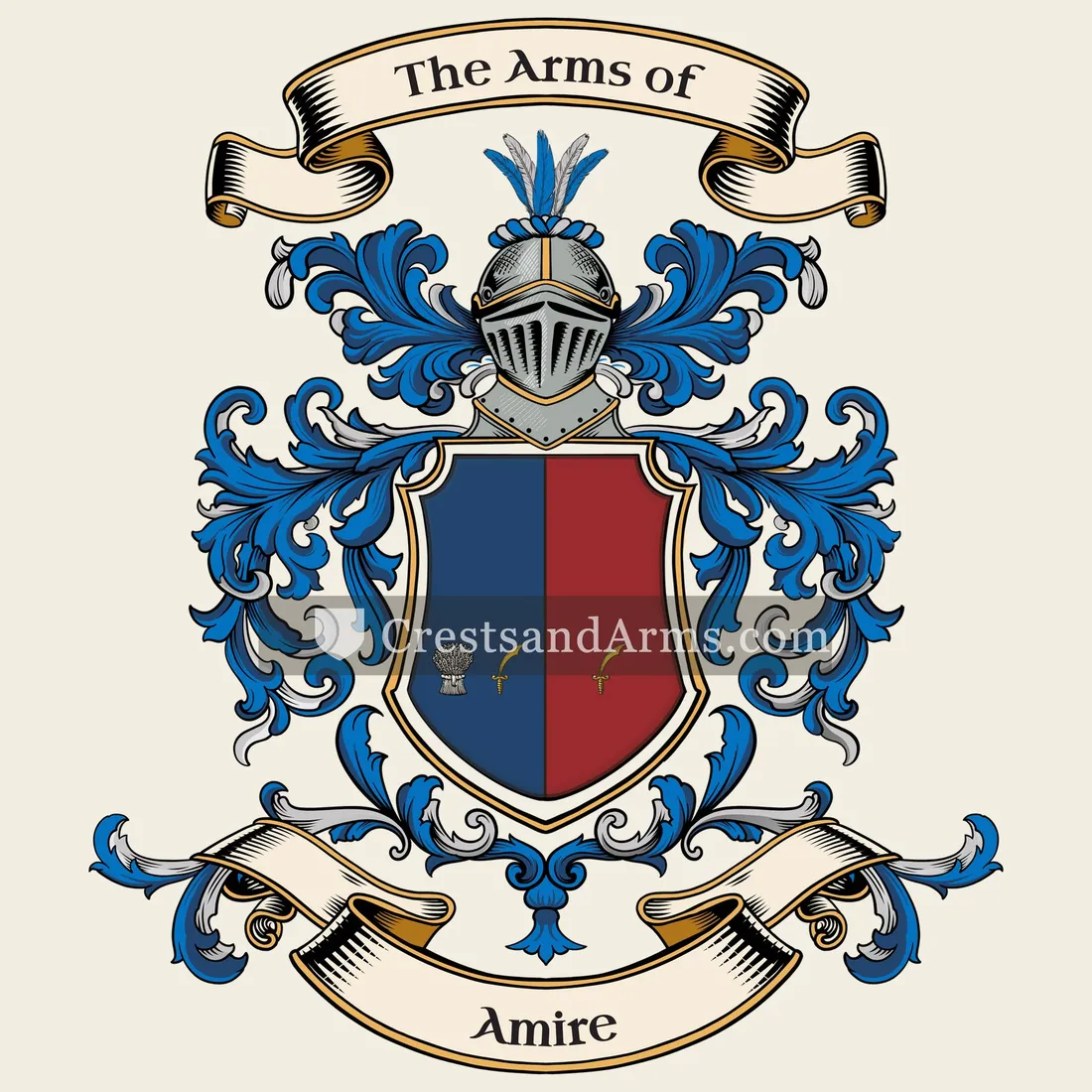
 wheatsheafPlenty, and the harvest of one's own labour
 swordJustice, and military honour
 wheatsheafPlenty, and the harvest of one's own labour
 swordJustice, and military honour