Map of Germany showing where the Amsler arms are recorded
The Amsler arms were recorded in Nuremberg, c. 1765.
This is where the arms were entered in the register. Families often moved to other parts of the country, so the same name can turn up in more than one region.
The body that granted and recorded arms in Germany in this period.
Francis I, Holy Roman Emperor
Sovereign of the period
Francis I, Holy Roman Emperor
1745–1765
Reigning in Germany when the Amsler arms are first recorded.
How Arms Worked in Germany
In the Holy Roman Empire, coats of arms were often granted to individuals by the Emperor or his representatives. These arms were then passed down through the generations to all legitimate descendants of the original holder. Younger branches of a family usually kept the same shield design without needing to change it, as the arms belonged to the entire lineage.
Granting authority
The Holy Roman Emperor held the sole power to grant new coats of arms throughout his vast imperial territories.
How they got arms
Families typically obtained their coats of arms through a formal imperial grant or by proving their noble status to the authorities.
Where arms were recorded
These grants were officially recorded in the Imperial Chancery registers, which began keeping formal records of such honors during the Middle Ages.
The family's standing
Recorded among the armigerous families of Germany.
Origin & History of the Amsler Family in Germany
The Amsler family name has deep roots in the German-speaking regions of Europe, with historical records confirming their presence in the city of Nuremberg by 1765. The name is generally considered a topographic or habitational surname, likely derived from the Middle High German word "Amel," which refers to a specific type of meadow or a small stream. Families often adopted these names to identify where they lived or worked within their local communities. By the mid-18th century, the Amslers in Nuremberg were established as part of the city’s industrious middle class, contributing to the vibrant trade and craft culture that defined the region during the Enlightenment. As the family grew, they maintained a reputation for stability and civic participation, leaving a clear paper trail in municipal tax records and parish registers that document their daily lives and professional activities.
Amsler Meaning & Related Branches
Root word
Amel
Derived from the Germanic element amal meaning work or industrious.
This name
AmslerAn occupational surname for someone who worked as a laborer or farmer.
also spelled
Amslere
Documented Sources
J. B. Rietstap, Armorial Général, Gouda: G. B. van Goor Zonen, 1884–87
Stadtarchiv Nürnberg (Nuremberg City Archives), Bürgerbücher der Stadt Nürnberg (Citizenship Books of the City of Nuremberg)
Bayerisches Hauptstaatsarchiv (Bavarian Main State Archive), Reichsstädtische Akten (Imperial City Records)
Brechenmacher, Josef Karlmann, Etymologisches Wörterbuch der deutschen Familiennamen (1957)
Digital archive packCoat of arms PNG, gold border print PDF, vector SVG and the certificate of authenticity. Sent to your email in minutes.


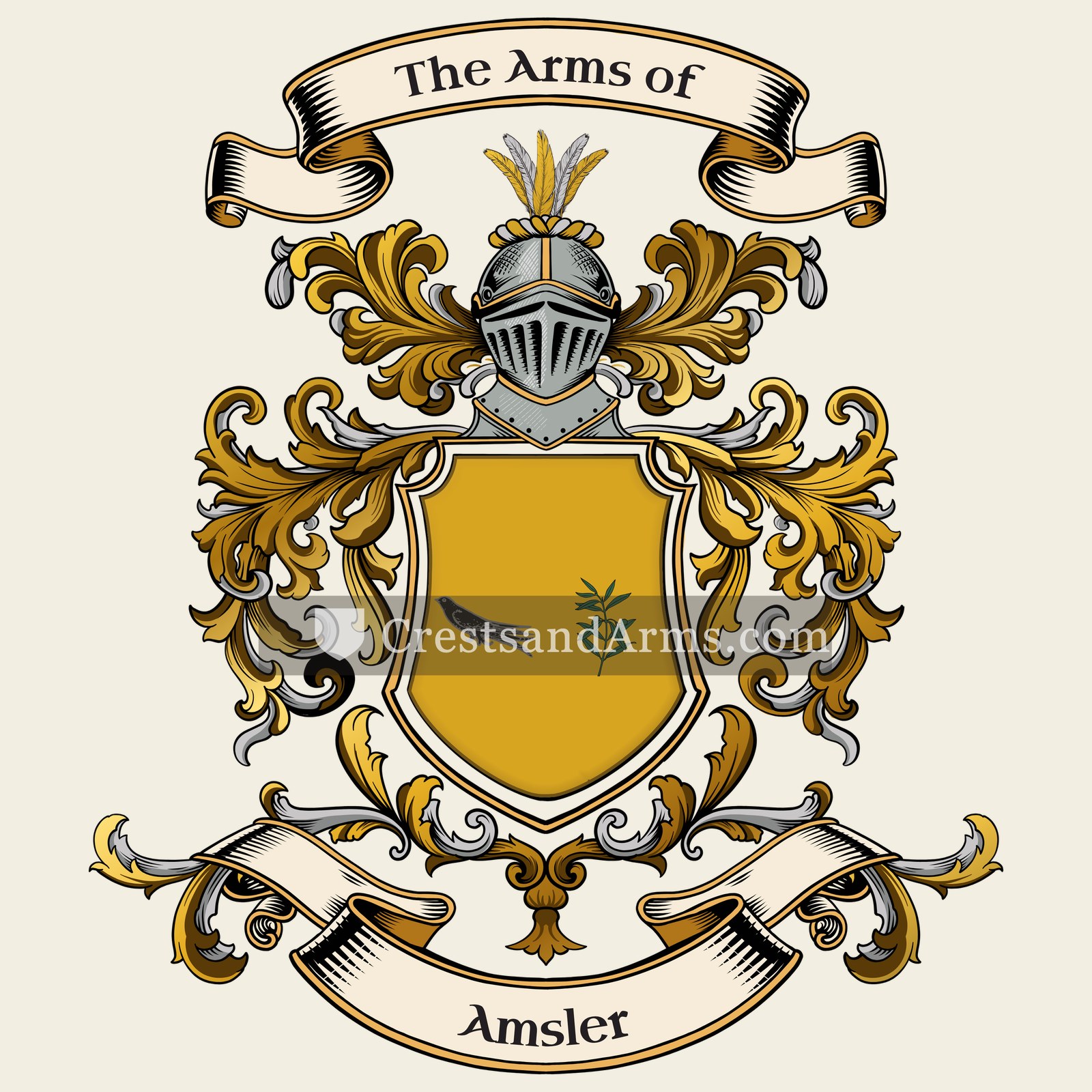
 martletA younger son, who must win his own land
 branchPeace, and new growth
 martletA younger son, who must win his own land
 branchPeace, and new growth