Map of France showing where the Andera arms are recorded
The Andera arms were recorded in Lille, c. 1611.
This is where the arms were entered in the register. Families often moved to other parts of the country, so the same name can turn up in more than one region.
The body that granted and recorded arms in France in this period.
Louis XIII of France
Sovereign of the period
Louis XIII of France
1610–1617
Reigning in France when the Andera arms are first recorded.
How Arms Worked in France
In France, a coat of arms was a mark of honor that passed down through the male line to all legitimate descendants. Families often used the same shield without changes to show their shared heritage. If a branch wanted to stand out, they could add a small mark to their shield to show their specific place in the family tree.
Granting authority
The Juge d'armes de France acted as the official authority that regulated and verified coats of arms across the country.
How they got arms
Families typically inherited their arms from ancestors, though they could also receive them through royal grants or by proving their noble status.
Where arms were recorded
Coats of arms were officially recorded in the Armorial Général de France, which began its main collection in the year 1696.
The family's standing
Recorded among the armigerous families of France.
Origin & History of the Andera Family in France
The history of the Andera family in France is deeply rooted in the northern region of Flanders, specifically within the city of Lille. By 1611, records confirm that members of the family were already established residents of this bustling trade center. During the early 17th century, Lille was a significant hub for textile production and commerce, which likely provided the family with opportunities to integrate into the local urban economy. As the region transitioned through various political shifts between French and Spanish influence during this era, families like the Anderas often navigated complex social landscapes to maintain their status as active citizens. Their presence in the city during this period suggests they were part of the growing middle class that helped sustain the administrative and mercantile life of the region. This early foothold in Lille serves as the primary anchor for understanding the family’s long-standing connection to the cultural and economic development of northern France.
Meaning of the Andera family crest colors & symbols
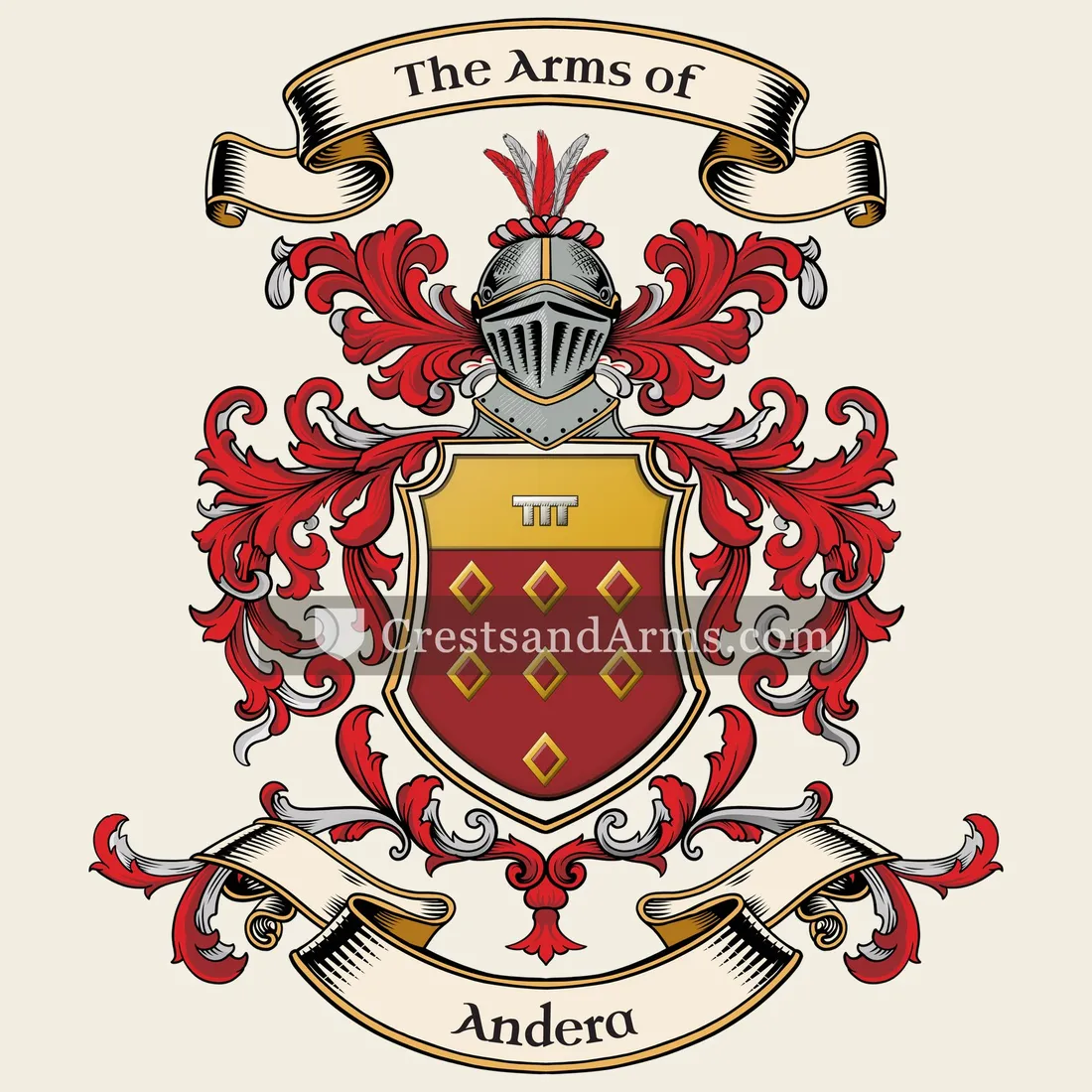
Symbols on this shield
labelThe eldest son, during his father's life
masclePersuasion and the mail of a knight's coat
Colours
Red (Gules)Means: Military strength
Gold (Or)Means: Generosity
Silver (Argent)Means: Peace and sincerity
Historical info
Source
Sir Bernard Burke, The General Armory of England, Scotland, Ireland and Wales, London: Harrison & Sons, 1884
Blazon (the actual original written record)
“Andrew. Gu. seven mascles, three three and one conjoined or, in chief a label ar”
Englandc. 1620
Digital archive packCoat of arms PNG, gold border print PDF, vector SVG and the certificate of authenticity. Sent to your email in minutes.
Map of England showing where the Andera arms are recorded
The Andera arms were recorded in England, c. 1620.
Arms such as these were typically recorded in York.
Yorkshire is the largest of the English counties, and it held more gentry families than any other. Land there was split among a great many households rather than a few, so a great many of them carried arms.
This is where the arms were entered in the register. Families often moved to other parts of the country, so the same name can turn up in more than one region.
The body that granted and recorded arms in England in this period.
James VI and I
Sovereign of the period
James VI and I
1603–1625
Reigning in France when the Andera arms are first recorded.
How Arms Worked in England
English heraldry allowed arms to be shared by all legitimate descendants of the original owner. These symbols were treated as personal property that moved through the generations to all children. While the eldest son kept the original design, other family members could use the same shield without needing to change it or register their own unique versions.
Granting authority
The College of Arms in London has regulated the use of coats of arms throughout England and Wales since 1484.
How they got arms
Families typically obtained their coats of arms through a formal grant from the Crown or by proving their ancient right to them.
Where arms were recorded
All official coats of arms are recorded in the registers kept at the College of Arms, which date back to the fifteenth century.
The family's standing
Recorded among the armigerous families of England.
Origin & History of the Andera Family in England
The history of the Andera family in England begins with documented roots in the city of York during the early seventeenth century. By 1620, members of the family were already established within this historic northern hub, a time when York served as a vital center for trade, religion, and regional administration. During this period, families often settled near major urban markets or religious parishes to secure their livelihoods through skilled labor or local commerce. While the name itself likely evolved from older linguistic roots, its presence in York suggests that the family was part of the growing urban middle class that helped shape the city’s social fabric during the reign of King James I. Living in York allowed the Andera family to participate in the vibrant life of a city that had been a focal point of English history since the Roman era. Their presence in the city records from this time provides a clear starting point for tracing their early contributions to the local community.
Andera Meaning & Related Branches
Root word
Andreas
Derived from the Greek word for man or manly.
This name
AnderaA French variant of Andrew, signifying strength, courage, and masculine virtue.
also spelled
Andreae
Andreah
Andria
Andrae
Documented Sources
J. B. Rietstap, Armorial Général, Gouda: G. B. van Goor Zonen, 1884–87
Archives départementales du Nord, Série B (Chambre des comptes de Lille)
Lottin, Alain, Histoire de Lille : des origines à l'avènement de Charles Quint, 1982
Trénard, Louis, Histoire de Lille : du XVIe siècle à 1789, 1991
Digital archive packCoat of arms PNG, gold border print PDF, vector SVG and the certificate of authenticity. Sent to your email in minutes.


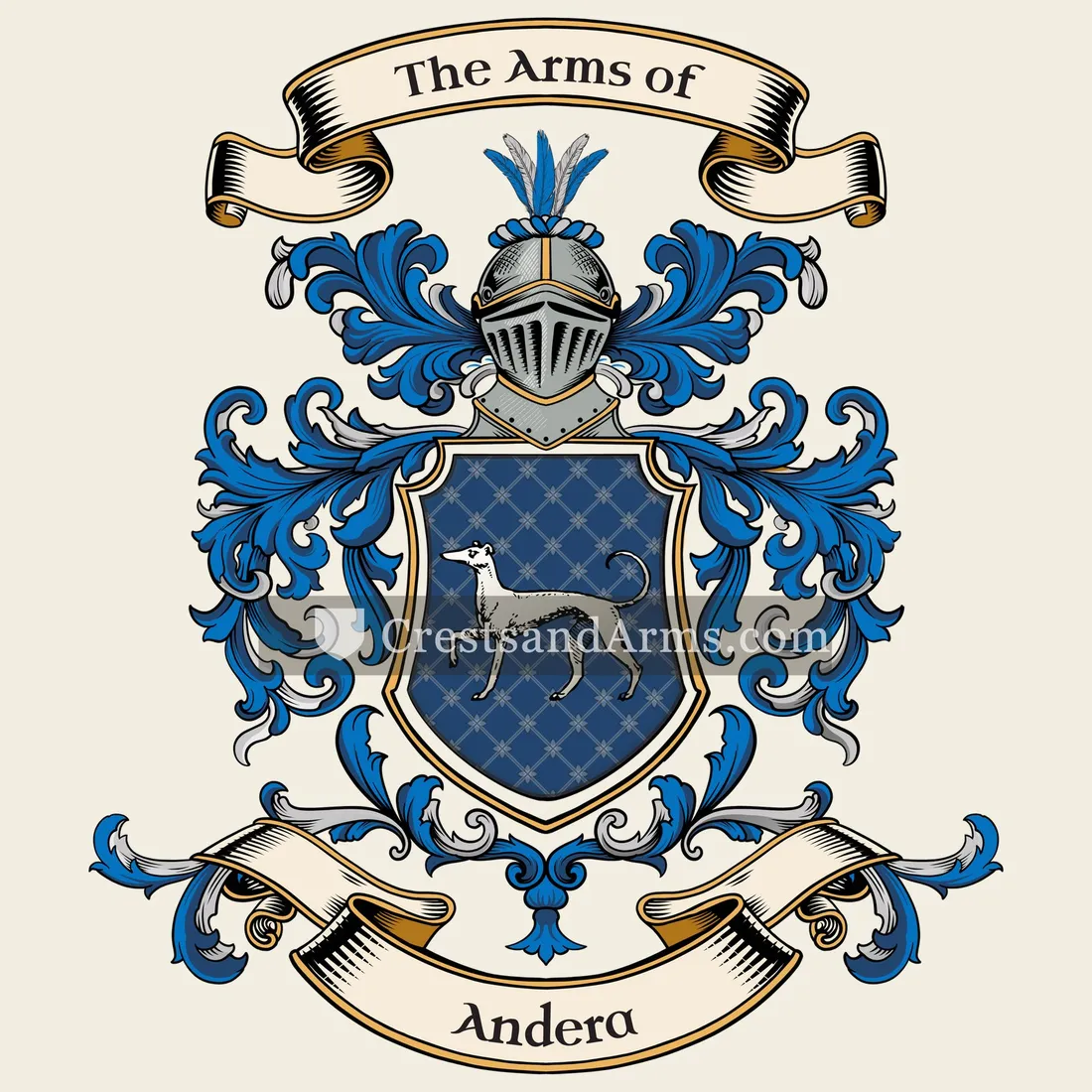
 greyhoundCourage, vigilance and loyalty
 greyhoundCourage, vigilance and loyalty


 labelThe eldest son, during his father's life
 masclePersuasion and the mail of a knight's coat