Map of Norway showing where the Andor arms are recorded
The Andor arms were recorded in Norvège, c. 1605.
Arms such as these were typically recorded in Oslo.
Oslo held the Norwegian court and the offices that went with it. Norway's landed families were few and most held some post under the crown, and a post of that kind was what brought a shield.
This is where the arms were entered in the register. Families often moved to other parts of the country, so the same name can turn up in more than one region.
The body that granted and recorded arms in Norway in this period.
Christian IV of Denmark
Sovereign of the period
Christian IV of Denmark
1588–1648
Reigning in Norway when the Andor arms are first recorded.
How Arms Worked in Norway
Norwegian families often assumed their own coats of arms freely without needing official permission from the crown. These symbols functioned as personal seals for merchants and farmers rather than just marks of nobility. Families passed these designs through generations as private property. When branches split, they frequently modified the original colors or shapes to create distinct versions for their own use.
Granting authority
The Norwegian royal chancery oversaw the formal recognition of noble status and the official registration of coats of arms.
How they got arms
Most families simply adopted their own unique designs to use on seals and property, though some sought royal confirmation.
Where arms were recorded
Official records of noble arms were kept in the royal chancery archives, which began documenting these grants during the union period.
The family's standing
Recorded among the armigerous families of Norway.
Origin & History of the Andor Family in Norway
The history of the Andor family is deeply rooted in the urban development of Oslo during the early seventeenth century. Records confirm that members of the family were established residents of the city by 1605, a time when Oslo was undergoing significant transformation under Danish rule. During this period, families with names like Andor often integrated into the growing merchant and administrative classes that supported the city’s trade networks. Because Oslo was a vital hub for timber exports and maritime commerce, the family likely participated in the bustling economic life of the harbor district. Their presence in the city archives from this era suggests they were part of the foundational population that helped shape the social and civic structure of Oslo long before it became the modern capital of Norway.
Andor Meaning & Related Branches
Root word
Arn-þórr
Derived from the Old Norse elements for eagle and the god Thor.
This name
AndorAn ancient Scandinavian name signifying an eagle of Thor or Thor's eagle.
also spelled
Andore
Andorr
Documented Sources
J. B. Rietstap, Armorial Général, Gouda: G. B. van Goor Zonen, 1884–87
Nielsen, Yngvar. Aktstykker vedkommende norske forhold, opbevarede i det danske Rigsarkiv, 1536-1572. 1891
Oslo byarkiv (Oslo City Archives), Oslo magistrats arkiv: Skifteprotokoller
Digital archive packCoat of arms PNG, gold border print PDF, vector SVG and the certificate of authenticity. Sent to your email in minutes.


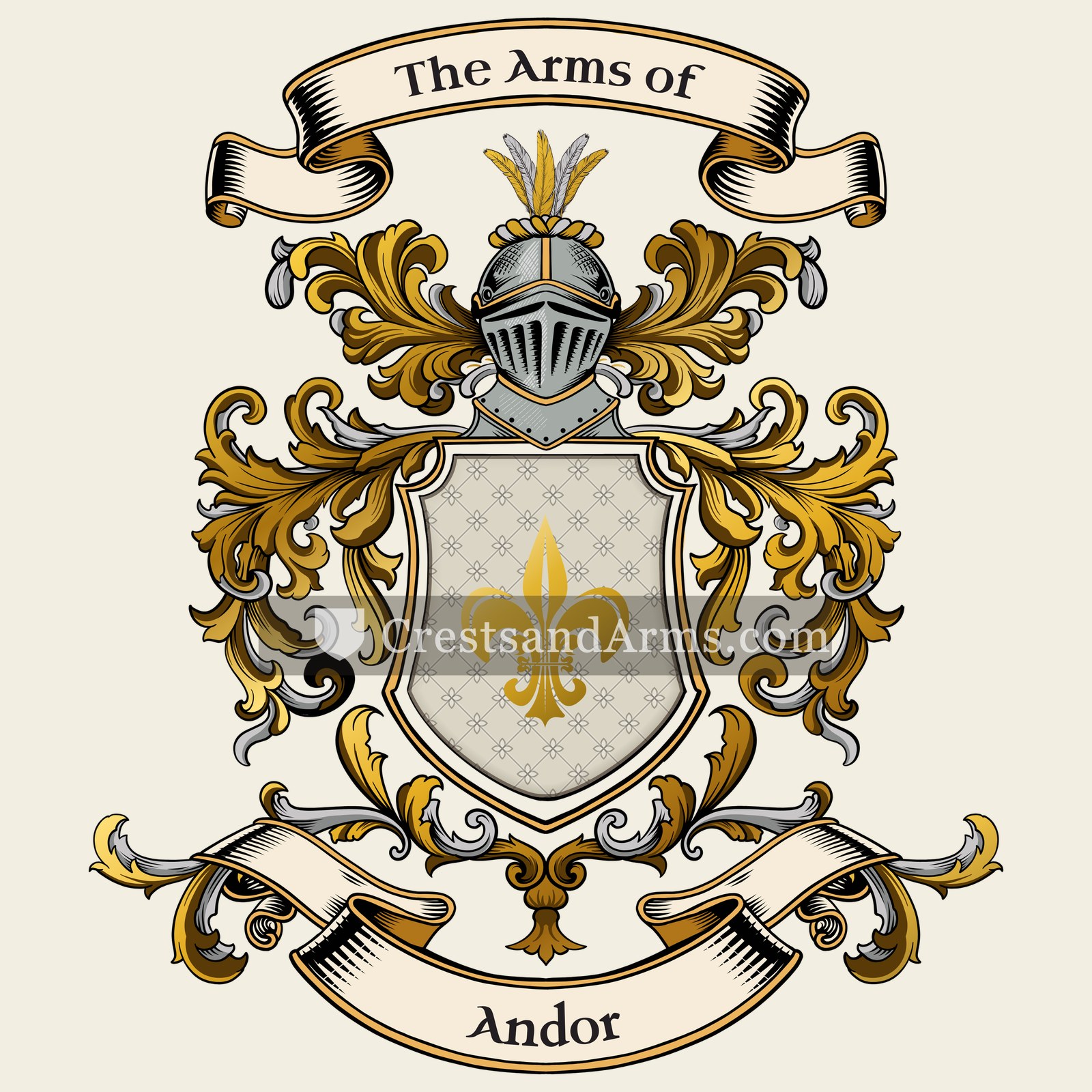
 fleur de lisPurity, light, and the sixth son
 fleur de lisPurity, light, and the sixth son