Map of Belgium showing where the Andreae arms are recorded
The Andreae arms were recorded in Tournai, c. 1737.
This is where the arms were entered in the register. Families often moved to other parts of the country, so the same name can turn up in more than one region.
The body that granted and recorded arms in Belgium in this period.
Charles VI, Holy Roman Emperor
Sovereign of the period
Charles VI, Holy Roman Emperor
1711–1740
Reigning in Belgium when the Andreae arms are first recorded.
How Arms Worked in Belgium
In Belgium, a coat of arms is considered personal property that is passed down through the male line to legitimate descendants. Families often use the same shield design across generations to show their shared heritage. If a branch of the family wants to change the design, they must apply for an official update to their specific version of the arms.
Granting authority
The Conseil héraldique is the official body that regulates and approves all coats of arms in Belgium.
How they got arms
Families obtain their coats of arms through formal royal grants or by confirming their historical right to use existing designs.
Where arms were recorded
All approved coats of arms are officially recorded in the public registers of the Conseil héraldique since 1844.
The family's standing
Recorded among the armigerous families of Belgium.
Origin & History of the Andreae Family in Belgium
The history of the Andreae family in Belgium is deeply rooted in the cultural and economic landscape of the eighteenth century. By 1737, records confirm that members of the family were established in the city of Tournai, which was a significant center for trade and craftsmanship in the Southern Netherlands. During this era, families with names derived from the Greek word for manliness often held positions of social standing or were involved in the professional guilds that governed city life. The presence of the Andreae name in Tournai suggests that these early ancestors were likely integrated into the urban middle class, participating in the local administration or the thriving textile industries that defined the region. As the family navigated the shifting political borders of the time, they maintained their identity through these urban networks, leaving a modest but clear footprint in the municipal registers that tracked the movement and growth of the local population.
Coat of Arms & Family Crest Details
Symbols on this shield
fessThe military belt, and readiness to serve
saltire coupedResolution, and the cross of St Andrew
mulletThe third son, and a divine quality from above
Colours
Green (Vert)Means: Hope
Gold (Or)Means: Generosity
Historical info
Source
J. B. Rietstap, Armorial Général, Gouda: G. B. van Goor Zonen, 1884–87
Blazon (the actual original written record)
“De sin. à une fasce, acc. en chef de deux flanchis et en p. d'une molette, le tout d'or.”
NormandieNormandie, c. 1663
Digital archive packCoat of arms PNG, gold border print PDF, vector SVG and the certificate of authenticity. Sent to your email in minutes.
Map of France showing where the Andreae arms are recorded
The Andreae arms were recorded in Normandie, c. 1663.
Normandie held a dense crowd of knightly families on some of the best farmland in France. Its men had fought and settled abroad for generations, and a family that sent sons to war needed a shield they could be recognised by.
This is where the arms were entered in the register. Families often moved to other parts of the country, so the same name can turn up in more than one region.
The body that granted and recorded arms in France in this period.
Louis XIV of France
Sovereign of the period
Louis XIV of France
1643–1715
Reigning in Belgium when the Andreae arms are first recorded.
How Arms Worked in France
In France, a coat of arms was a mark of honor that passed down through the male line to all legitimate descendants. Families often used the same shield without changes to show their shared heritage. If a branch wanted to stand out, they could add a small mark to their shield to show their specific place in the family tree.
Granting authority
The Juge d'armes de France acted as the official authority that regulated and verified coats of arms across the country.
How they got arms
Families typically inherited their arms from ancestors, though they could also receive them through royal grants or by proving their noble status.
Where arms were recorded
Coats of arms were officially recorded in the Armorial Général de France, which began its main collection in the year 1696.
The family's standing
Recorded among the armigerous families of Normandie.
Origin & History of the Andreae Family in France
The family name Andreae carries a long history that traces back to the linguistic roots of the name Andrew, which signifies strength and manliness. By the year 1663, records confirm that members of the family were established in the region of Normandie in northern France. During this period, families in Normandie were often shaped by the local agricultural economy and the unique legal traditions of the province. As the name spread through the region, it became associated with the local parish life and the social structures of the seventeenth century. The presence of the family in this area suggests they were part of the steady population that helped define the cultural identity of the French countryside before the major political shifts of the following centuries. This early history reflects a time when families were deeply tied to their specific provinces and the local customs that governed daily life in rural France.
Coat of Arms & Family Crest Details
Symbols on this shield
saltireResolution, and St Andrew's cross
roseThe seventh son, and beauty with grace
Colours
Silver (Argent)Means: Peace and sincerity
Red (Gules)Means: Military strength
Historical info
Source
J. B. Rietstap, Armorial Général, Gouda: G. B. van Goor Zonen, 1884–87
Blazon (the actual original written record)
“D'arg. au saut. alésé de gu., cant. de quatre roses du même. C.: un vol, aux armes de l'écu.”
GermanyFrancfort s, c. 1551
Digital archive packCoat of arms PNG, gold border print PDF, vector SVG and the certificate of authenticity. Sent to your email in minutes.
Map of Germany showing where the Andreae arms are recorded
The Andreae arms were recorded in Francfort s, c. 1551.
This is where the arms were entered in the register. Families often moved to other parts of the country, so the same name can turn up in more than one region.
The body that granted and recorded arms in Germany in this period.
Charles V
Sovereign of the period
Charles V
1519–1556
Reigning in Belgium when the Andreae arms are first recorded.
How Arms Worked in Germany
In the Holy Roman Empire, coats of arms were often granted to individuals by the Emperor or his representatives. These arms were then passed down through the generations to all legitimate descendants of the original holder. Younger branches of a family usually kept the same shield design without needing to change it, as the arms belonged to the entire lineage.
Granting authority
The Holy Roman Emperor held the sole power to grant new coats of arms throughout his vast imperial territories.
How they got arms
Families typically obtained their coats of arms through a formal imperial grant or by proving their noble status to the authorities.
Where arms were recorded
These grants were officially recorded in the Imperial Chancery registers, which began keeping formal records of such honors during the Middle Ages.
The family's standing
Recorded among the armigerous families of Germany.
Origin & History of the Andreae Family in Germany
The family name Andreae traces its roots to the intellectual and religious shifts occurring in Germany during the sixteenth century. The name itself is a Latinized version of the Greek name Andreas, which became a popular choice among scholars and clergy during the Renaissance and the Reformation. By 1551, records confirm that members of the family were established in Frankfurt, a city that served as a vital hub for trade and printing at the time. Many early members of the Andreae family were deeply involved in the Lutheran movement, serving as influential theologians, pastors, and educators. Their presence in Frankfurt placed them at the center of a growing network of thinkers who shaped German academic life. Over the following decades, the family became known for their dedication to scholarship and their contributions to the cultural development of the region. This commitment to learning helped the name Andreae gain respect across various German territories as the family members moved into roles of public service and religious leadership.
Andreae Meaning & Related Branches
Root word
Andreas
Derived from the Greek word for man or manly.
This name
AndreaeA Latinized patronymic form indicating descent from a man named Andrew.
also spelled
Andreae
Andrea
Andree
Andrey
Andrie
Documented Sources
J. B. Rietstap, Armorial Général, Gouda: G. B. van Goor Zonen, 1884–87
Archives de l'État à Tournai, Registres paroissiaux de la ville de Tournai, 1737
Pirenne, Henri, Histoire de Belgique, 1902
De Smet, Joseph, L'histoire de Tournai et de ses habitants, 1955
Digital archive packCoat of arms PNG, gold border print PDF, vector SVG and the certificate of authenticity. Sent to your email in minutes.


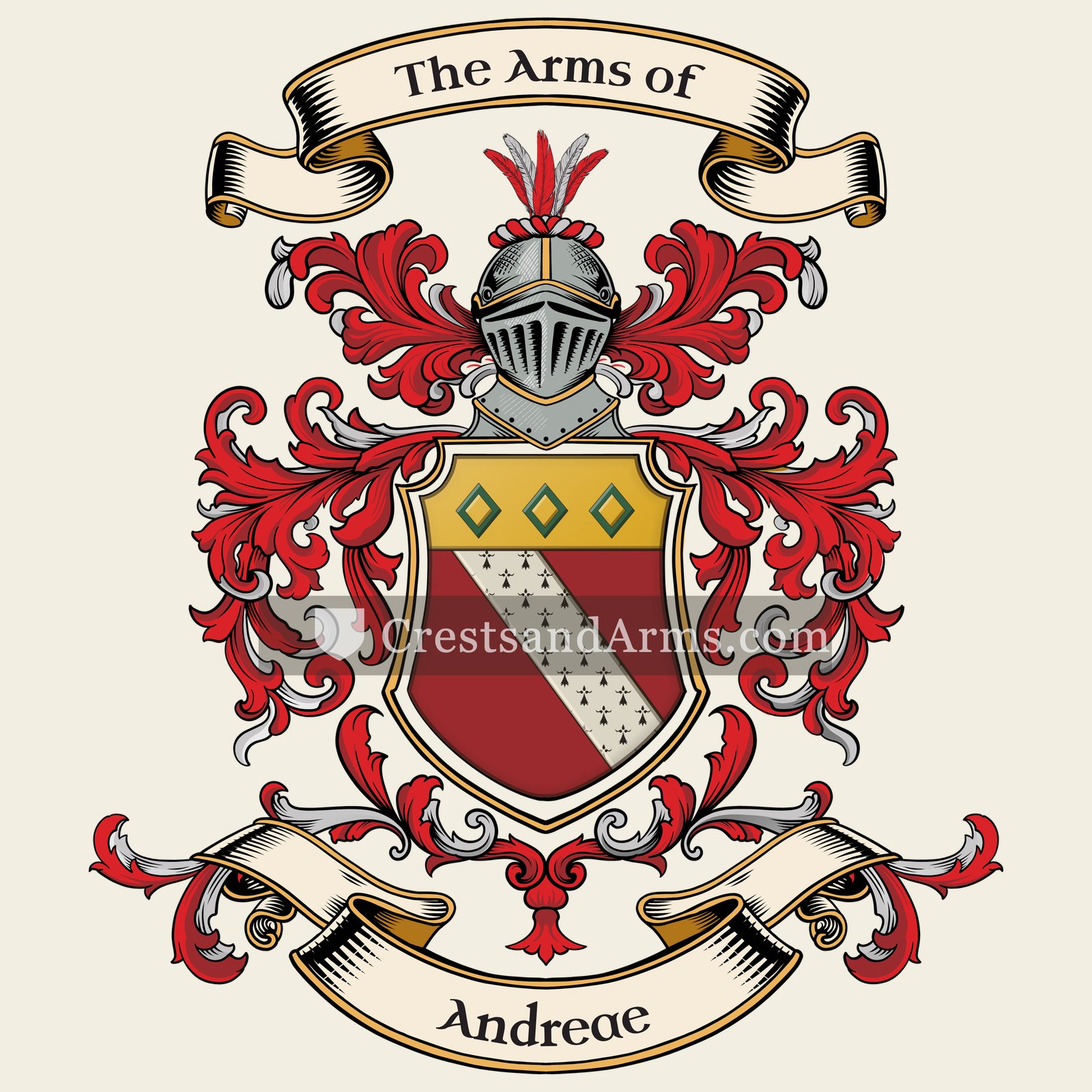
 bendDefence, and the scarf of a commander
 chiefAuthority, wisdom and dominion
 masclePersuasion and the mail of a knight's coat
 bendDefence, and the scarf of a commander
 chiefAuthority, wisdom and dominion
 masclePersuasion and the mail of a knight's coat


 fessThe military belt, and readiness to serve
 saltire coupedResolution, and the cross of St Andrew
 mulletThe third son, and a divine quality from above



 saltireResolution, and St Andrew's cross
 roseThe seventh son, and beauty with grace