Map of Spain showing where the Anes arms are recorded
The Anes arms were recorded in Dunstan Anes, c. 1568.
Arms such as these were typically recorded in Castile.
Castile was the heart of Spain and the source of most of its noble families. Land won in the long wars against the Moors was granted out to fighting men, and a man granted land was granted arms along with it.
This is where the arms were entered in the register. Families often moved to other parts of the country, so the same name can turn up in more than one region.
The body that granted and recorded arms in Spain in this period.
Philip II of Spain
Sovereign of the period
Philip II of Spain
1556–1598
Reigning in Spain when the Anes arms are first recorded.
How Arms Worked in Spain
In Spain, a coat of arms was considered a form of property that belonged to the entire family line. These arms were passed down from a father to all his children equally. Younger branches of the family usually kept the original design without needing to add any special marks to distinguish their specific line.
Granting authority
The Cronista Rey de Armas was the official body that regulated and granted coats of arms throughout Spain.
How they got arms
Families often obtained their arms through royal grants or by proving their noble status to the official heraldic authority.
Where arms were recorded
Coats of arms were officially recorded in the registers of the Cronista Rey de Armas starting in 1496.
The family's standing
Recorded among the armigerous families of Spain.
Origin & History of the Anes Family in Spain
The family name Anes traces its roots to the Iberian Peninsula, specifically within the historic Kingdom of Castile. By the year 1568, records confirm that members of the family were firmly established in this region, which was then a central hub of Spanish culture and administration. The name itself is considered a patronymic, meaning it was originally derived from the given name of an ancestor, likely a variation of the name Johannes or Juan. During the sixteenth century, families in Castile were often deeply involved in the social and economic shifts of the Spanish Empire. As the family grew, they integrated into the local community, contributing to the agricultural and civic life of the Castilian landscape. This period was a time of significant documentation for the Spanish crown, allowing historians to track the presence of the Anes name through local tax records and parish registries as the family expanded across the region.
Anes Meaning & Related Branches
Root word
Johannes
God is gracious
This name
AnesA Spanish patronymic derivative signifying grace and divine favor.
also spelled
Anis
Documented Sources
Sir Bernard Burke, The General Armory of England, Scotland, Ireland and Wales, London: Harrison & Sons, 1884
Archivo General de Simancas, Registro del Sello de Corte
Archivo Histórico Nacional, Consejo de Castilla
Ladero Quesada, Miguel Ángel, La población de Castilla en el siglo XVI, 1989
Moll, Francesc de Borja, Els llinatges catalans, 1959
Digital archive packCoat of arms PNG, gold border print PDF, vector SVG and the certificate of authenticity. Sent to your email in minutes.


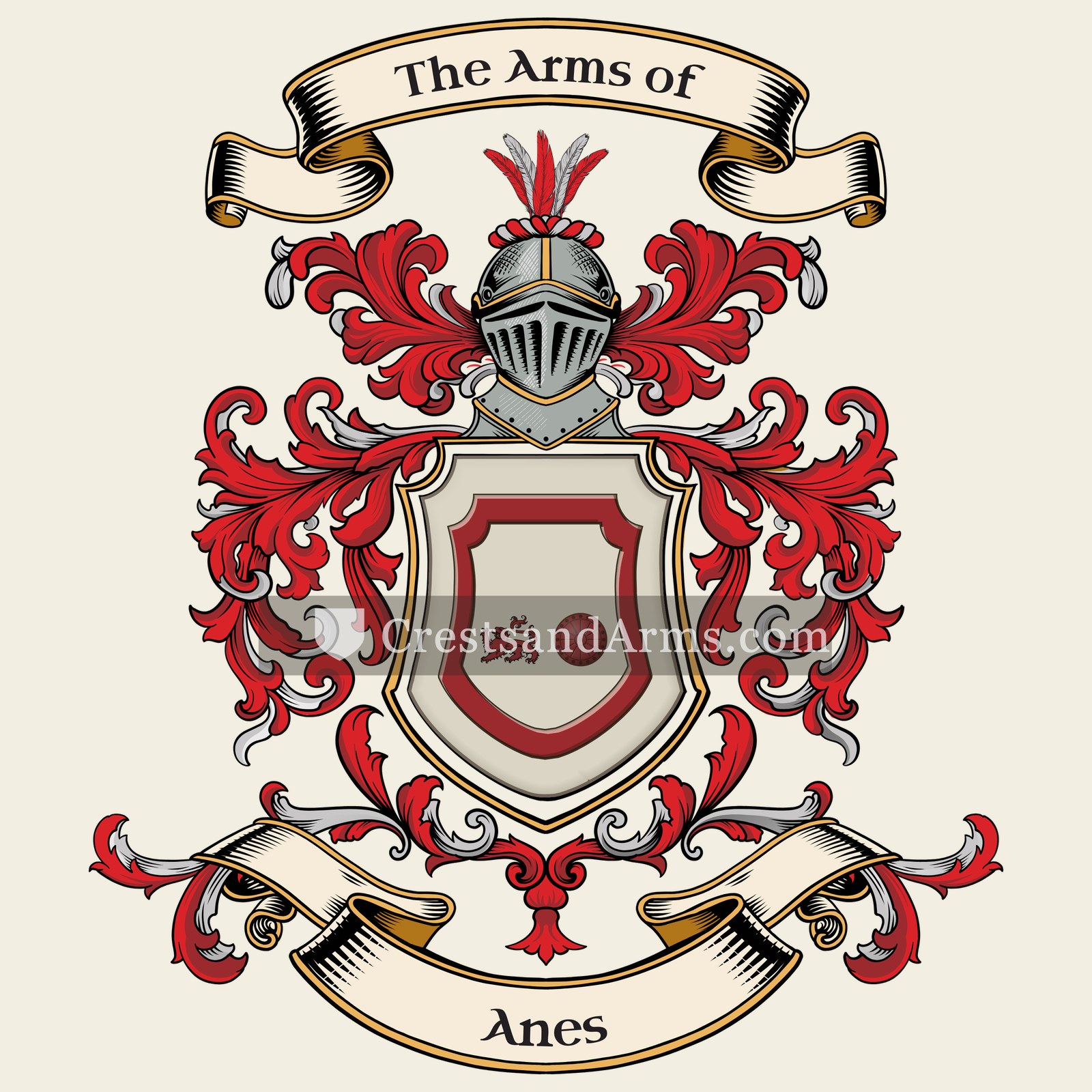
 orlePreservation, and protection in battle
 lionCourage, strength and royalty
 roundelA coin, and one who has been to the crusades
 orlePreservation, and protection in battle
 lionCourage, strength and royalty
 roundelA coin, and one who has been to the crusades