Map of Germany showing where the Anker arms are recorded
The Anker arms were recorded in Germany, c. 1866.
Arms such as these were typically recorded in Bavaria.
Bavaria was a country of old landed families and walled market towns. Estates passed down the same line for centuries, and both the landowners and the leading townsmen kept arms, which is why so many Bavarian names sit in the registers.
This is where the arms were entered in the register. Families often moved to other parts of the country, so the same name can turn up in more than one region.
The body that granted and recorded arms in Germany in this period.
Wilhelm I
Sovereign of the period
Wilhelm I
1861–1888
Reigning in Germany when the Anker arms are first recorded.
How Arms Worked in Germany
Prussian heraldry was strictly tied to social rank and noble status rather than being a free choice for every citizen. These symbols were treated as permanent family property that moved through the generations to all legitimate heirs. If a family branch wanted to change their design to stand out, they had to apply for official permission to alter their specific version of the shield.
Granting authority
The Prussian Heroldsamt acted as the central state office that managed and strictly controlled all noble titles and coats of arms.
How they got arms
Families usually obtained their arms through formal royal grants or by proving their long-standing noble status to the state authorities.
Where arms were recorded
All official coats of arms were kept in the rolls of the Prussian Heroldsamt, which functioned from 1706 until 1918.
The family's standing
Recorded among the armigerous families of Germany.
Origin & History of the Anker Family in Germany
The surname Anker has deep roots in the Germanic regions of Europe, where it functioned as a descriptive occupational name. In the Middle Ages, the term often referred to a person who lived near an anchorite cell, which was a small dwelling for a religious recluse, or it was used to identify someone who worked as a maker or operator of anchors for river shipping. By the time your ancestors were documented in Bavaria in 1866, the name was well-established across various German-speaking territories. Families carrying this name were typically integrated into the local agricultural or trade communities of the region. As people moved through the Bavarian landscape during the mid-nineteenth century, the name remained a steady marker of their regional identity and historical connection to the craft and religious traditions of their homeland.
Anker Meaning & Related Branches
Root word
Ancora
A heavy object used to moor a ship to the sea floor.
This name
AnkerAn occupational surname for a maker of anchors or a nickname for a sailor.
Related arms
Anckervariant spelling
Documented Sources
J. B. Rietstap, Armorial Général, Gouda: G. B. van Goor Zonen, 1884–87
Bahlow, Hans, Deutsches Namenlexikon: Familien- und Vornamen nach Ursprung und Sinn erklärt, 1967
Bayerisches Hauptstaatsarchiv, Kirchenbücher der bayerischen Pfarreien, 1866
Heintze, Albert, Die deutschen Familien-Namen: geschichtlich, geographisch, sprachlich, 1903
Digital archive packCoat of arms PNG, gold border print PDF, vector SVG and the certificate of authenticity. Sent to your email in minutes.


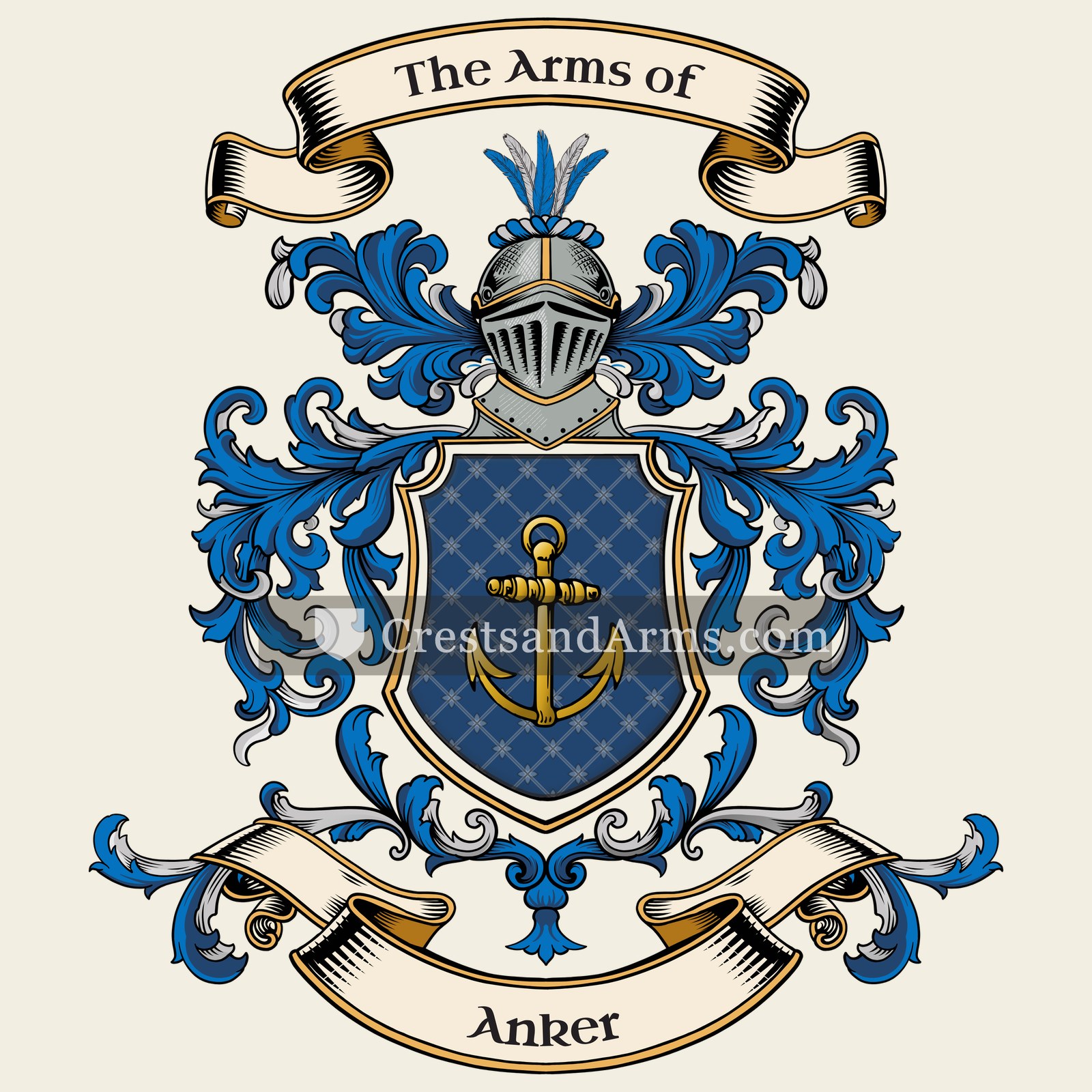
 anchorHope, and steadfastness in trouble
 anchorHope, and steadfastness in trouble