A record of documented arms, meaning and origin, researched for the Anna family lines. Documented in 2 countries.
Reg. 5916 · Italian, A–C
Coat of Arms & Family Crest Details
Symbols on this shield
bendDefence, and the scarf of a commander
chiefAuthority, wisdom and dominion
fleur de lisPurity, light, and the sixth son
crescentHonour by the sovereign, and the second son
mulletThe third son, and a divine quality from above
Colours
Silver (Argent)Means: Peace and sincerity
Red (Gules)Means: Military strength
Blue (Azure)Means: Loyalty and truth
Gold (Or)Means: Generosity
Historical info
Source
J. B. Rietstap, Armorial Général, Gouda: G. B. van Goor Zonen, 1884–87
Blazon (the actual original written record)
“Ec.: aux 1 et 4 d'arg. à trois bandes de gu.; au chef d'azur, ch. de trois fleurs-de-lis d'or: aux 2 et 3 d'arg. à trois bandes de gu.; au chef d'azur, ch. d'un croiss. d'or entre deux étoiles du même.”
NaplesNaples, c. 1775
Digital archive packCoat of arms PNG, gold border print PDF, vector SVG and the certificate of authenticity. Sent to your email in minutes.
Map of Italy showing where the Anna arms are recorded
The Anna arms were recorded in Naples, c. 1775.
Naples was the largest city in Italy and the seat of a kingdom. Its noble houses were numerous, and the kingdom kept formal lists of the families entitled to arms, which is why so many appear in the records.
This is where the arms were entered in the register. Families often moved to other parts of the country, so the same name can turn up in more than one region.
The body that granted and recorded arms in Italy in this period.
Alvise Giovanni Mocenigo
Sovereign of the period
Alvise Giovanni Mocenigo
1763–1778
Reigning in Italy when the Anna arms are first recorded.
How Arms Worked in Italy
In the Italian states, coats of arms were often used by noble families to show their status and history. These symbols were passed down through the generations to all legitimate male descendants. Younger branches of a family usually kept the original design but sometimes added small changes to distinguish their specific line from the main branch.
Granting authority
Various local rulers and city governments controlled the use of coats of arms across the different Italian states.
How they got arms
Families often assumed their own arms or received them as official grants from local lords, popes, or city councils.
Where arms were recorded
Arms were recorded in local city archives or private family books rather than in one single national register.
The family's standing
Recorded among the armigerous families of Naples.
Origin & History of the Anna Family in Italy
The surname Anna finds its roots in the rich cultural landscape of southern Italy, where it emerged as a family name tied to the historical traditions of the region. By 1775, records confirm that members of the family were well-established in the vibrant city of Naples. During this era, Naples served as a major intellectual and social hub under the Bourbon monarchy, and families like the Annas were often integrated into the local urban fabric through trade, craftsmanship, or service. The name itself likely evolved from the ancient Latin and Greek name Anna, which was widely popular across the Mediterranean due to its association with historical and religious figures. As the family grew in Naples, they became part of the complex social hierarchy of the Kingdom of the Two Sicilies, living through a time of significant enlightenment and political transition. Their presence in the city during the late 18th century suggests a family deeply connected to the daily life and administrative evolution of one of Europe’s most important historical capitals.
Coat of Arms & Family Crest Details
Symbols on this shield
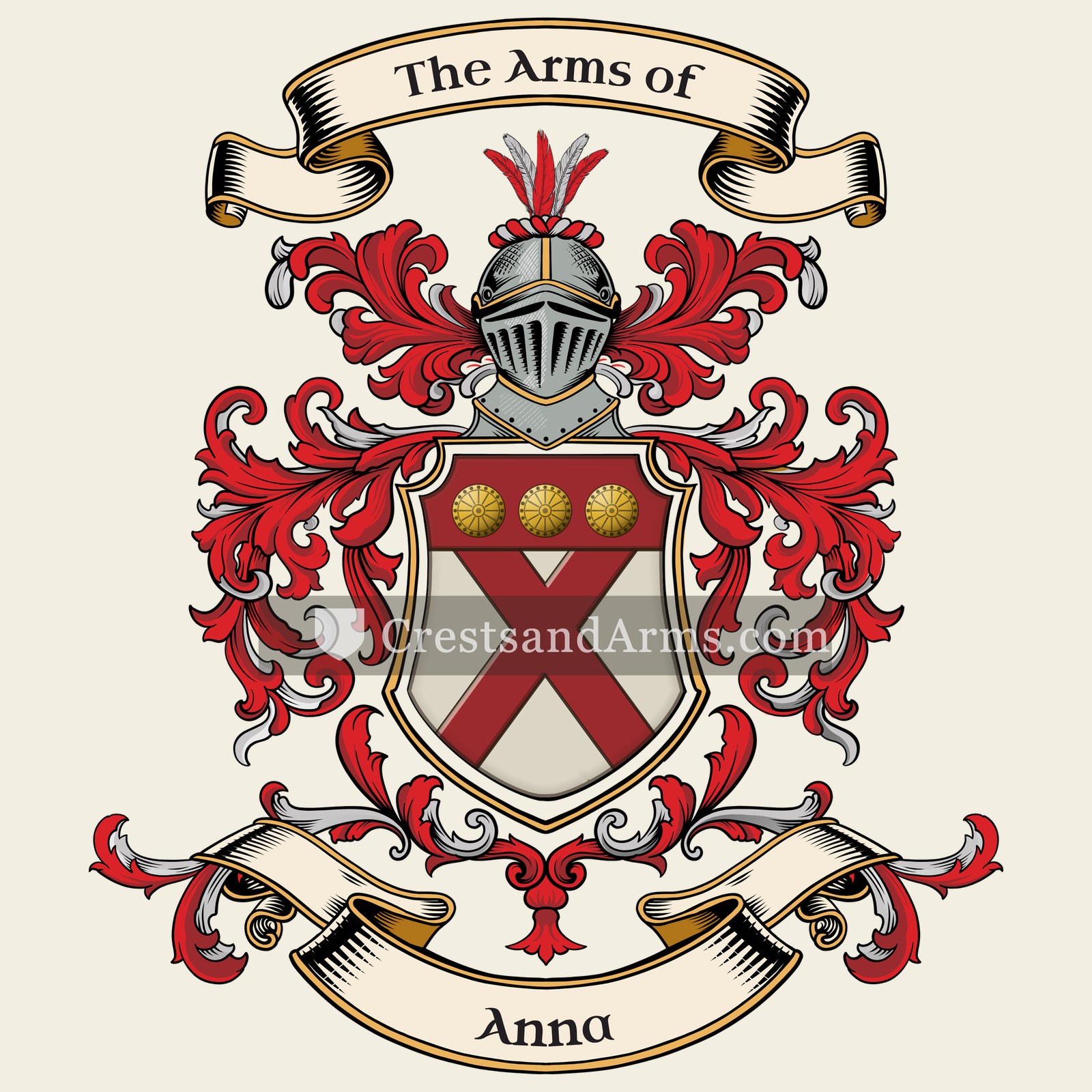
saltireResolution, and St Andrew's cross
chiefAuthority, wisdom and dominion
roundelA coin, and one who has been to the crusades
Colours
Silver (Argent)Means: Peace and sincerity
Red (Gules)Means: Military strength
Gold (Or)Means: Generosity
Historical info
Source
Sir Bernard Burke, The General Armory of England, Scotland, Ireland and Wales, London: Harrison & Sons, 1884
Blazon (the actual original written record)
“Ar. a saltire gu. on a chief of the second three bezants”
EnglandFarringdon, c. 1620
Digital archive packCoat of arms PNG, gold border print PDF, vector SVG and the certificate of authenticity. Sent to your email in minutes.
Map of England showing where the Anna arms are recorded
The Anna arms were recorded in Farringdon, c. 1620.
Arms such as these were typically recorded in York.
Yorkshire is the largest of the English counties, and it held more gentry families than any other. Land there was split among a great many households rather than a few, so a great many of them carried arms.
This is where the arms were entered in the register. Families often moved to other parts of the country, so the same name can turn up in more than one region.
The body that granted and recorded arms in England in this period.
James VI and I
Sovereign of the period
James VI and I
1603–1625
Reigning in Italy when the Anna arms are first recorded.
How Arms Worked in England
English heraldry allowed arms to be shared by all legitimate descendants of the original owner. These symbols were treated as personal property that moved through the generations to all children. While the eldest son kept the original design, other family members could use the same shield without needing to change it or register their own unique versions.
Granting authority
The College of Arms in London has regulated the use of coats of arms throughout England and Wales since 1484.
How they got arms
Families typically obtained their coats of arms through a formal grant from the Crown or by proving their ancient right to them.
Where arms were recorded
All official coats of arms are recorded in the registers kept at the College of Arms, which date back to the fifteenth century.
The family's standing
Recorded among the armigerous families of England.
Origin & History of the Anna Family in England
The name Anna, while traditionally recognized as a given name of Hebrew origin meaning grace, began to appear in English records as a surname during the seventeenth century. By 1620, families bearing this name were established in the city of York, a region shaped by its long history as a center for trade and religious administration. During this period, the transition from using a single name to a hereditary surname was often influenced by local parish record-keeping and the movement of people into growing urban hubs like York. Families in this area were likely involved in the local merchant guilds or the agricultural life of the North Riding, contributing to the social fabric of the city as it navigated the political shifts of the early Stuart era. Because the name was relatively rare as a surname at this time, those living in York were part of a small group that helped define the early geographical footprint of the name in Northern England.
Anna Meaning & Related Branches
Root word
Hannah
Derived from the Hebrew word for grace or favor.
This name
AnnaA classic Italian name signifying grace, mercy, and divine favor.
also spelled
Anne
Annah
Annea
Related arms
Annevariant spelling
Documented Sources
J. B. Rietstap, Armorial Général, Gouda: G. B. van Goor Zonen, 1884–87
De Felice, Emidio. Dizionario dei cognomi italiani. 1978
Archivio di Stato di Napoli, Stato Civile della Restaurazione
Digital archive packCoat of arms PNG, gold border print PDF, vector SVG and the certificate of authenticity. Sent to your email in minutes.


 bendDefence, and the scarf of a commander
 chiefAuthority, wisdom and dominion
 fleur de lisPurity, light, and the sixth son
 crescentHonour by the sovereign, and the second son
 mulletThe third son, and a divine quality from above
 bendDefence, and the scarf of a commander
 chiefAuthority, wisdom and dominion
 fleur de lisPurity, light, and the sixth son
 crescentHonour by the sovereign, and the second son
 mulletThe third son, and a divine quality from above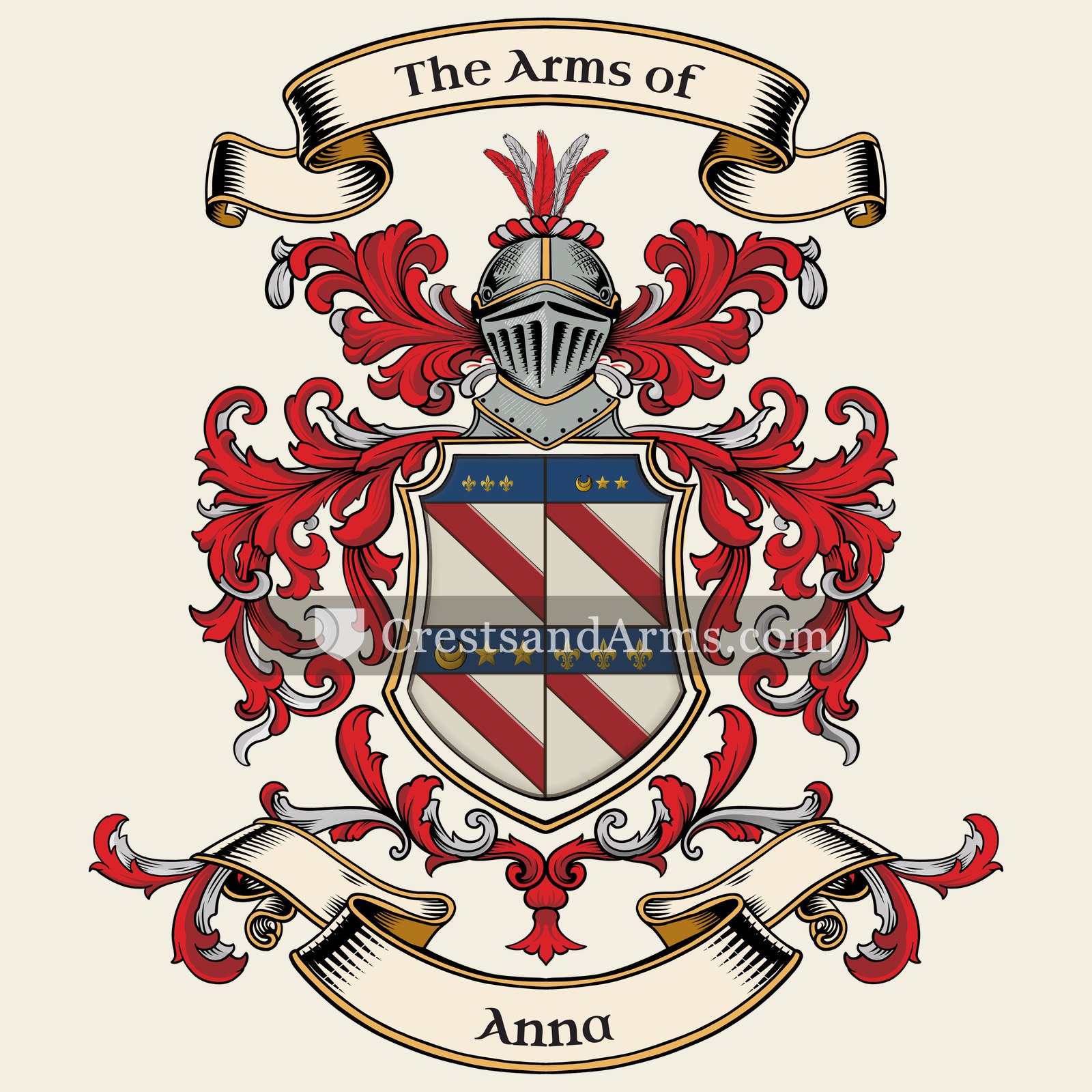


 saltireResolution, and St Andrew's cross
 roundelA coin, and one who has been to the crusades