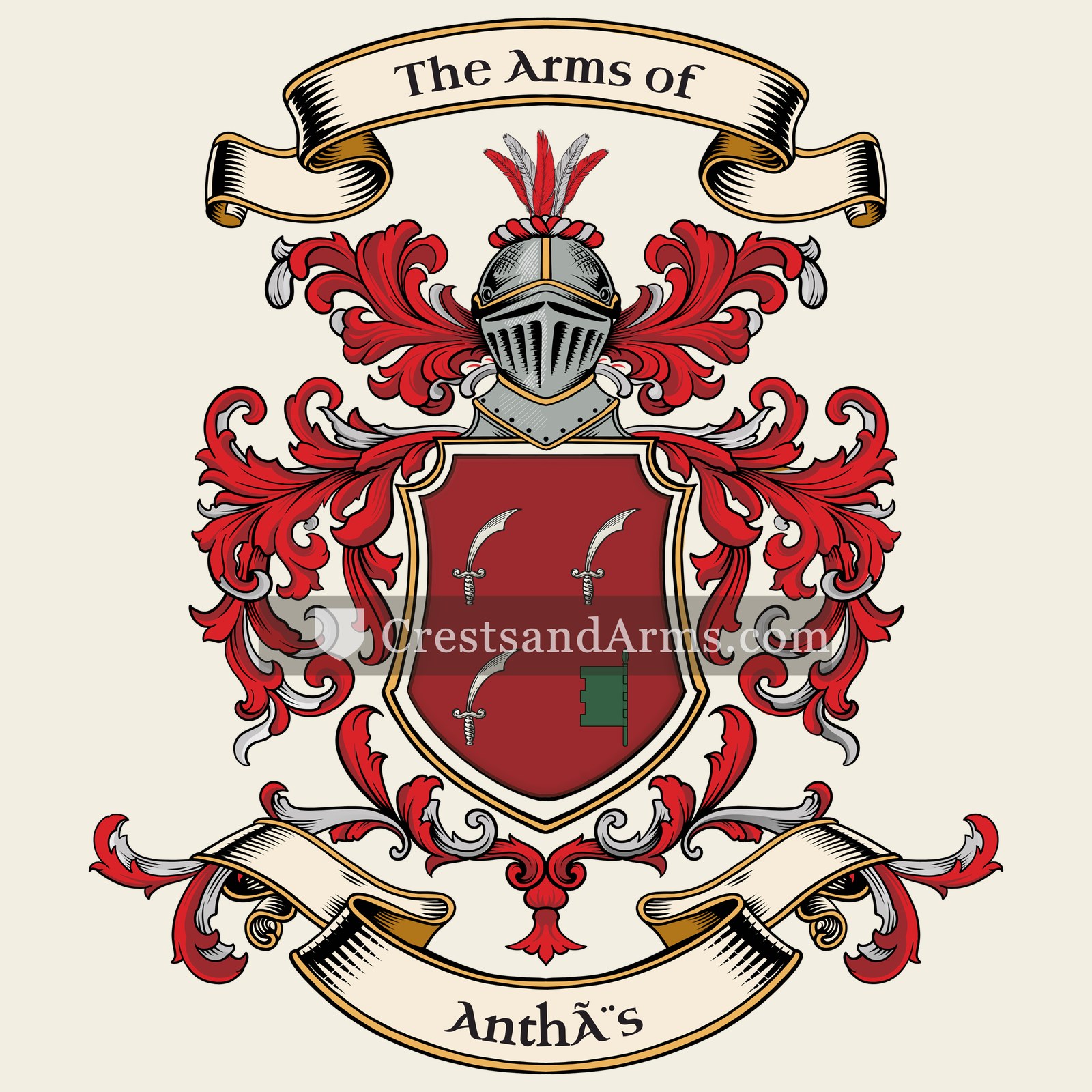
A record of documented arms, meaning and origin, researched for the Anthès family of France.
Reg. 1732 · French, A–C
Coat of Arms & Family Crest Details
Symbols on this shield
swordJustice, and military honour
flag / pennantA command held, and a following kept
Colours
Red (Gules)Means: Military strength
Silver (Argent)Means: Peace and sincerity
Green (Vert)Means: Hope
Historical info
Source
J. B. Rietstap, Armorial Général, Gouda: G. B. van Goor Zonen, 1884–87
Blazon (the actual original written record)
“De gu. à trois épées d'arg., garnies d'or, dont deux passées en saut., la pointe en bas, et la troisième, en pal, la pointe en haut, br. sur les deux autres; lesdites épées liées d'un ruban de sin. S.: deux lions d'or [George Charles baron d'Anthès prit en 1833 le nom et les armes de Heeckeren et fut inc. dans la nob. néerlandaise en 1836.]”
AlsaceAlsace, c. 1663
Digital archive packCoat of arms PNG, gold border print PDF, vector SVG and the certificate of authenticity. Sent to your email in minutes.
Map of France showing where the Anthès arms are recorded
The Anthès arms were recorded in Alsace, c. 1663.
Alsace lay between France and the German lands and belonged to both at different times. Its families held small estates and served whichever side ruled, and men who served in arms carried arms of their own.
This is where the arms were entered in the register. Families often moved to other parts of the country, so the same name can turn up in more than one region.
The body that granted and recorded arms in France in this period.
Louis XIV of France
Sovereign of the period
Louis XIV of France
1643–1715
Reigning in France when the Anthès arms are first recorded.
How Arms Worked in France
In France, a coat of arms was a mark of honor that passed down through the male line to all legitimate descendants. Families often used the same shield without changes to show their shared heritage. If a branch wanted to stand out, they could add a small mark to their shield to show their specific place in the family tree.
Granting authority
The Juge d'armes de France acted as the official authority that regulated and verified coats of arms across the country.
How they got arms
Families typically inherited their arms from ancestors, though they could also receive them through royal grants or by proving their noble status.
Where arms were recorded
Coats of arms were officially recorded in the Armorial Général de France, which began its main collection in the year 1696.
The family's standing
Recorded among the armigerous families of Alsace.
Origin & History of the Anthès Family in France
The history of the Anthès family is deeply rooted in the industrial development of the Alsace region during the seventeenth century. The family first appeared in historical records in 1663 when Johann-Philipp Anthès settled in the area. He was a skilled entrepreneur who played a major role in the local economy by managing ironworks and mining operations. This focus on metallurgy allowed the family to gain significant influence and social status within the community. Over the following decades, they expanded their business interests across the Rhine valley. Their work helped transform the regional landscape and established the family as a prominent name in the history of Alsatian industry.
Anthès Meaning & Related Branches
Root word
Anthos
Ancient Greek word meaning flower or blossom.
This name
AnthèsA locative surname derived from a place name associated with flowering fields or gardens.
also spelled
Anthez
Anthess
Antay
Related arms
van den Broecksimilar arms
Documented Sources
J. B. Rietstap, Armorial Général, Gouda: G. B. van Goor Zonen, 1884–87
Kohl, Wilhelm, Die Familie von Anthès und ihre Bedeutung für die elsässische Industrie, 1954
Archives départementales du Haut-Rhin, Série E, État civil et registres paroissiaux
Weller, Karl, Geschichte des Elsasses, 1925
Digital archive packCoat of arms PNG, gold border print PDF, vector SVG and the certificate of authenticity. Sent to your email in minutes.


 swordJustice, and military honour
 flag / pennantA command held, and a following kept
 swordJustice, and military honour
 flag / pennantA command held, and a following kept