A record of documented arms, meaning and origin, researched for the Anthoine family lines. Documented in 2 countries.
Reg. 6578 · French, A–C
Coat of Arms & Family Crest Details
Symbols on this shield
fessThe military belt, and readiness to serve
eagleNobility, strength and a keen mind
lozengeHonour and nobility, and the arms of a woman
Colours
Gold (Or)Means: Generosity
Silver (Argent)Means: Peace and sincerity
Blue (Azure)Means: Loyalty and truth
Red (Gules)Means: Military strength
Black (Sable)Means: Constancy
Historical info
Source
J. B. Rietstap, Armorial Général, Gouda: G. B. van Goor Zonen, 1884–87
Blazon (the actual original written record)
“Ec.: aux 1 et 4 d'or à l'aigle ép. de sa., iss. d'une fasce d'azur, qui est acc. d'un T du sec. en p.; aux 2 et 3 d'arg. à quatre los. de gu., 2 et 2, et une bord. du même. Cq. cour. C.: trois pl. d'aut.: d'or, de gu. et d'azur.”
FlandreFlandre, c. 1663
Digital archive packCoat of arms PNG, gold border print PDF, vector SVG and the certificate of authenticity. Sent to your email in minutes.
Map of France showing where the Anthoine arms are recorded
The Anthoine arms were recorded in Flandre, c. 1663.
Flandre grew rich on cloth, and its towns were among the busiest in Europe. Merchant families bought land with their profits and took arms to go with it, so trade put as many names in the registers here as land did.
This is where the arms were entered in the register. Families often moved to other parts of the country, so the same name can turn up in more than one region.
The body that granted and recorded arms in France in this period.
Louis XIV of France
Sovereign of the period
Louis XIV of France
1643–1715
Reigning in France when the Anthoine arms are first recorded.
How Arms Worked in France
In France, a coat of arms was a mark of honor that passed down through the male line to all legitimate descendants. Families often used the same shield without changes to show their shared heritage. If a branch wanted to stand out, they could add a small mark to their shield to show their specific place in the family tree.
Granting authority
The Juge d'armes de France acted as the official authority that regulated and verified coats of arms across the country.
How they got arms
Families typically inherited their arms from ancestors, though they could also receive them through royal grants or by proving their noble status.
Where arms were recorded
Coats of arms were officially recorded in the Armorial Général de France, which began its main collection in the year 1696.
The family's standing
Recorded among the armigerous families of Flandre.
Origin & History of the Anthoine Family in France
The family name Anthoine finds its roots in the French-speaking regions of Northern Europe, with documented evidence placing the family in the historic territory of Flandre by 1663. The name itself is a variant of Antoine, which evolved from the Latin name Antonius and became widely popular across France due to the influence of Saint Anthony the Great. During the seventeenth century, families in the border regions of Flandre often navigated a complex cultural landscape where French linguistic traditions blended with local customs. As the name spread through these northern provinces, it was frequently recorded in parish registers that tracked baptisms, marriages, and burials. These early records suggest that the Anthoine family was part of a stable, settled population that contributed to the agricultural and social life of the region during a time of significant political transition. By maintaining a consistent presence in these northern archives, the family helped preserve a distinct regional identity that remained tied to its French linguistic origins for generations.
Coat of Arms & Family Crest Details
Symbols on this shield
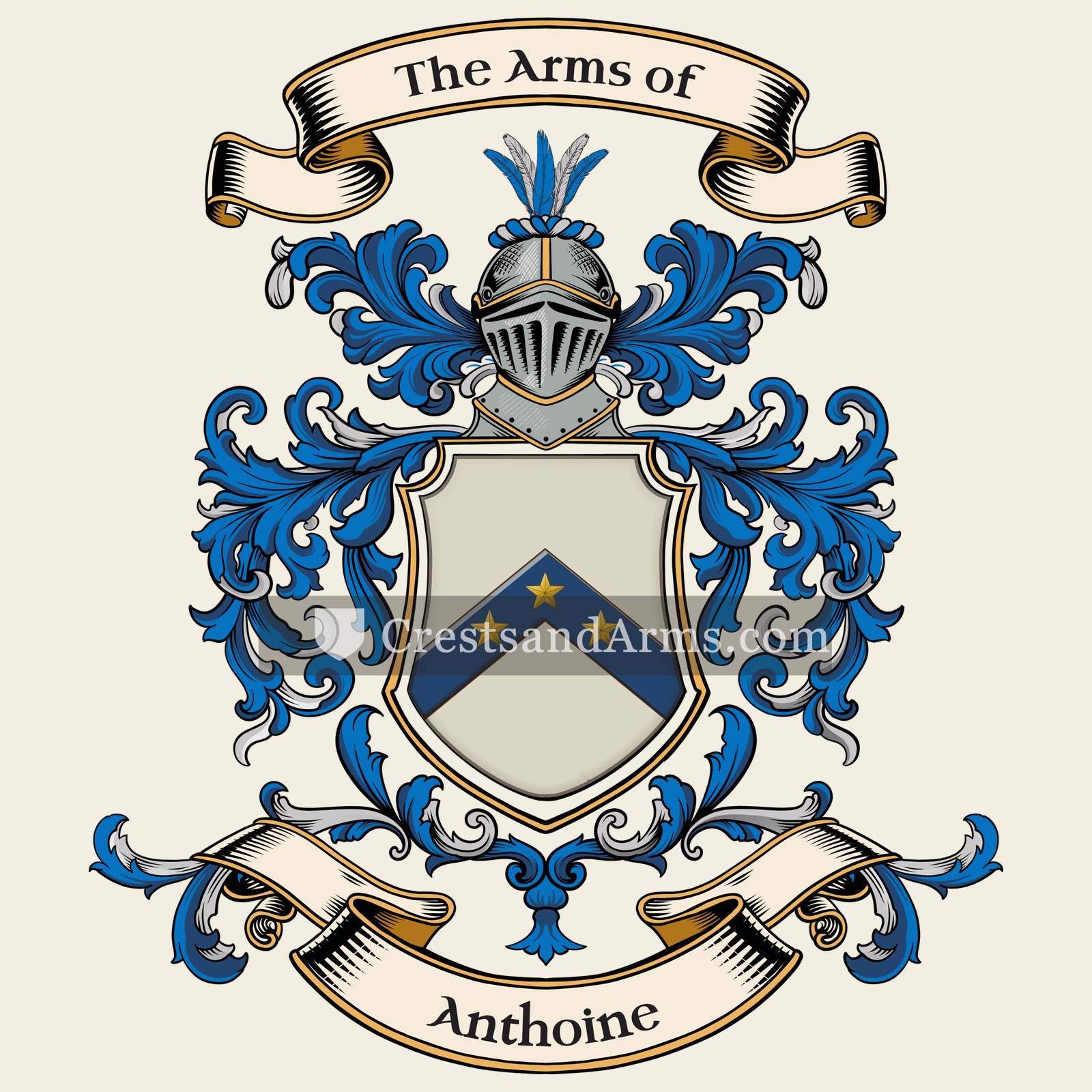
chevronProtection, and faithful service completed
mulletThe third son, and a divine quality from above
Colours
Silver (Argent)Means: Peace and sincerity
Blue (Azure)Means: Loyalty and truth
Gold (Or)Means: Generosity
Historical info
Source
J. B. Rietstap, Armorial Général, Gouda: G. B. van Goor Zonen, 1884–87
Blazon (the actual original written record)
“D'arg. au chev. d'azur, ch. de trois étoiles d'or et acc. de trois taux ou béquilles de St.-Antoine du même. Cq. cour. C.: une tête et col de griffon d'azur, entre un vol d'or. L.: d'or et d'azur. S.: deux griffons d'or [Une autre branche avait deux lions d'or, tenant chacun une bannière aux armes de l'écu.]”
BrabantAnvers · Brabant, c. 1737
Digital archive packCoat of arms PNG, gold border print PDF, vector SVG and the certificate of authenticity. Sent to your email in minutes.
Map of Belgium showing where the Anthoine arms are recorded
The Anthoine arms were recorded in Brabant, c. 1737.
Brabant lay at the heart of the Low Countries, where the trade routes met. Its towns were wealthy and its landowners many, and both kinds of family kept arms, which is why the region is so heavily represented.
This is where the arms were entered in the register. Families often moved to other parts of the country, so the same name can turn up in more than one region.
The body that granted and recorded arms in Belgium in this period.
Charles VI, Holy Roman Emperor
Sovereign of the period
Charles VI, Holy Roman Emperor
1711–1740
Reigning in France when the Anthoine arms are first recorded.
How Arms Worked in Belgium
In Belgium, a coat of arms is considered personal property that is passed down through the male line to legitimate descendants. Families often use the same shield design across generations to show their shared heritage. If a branch of the family wants to change the design, they must apply for an official update to their specific version of the arms.
Granting authority
The Conseil héraldique is the official body that regulates and approves all coats of arms in Belgium.
How they got arms
Families obtain their coats of arms through formal royal grants or by confirming their historical right to use existing designs.
Where arms were recorded
All approved coats of arms are officially recorded in the public registers of the Conseil héraldique since 1844.
The family's standing
Recorded among the armigerous families of Brabant.
Origin & History of the Anthoine Family in Belgium
The family name Anthoine traces its roots in Belgium back to the historic Duchy of Brabant, where records confirm members of the family were established by 1737. The name itself is a variation of the French form of Anthony, which gained widespread popularity across Europe due to the influence of Saint Anthony the Great. During the eighteenth century, families in the Brabant region often lived in close-knit agricultural or merchant communities where names were passed down through generations to preserve local identity. As the Anthoine family settled into this landscape, they became part of the social fabric of the Low Countries, navigating the shifting political boundaries and the transition from Austrian rule to later periods of change. Their presence in the region during this time reflects the common movement of families who sought stability and trade opportunities within the prosperous towns and rural parishes of central Belgium.
Anthoine Meaning & Related Branches
Root word
Antonius
A Roman family name of uncertain etymology, possibly meaning priceless or flourishing.
This name
AnthoineA French patronymic surname derived from the given name Anthony, signifying descendant of Anthony.
also spelled
Anthoyn
Antwan
Anthony
Related arms
Billard de St.-Laumersimilar arms
Bouldnesimilar arms
Faillesimilar arms
Anthoynevariant spelling
Documented Sources
J. B. Rietstap, Armorial Général, Gouda: G. B. van Goor Zonen, 1884–87
Archives départementales du Nord, Série G: Clergé séculier
Dauzat, Albert, Dictionnaire étymologique des noms de famille et prénoms de France, 1951
Morlet, Marie-Thérèse, Dictionnaire étymologique des noms de famille, 1991
Digital archive packCoat of arms PNG, gold border print PDF, vector SVG and the certificate of authenticity. Sent to your email in minutes.


 fessThe military belt, and readiness to serve
 eagleNobility, strength and a keen mind
 lozengeHonour and nobility, and the arms of a woman
 fessThe military belt, and readiness to serve
 eagleNobility, strength and a keen mind
 lozengeHonour and nobility, and the arms of a woman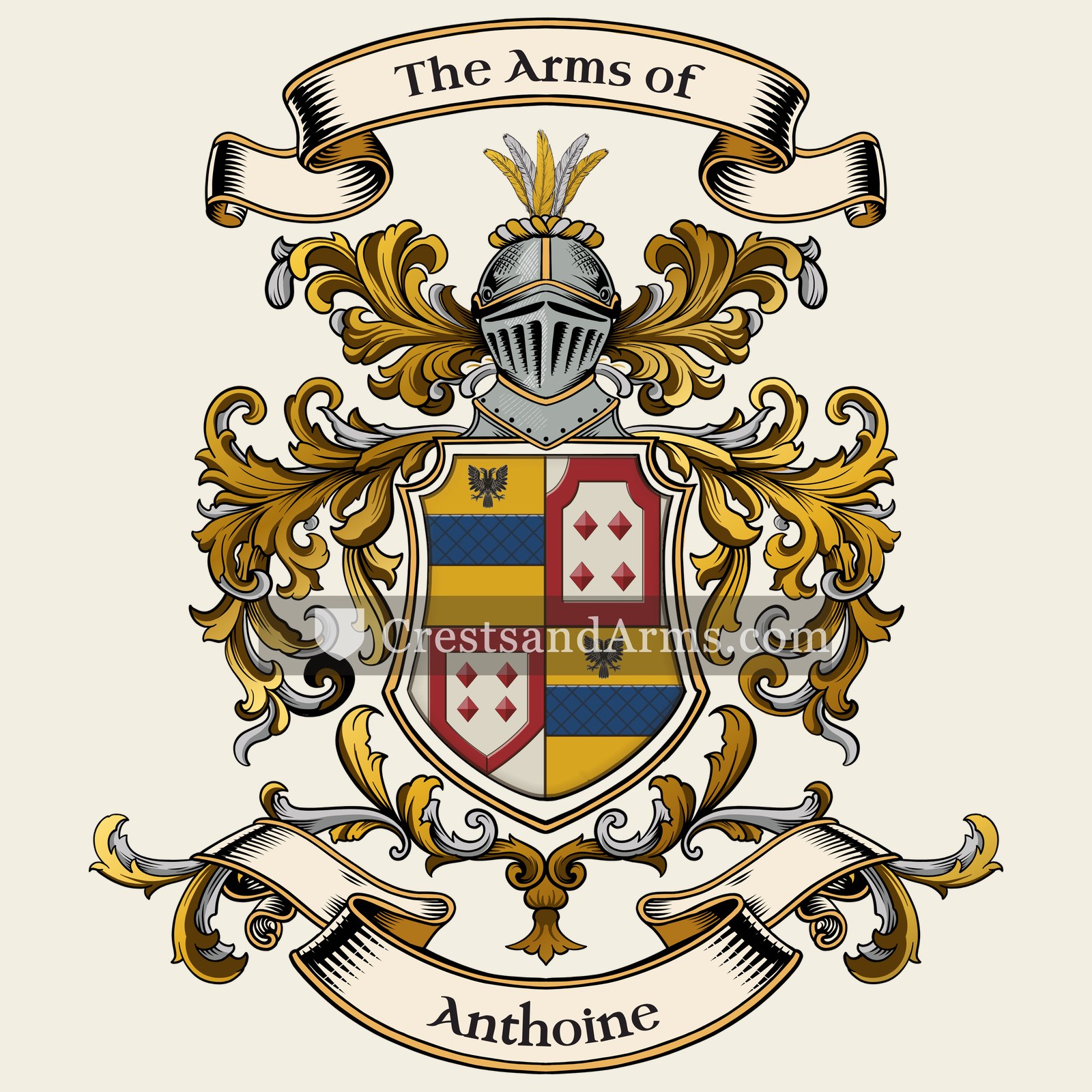


 chevronProtection, and faithful service completed
 mulletThe third son, and a divine quality from above