Map of Italy showing where the Antolik arms are recorded
The Antolik arms were recorded in Venice, c. 1775.
Venice ran on trade, and its great families were merchants before they were anything else. The city kept a formal list of its noble houses, and a name on that list carried arms as a matter of record.
This is where the arms were entered in the register. Families often moved to other parts of the country, so the same name can turn up in more than one region.
The body that granted and recorded arms in Italy in this period.
Alvise Giovanni Mocenigo
Sovereign of the period
Alvise Giovanni Mocenigo
1763–1778
Reigning in Italy when the Antolik arms are first recorded.
How Arms Worked in Italy
In the Italian states, coats of arms were often used by noble families to show their status and history. These symbols were passed down through the generations to all legitimate male descendants. Younger branches of a family usually kept the original design but sometimes added small changes to distinguish their specific line from the main branch.
Granting authority
Various local rulers and city governments controlled the use of coats of arms across the different Italian states.
How they got arms
Families often assumed their own arms or received them as official grants from local lords, popes, or city councils.
Where arms were recorded
Arms were recorded in local city archives or private family books rather than in one single national register.
The family's standing
Recorded among the armigerous families of Venice.
Origin & History of the Antolik Family in Italy
The family name Antolik traces its roots to the Slavic linguistic tradition, where it functioned as a diminutive form of the name Anthony. While the name is widely associated with Central and Eastern Europe, historical records confirm that members of the family were established in the city of Venice by 1775. During this period, Venice served as a major crossroads for trade and cultural exchange between the Italian peninsula and the lands of the Austro-Hungarian Empire. Families like the Antoliks often moved along these established maritime and overland routes to pursue opportunities in commerce or skilled craftsmanship. Their presence in a major international port suggests that they were part of a mobile population that helped connect different regions of the continent through their work and social ties.
Related Branches & Arms
Root word
Antonius
A Roman family name of uncertain Etruscan origin.
This name
AntolikA diminutive form indicating a descendant or follower of Anthony.
also spelled
Antoliny
Antoline
Antolin
Antolinee
Documented Sources
J. B. Rietstap, Armorial Général, Gouda: G. B. van Goor Zonen, 1884–87
Archivio di Stato di Venezia, Anagrafe di Venezia
Archivio Storico del Patriarcato di Venezia, Libri dei battesimi
Migliorini, Bruno, Storia della lingua italiana, 1960
Lane, Frederic C., Venice, a Maritime Republic, 1973
Digital archive packCoat of arms PNG, gold border print PDF, vector SVG and the certificate of authenticity. Sent to your email in minutes.


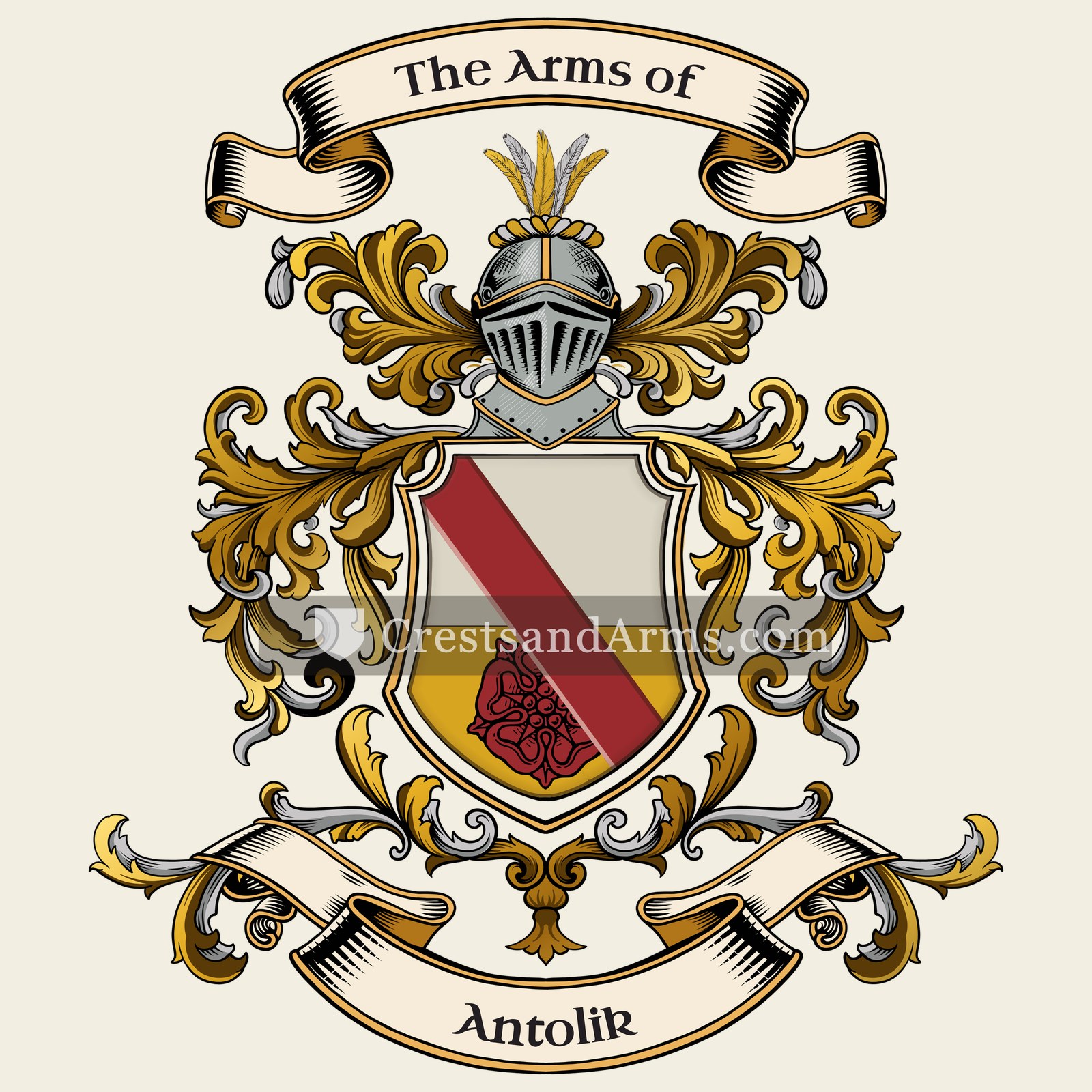
 bendDefence, and the scarf of a commander
 roseThe seventh son, and beauty with grace
 bendDefence, and the scarf of a commander
 roseThe seventh son, and beauty with grace