Map of Germany showing where the Anton arms are recorded
The Anton arms were recorded in Saxony, c. 1802.
Saxony had mines, trade and old landed families all at once. Silver made some fortunes and land held others, and both sorts of family kept arms, which is why Saxon names appear so often in the registers.
This is where the arms were entered in the register. Families often moved to other parts of the country, so the same name can turn up in more than one region.
The body that granted and recorded arms in Germany in this period.
Francis II, Holy Roman Emperor
Sovereign of the period
Francis II, Holy Roman Emperor
1792–1806
Reigning in Germany when the Anton arms are first recorded.
How Arms Worked in Germany
In the Holy Roman Empire, coats of arms were often granted to individuals by the Emperor or his representatives. These arms were then passed down through the generations to all legitimate descendants of the original holder. Younger branches of a family usually kept the same shield design without needing to change it, as the arms belonged to the entire lineage.
Granting authority
The Holy Roman Emperor held the sole power to grant new coats of arms throughout his vast imperial territories.
How they got arms
Families typically obtained their coats of arms through a formal imperial grant or by proving their noble status to the authorities.
Where arms were recorded
These grants were officially recorded in the Imperial Chancery registers, which began keeping formal records of such honors during the Middle Ages.
The family's standing
Recorded among the armigerous families of Saxony.
Origin & History of the Anton Family in Germany
The surname Anton has deep roots in the German-speaking regions of Europe, where it evolved from the ancient Latin name Antonius. By the early 19th century, the family was well-established in the region of Saxony, a historic area known for its strong traditions in trade and mining. In 1802, records indicate that families bearing this name were active participants in the local community life of the Saxon countryside. During this era, Germany was undergoing significant social changes as it transitioned from a collection of smaller states toward a more unified national identity. Families like the Antons often lived in close-knit rural or semi-urban settings, where they contributed to the local economy through agriculture or skilled craftsmanship. The survival and growth of the name in Saxony during this period reflect the broader movement of families who helped build the foundations of modern German society through their steady work and community involvement.
Coat of Arms & Family Crest Details
Symbols on this shield
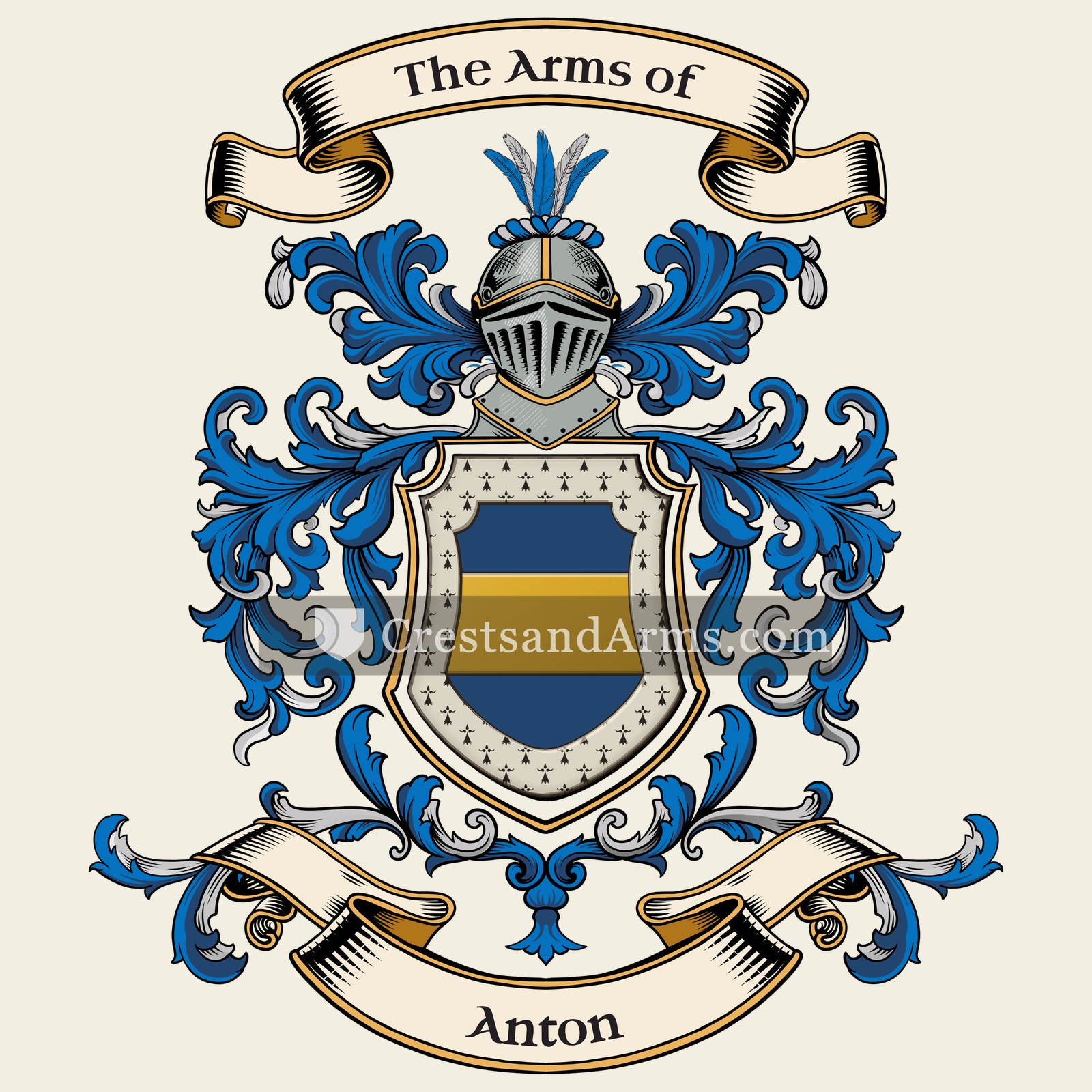
fessThe military belt, and readiness to serve
bordureA difference between branches of one family
Colours
Blue (Azure)Means: Loyalty and truth
Gold (Or)Means: Generosity
ErmineMeans: Dignity
Historical info
Source
Sir Bernard Burke, The General Armory of England, Scotland, Ireland and Wales, London: Harrison & Sons, 1884
Blazon (the actual original written record)
“Az. a fesse or, a bordure erm”
LancasterStoatfield · Lancaster, c. 1645
Digital archive packCoat of arms PNG, gold border print PDF, vector SVG and the certificate of authenticity. Sent to your email in minutes.
Map of Ireland showing where the Anton arms are recorded
The Anton arms were recorded in Lancaster, c. 1645.
Lancashire was divided among a great many small landed families, more than most northern counties. Estates were passed down whole rather than split up, so the same names hold the same ground for centuries in the records.
This is where the arms were entered in the register. Families often moved to other parts of the country, so the same name can turn up in more than one region.
The body that granted and recorded arms in Ireland in this period.
Charles I of England
Sovereign of the period
Charles I of England
1625–1649
Reigning in Germany when the Anton arms are first recorded.
How Arms Worked in Ireland
The Ulster King of Arms granted coats of arms to individuals who proved their social standing and good character. These symbols were typically inherited by all legitimate descendants of the original holder. If a family branch wanted a unique look, they could apply for a specific change to their design through the office to ensure their identity remained distinct.
Granting authority
The Ulster King of Arms acted as the official body that regulated and issued all coats of arms throughout Ireland.
How they got arms
Families obtained their arms through formal grants issued by the office after proving their eligibility and paying the required fees.
Where arms were recorded
All official grants were recorded in the registers held by the Ulster King of Arms starting from the year 1552.
The family's standing
Recorded among the armigerous families of Lancaster.
Origin & History of the Anton Family in Ireland
The history of the Anton name in Ireland is closely linked to the movement of families across the British Isles during the seventeenth century. While the name has roots in various regions, historical records confirm that members of the family were established in Lancaster by 1645. During this period, many families moved between England and Ireland due to shifting political landscapes and the plantation policies of the era. The Anton family likely arrived in Ireland as part of this broader migration, settling into local communities where they integrated into the social and economic fabric of their new home. Over time, the name became associated with specific regions in Ireland, reflecting the ways in which families adapted to life in a new country while maintaining connections to their ancestral origins in places like Lancaster.
Anton Meaning & Related Branches
Root word
Antonius
A Roman family name of uncertain Etruscan origin.
This name
AntonDerived from the Latin name Antonius, often associated with the Greek word for priceless or flourishing.
also spelled
Antone
Antonn
Antonne
Antoun
Antun
Documented Sources
J. B. Rietstap, Armorial Général, Gouda: G. B. van Goor Zonen, 1884–87
Bahlow, Hans, Deutsches Namenlexikon: Familien- und Vornamen nach Ursprung und Sinn erklärt, 1967
Heintze, Albert, Die deutschen Familiennamen: geschichtlich, geographisch, sprachlich, 1903
Sächsisches Staatsarchiv, Kirchenbücher der evangelisch-lutherischen Landeskirche Sachsens, 1802
Digital archive packCoat of arms PNG, gold border print PDF, vector SVG and the certificate of authenticity. Sent to your email in minutes.


 hammerHonest labour, and the smith's craft
 hammerHonest labour, and the smith's craft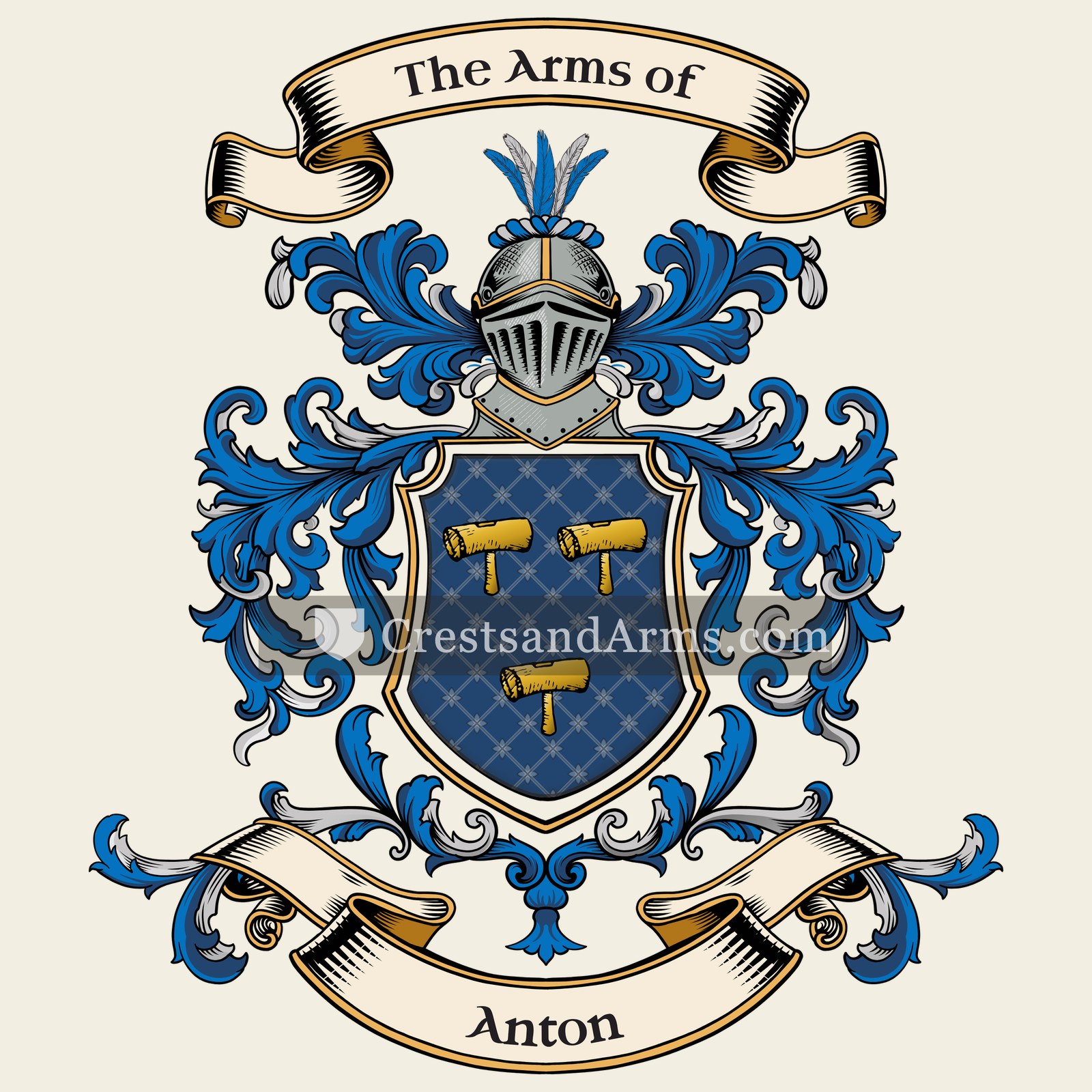


 fessThe military belt, and readiness to serve
 bordureA difference between branches of one family