Map of Germany showing where the Antonoff arms are recorded
The Antonoff arms were recorded in Saxony, c. 1802.
Saxony had mines, trade and old landed families all at once. Silver made some fortunes and land held others, and both sorts of family kept arms, which is why Saxon names appear so often in the registers.
This is where the arms were entered in the register. Families often moved to other parts of the country, so the same name can turn up in more than one region.
The body that granted and recorded arms in Germany in this period.
Francis II, Holy Roman Emperor
Sovereign of the period
Francis II, Holy Roman Emperor
1792–1806
Reigning in Germany when the Antonoff arms are first recorded.
How Arms Worked in Germany
In the Holy Roman Empire, coats of arms were often granted to individuals by the Emperor or his representatives. These arms were then passed down through the generations to all legitimate descendants of the original holder. Younger branches of a family usually kept the same shield design without needing to change it, as the arms belonged to the entire lineage.
Granting authority
The Holy Roman Emperor held the sole power to grant new coats of arms throughout his vast imperial territories.
How they got arms
Families typically obtained their coats of arms through a formal imperial grant or by proving their noble status to the authorities.
Where arms were recorded
These grants were officially recorded in the Imperial Chancery registers, which began keeping formal records of such honors during the Middle Ages.
The family's standing
Recorded among the armigerous families of Saxony.
Origin & History of the Antonoff Family in Germany
The family name Antonoff carries a rich history that reflects the shifting cultural landscape of Germany during the early nineteenth century. By 1802, records confirm that members of the family were established in the region of Saxony, a territory known for its significant role in the intellectual and industrial growth of the German states. During this era, the name likely evolved as a variation of the name Anton, which traces its roots back to the Latin name Antonius. In the context of Saxony, families with this surname often lived in communities that valued craftsmanship and trade, as the region was a bustling hub for merchants and artisans. As the family integrated into the local society of the time, they participated in the daily life of a region undergoing rapid political and social changes. This early presence in Saxony suggests that the family was part of the stable middle class that helped sustain the local economy and culture before the major national shifts of the later nineteenth century.
Meaning of the Antonoff family crest colors & symbols
Symbols on this shield
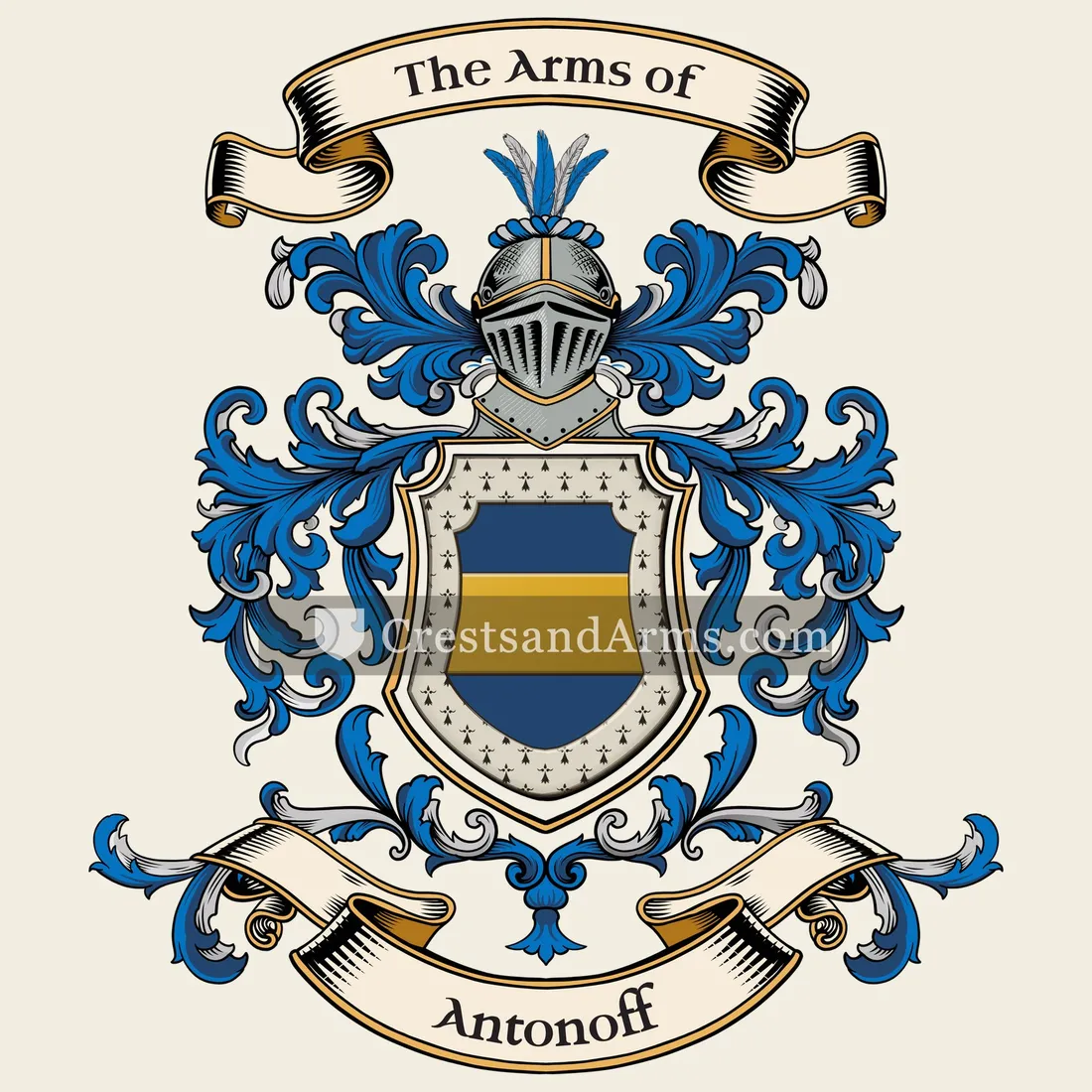
fessThe military belt, and readiness to serve
bordureA difference between branches of one family
Colours
Blue (Azure)Means: Loyalty and truth
Gold (Or)Means: Generosity
ErmineMeans: Dignity
Historical info
Source
Sir Bernard Burke, The General Armory of England, Scotland, Ireland and Wales, London: Harrison & Sons, 1884
Blazon (the actual original written record)
“Az. a fesse or, a bordure erm”
LancasterStoatfield · Lancaster, c. 1645
Digital archive packCoat of arms PNG, gold border print PDF, vector SVG and the certificate of authenticity. Sent to your email in minutes.
Map of Ireland showing where the Antonoff arms are recorded
The Antonoff arms were recorded in Lancaster, c. 1645.
Lancashire was divided among a great many small landed families, more than most northern counties. Estates were passed down whole rather than split up, so the same names hold the same ground for centuries in the records.
This is where the arms were entered in the register. Families often moved to other parts of the country, so the same name can turn up in more than one region.
The body that granted and recorded arms in Ireland in this period.
Charles I of England
Sovereign of the period
Charles I of England
1625–1649
Reigning in Germany when the Antonoff arms are first recorded.
How Arms Worked in Ireland
The Ulster King of Arms granted coats of arms to individuals who proved their social standing and good character. These symbols were typically inherited by all legitimate descendants of the original holder. If a family branch wanted a unique look, they could apply for a specific change to their design through the office to ensure their identity remained distinct.
Granting authority
The Ulster King of Arms acted as the official body that regulated and issued all coats of arms throughout Ireland.
How they got arms
Families obtained their arms through formal grants issued by the office after proving their eligibility and paying the required fees.
Where arms were recorded
All official grants were recorded in the registers held by the Ulster King of Arms starting from the year 1552.
The family's standing
Recorded among the armigerous families of Lancaster.
Origin & History of the Antonoff Family in Ireland
The history of the Antonoff name in Ireland is closely linked to the movement of families across the British Isles during the mid-seventeenth century. While the name has roots that stretch toward Eastern Europe, records confirm that members of the family were established in Lancaster by 1645. During this period, many families with similar backgrounds migrated across the Irish Sea, often seeking new opportunities or fleeing the political instability that gripped England at the time. Once in Ireland, these families frequently integrated into local communities, adapting their surnames to fit the phonetic patterns of the region. This transition allowed the Antonoff name to persist through generations, marking the family as part of a broader wave of settlers who contributed to the changing social landscape of seventeenth-century Ireland.
Antonoff Meaning & Related Branches
Root word
Antonius
A Roman family name of uncertain, possibly Etruscan, origin.
This name
AntonoffA patronymic surname meaning son of Anton, derived from the Latin Antonius.
also spelled
Antone
Antonn
Antonne
Antoun
Antun
Documented Sources
J. B. Rietstap, Armorial Général, Gouda: G. B. van Goor Zonen, 1884–87
Sächsisches Staatsarchiv, Bestand 10001 (Ältere Behörden), 1802
Heintze, Albert, Die deutschen Familiennamen: geschichtlich, geographisch, sprachlich, 1903
Bahlow, Hans, Deutsches Namenlexikon: Familien- und Vornamen nach Ursprung und Sinn erklärt, 1967
Digital archive packCoat of arms PNG, gold border print PDF, vector SVG and the certificate of authenticity. Sent to your email in minutes.


 hammerHonest labour, and the smith's craft
 hammerHonest labour, and the smith's craft
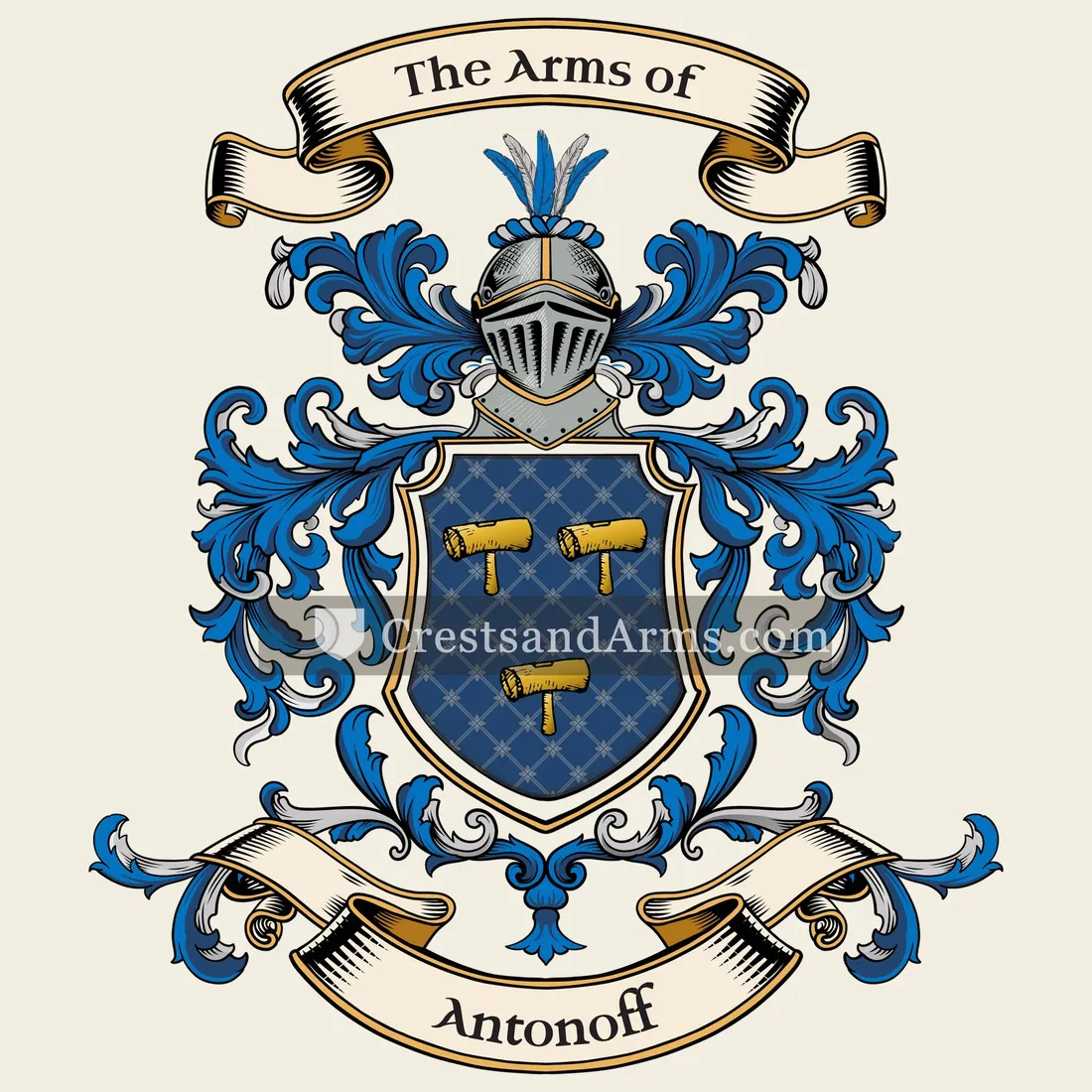


 fessThe military belt, and readiness to serve
 bordureA difference between branches of one family